Psychology of Crowd Madness: How Emotional Herding Destroys Wealth and Clarity
July 23, 2026
Why Crowds Break Faster Than Logic Can Catch Them
Crowd madness is not a metaphor but a recurring psychological pattern that gradually strips individuals of independent judgement until instinct overwhelms reason. When fear or excitement reaches critical mass, people stop evaluating events for themselves and begin responding to the emotional cues of those around them, allowing markets, political movements, and entire societies to swing with astonishing speed from confidence to panic. Every major financial crisis follows this pattern because collective emotion accelerates far faster than rational analysis, creating an environment in which wealth is destroyed long before most participants understand what has changed. Investors who study crowd psychology are therefore not indulging a curiosity but developing a practical defence, learning to recognise the emotional fault lines that precede both opportunity and disaster.
The Anatomy of Crowd Madness
Crowd madness begins when individual identity gradually dissolves into collective behaviour, causing people to rely less on independent judgement and more on the actions of those around them. Three forces consistently drive this process. Emotional contagion spreads fear and optimism far faster than facts, deindividuation weakens personal responsibility until individuals behave in ways they never would alone, and social proof encourages imitation whenever uncertainty rises. Together these forces create a self-reinforcing feedback loop in which the crowd no longer evaluates events objectively but amplifies its own emotions until panic or euphoria becomes its dominant state.
History repeatedly demonstrates how quickly this transformation occurs. The speculative excesses of 1929, the medieval witch hunts, and even the strange dancing plague of 1518 all reveal the same underlying mechanism: once emotion overwhelms critical thought, ordinary people begin reinforcing one another’s fears and expectations until irrational behaviour becomes entirely normal. Technology has not changed this process. It has simply accelerated the speed at which collective emotion spreads.
Why the Majority Is Usually Wrong
Human beings naturally rely on mental shortcuts, but those shortcuts become increasingly unreliable under pressure. Confirmation bias encourages people to seek information that supports existing beliefs, herd instinct makes social acceptance feel safer than independent judgement, and confident authority figures often replace careful analysis with reassuring certainty. As uncertainty grows, individuals increasingly surrender their own reasoning to the collective because belonging feels less threatening than standing alone.
This explains why speculative bubbles expand far beyond rational valuation and why market declines frequently overshoot intrinsic value. Rumours of shortages create genuine shortages as consumers rush to hoard supplies, while investors chasing rapidly rising assets reinforce the very price movements convincing others to join them. The majority is usually wrong not because it lacks intelligence, but because emotion consistently outruns analysis.
Lessons from History’s Greatest Manias
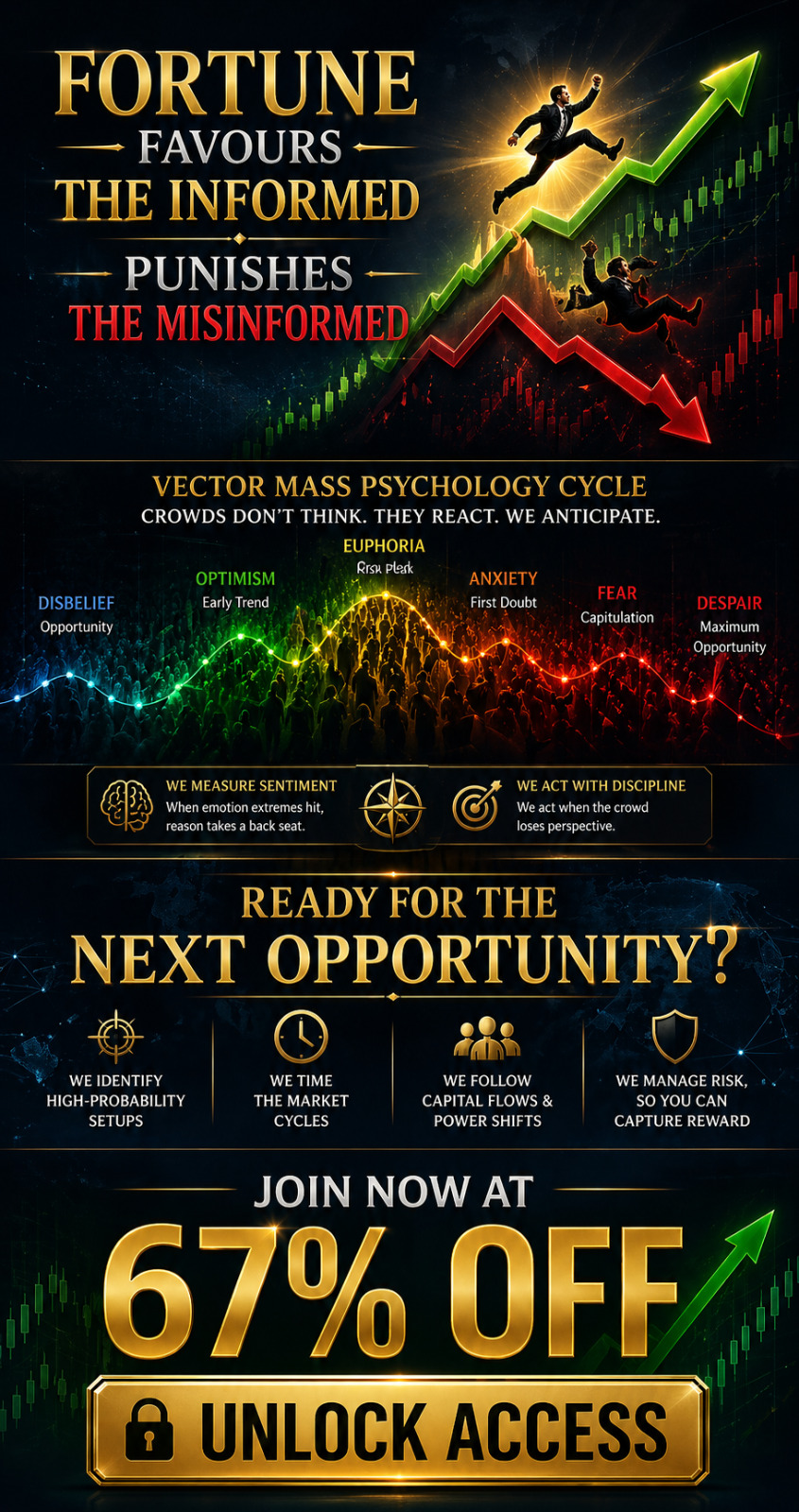
History’s greatest financial bubbles differ in detail but not in structure. Tulip Mania, the South Sea Bubble, the dot-com collapse, and the 2008 housing crisis all followed the same psychological sequence: optimism evolved into certainty, certainty dismissed scepticism, and scepticism eventually gave way to widespread denial until reality could no longer be ignored. By the time the crowd recognised conditions had changed, prices had already begun their descent.
The lesson extends far beyond investing. Every speculative boom convinces participants that existing rules no longer apply, while every collapse reminds them that human psychology changes far more slowly than markets themselves. Those who questioned prevailing assumptions appeared foolish during the advance but were ultimately rewarded because they recognised that emotional conviction is not evidence.
Remaining Rational While the Herd Panics
Maintaining independence during periods of mass emotion requires discipline rather than superior intelligence. Investors must deliberately seek conflicting viewpoints instead of reinforcing their existing beliefs, test claims against evidence rather than repetition, and recognise that timing often matters as much as being correct because confronting collective hysteria rarely changes its direction. Emotional self-control remains equally important, since fear and excitement narrow perception while calm thinking preserves the ability to distinguish temporary emotional extremes from lasting structural change.
Periods of panic frequently create extraordinary opportunities, but exploiting them requires restraint as much as courage. Investors who remain objective while others become emotional preserve both their judgement and their capital, allowing them to benefit from opportunities created by the crowd rather than becoming victims of its behaviour.
Collective Illusion and Independent Judgement
Most people fear isolation more than error, making collective belief psychologically comforting even when it is demonstrably wrong. Individuals routinely repeat opinions they privately doubt, support ideas they only partially understand, and follow leaders they quietly question because belonging offers emotional security that independent thinking cannot.
Digital media has intensified this tendency by surrounding individuals with constant reinforcement, creating the illusion that consensus reflects objective truth rather than repeated opinion. Yet history consistently rewards those willing to challenge prevailing assumptions. Figures ranging from Galileo to Michael Burry succeeded not because they enjoyed opposing the majority, but because they were willing to follow evidence after others had stopped looking.
What Armies Teach Us About Crowd Behaviour
Military organisations have studied group psychology for centuries because morale, leadership, and shared belief often determine outcomes as much as equipment or numbers. Markets display many of the same characteristics. Confidence strengthens participation, collapsing morale accelerates retreat, and persuasive narratives can move entire populations toward action or paralysis long before objective conditions justify either response.
Peer pressure reinforces these dynamics because individuals frequently hold losing positions or delay difficult decisions simply to avoid admitting error. Crowds therefore resemble armies: formidable while confidence remains intact, yet surprisingly fragile once belief begins to fracture.
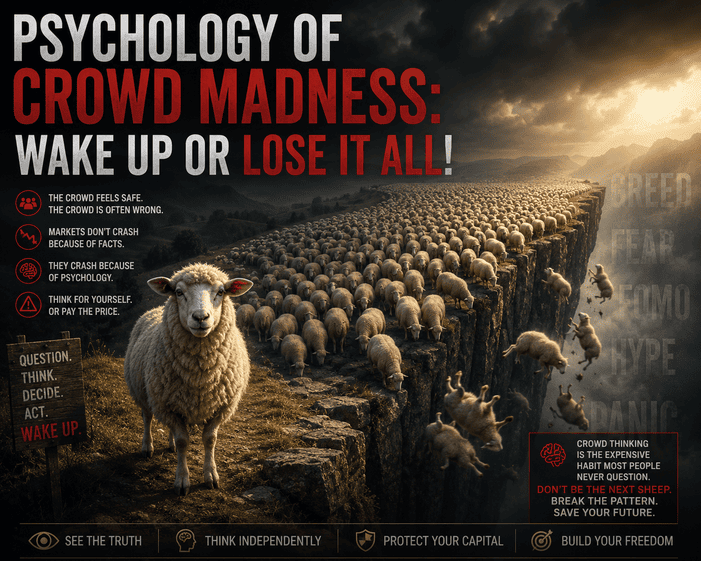
Why the Majority Keeps Walking Toward the Cliff
Most investors fail to leave speculative manias early because doing so requires admitting uncertainty while everyone else remains convinced the trend will continue. The technology bubble, the housing boom, and countless meme-stock episodes all demonstrated how difficult it is to abandon a profitable narrative before its flaws become obvious. By the time consensus finally changes, prices have usually adjusted first.
Contrarians face a different challenge. Standing apart invites criticism and isolation, making independent thinking psychologically expensive even when it proves financially rewarding. Yet history repeatedly shows that preserving capital often requires accepting temporary unpopularity.
Turning Crowd Psychology into Strategy
Understanding mass psychology provides a strategic advantage because it allows investors to recognise emotional extremes before they become fully reflected in prices. Facts alone rarely change behaviour during periods of collective excitement or fear, but disciplined analysis combined with a coherent narrative can gradually shift perception and restore perspective. Crowd psychology therefore becomes dangerous only when emotion operates without restraint or critical examination. Used responsibly, it becomes an essential tool for recognising opportunity while avoiding unnecessary risk.
Building Immunity to Mass Hysteria
Resistance to crowd behaviour is built through deliberate habits rather than natural temperament. Exposure to diverse viewpoints reduces the influence of groupthink, emotional discipline prevents fear from overwhelming judgement, responsible leadership encourages evidence over manipulation, and strong communities grounded in honest dialogue provide stability when public opinion becomes increasingly emotional. These habits strengthen both societies and investors by encouraging resilience instead of reaction.
Conclusion: See the Storm Before It Forms
Crowd madness destroys wealth, clarity, and social order because emotion compounds faster than reason can respond, allowing small shifts in sentiment to grow into self-reinforcing cycles of optimism or panic. The enduring advantage belongs to those who question prevailing narratives, slow their decision-making precisely when everyone else accelerates, and recognise that markets are driven as much by psychology as by fundamentals. They are not immune to fear or excitement, but they refuse to surrender judgement to the crowd, preserving both their capital and their clarity while others become trapped by emotional extremes. In the end, survival belongs not to the loudest voice or the strongest conviction, but to the clearest mind in the noisiest room.