
The Adaptive Market: Success Plants the Seeds of Future Failure
July 21, 2026
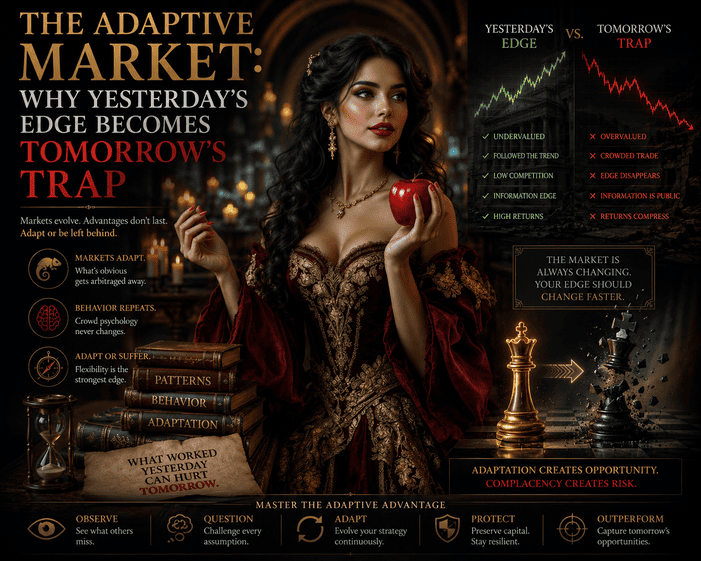
Markets have an extraordinary ability to make intelligence obsolete. A strategy that generated exceptional returns for years can suddenly become ineffective, not because its underlying logic was flawed but because the environment that rewarded it quietly disappeared while its users remained convinced nothing had changed. This is one of the least appreciated realities in investing. Markets are not static systems governed by permanent rules. They are adaptive systems in which every successful idea gradually alters the behaviour of other participants until the very conditions that created the opportunity begin to vanish. The edge doesn’t usually disappear overnight. It erodes so slowly that success itself blinds investors to the fact that they are gradually becoming prisoners of yesterday’s market.
This explains why so many experienced investors eventually suffer the same fate as beginners. Knowledge accumulates, confidence grows and successful decisions become reinforced through repetition until adaptability quietly gives way to certainty. The investor no longer evaluates each market on its own terms because every new situation is unconsciously forced into an existing framework, causing yesterday’s solutions to become today’s liabilities. Markets rarely punish ignorance as severely as they punish rigid thinking because ignorance can learn, while certainty resists evidence that threatens its identity.
Every Winning Strategy Carries Its Own Expiration Date
Most investors assume profitable strategies stop working because markets become irrational or because unexpected events temporarily distort price action. The opposite is usually closer to the truth. Strategies fail because they become widely understood, broadly adopted and increasingly crowded until their effectiveness begins attracting the very competition that ultimately destroys it. Every successful trade invites imitation, every discovered inefficiency attracts additional capital and every edge gradually compresses as more participants recognise the same opportunity.
This process unfolds across every generation of markets. A trading strategy initially works because few people employ it, allowing early adopters to profit from behaviour others have yet to recognise. Success attracts attention, attention attracts capital and capital attracts competition until what was once an overlooked opportunity becomes common knowledge. Eventually the market adjusts, not through conscious intent but through the countless decisions of participants responding to one another. The strategy has not failed because its logic disappeared. It failed because success changed the environment that made it successful.
Markets therefore evolve through feedback rather than equilibrium. Every participant influences the behaviour of every other participant, creating an environment in which profitable actions continually reshape future opportunities. This makes adaptation a permanent requirement rather than an occasional adjustment because the market never stops responding to its own participants.
Success Is Often the Beginning of Failure
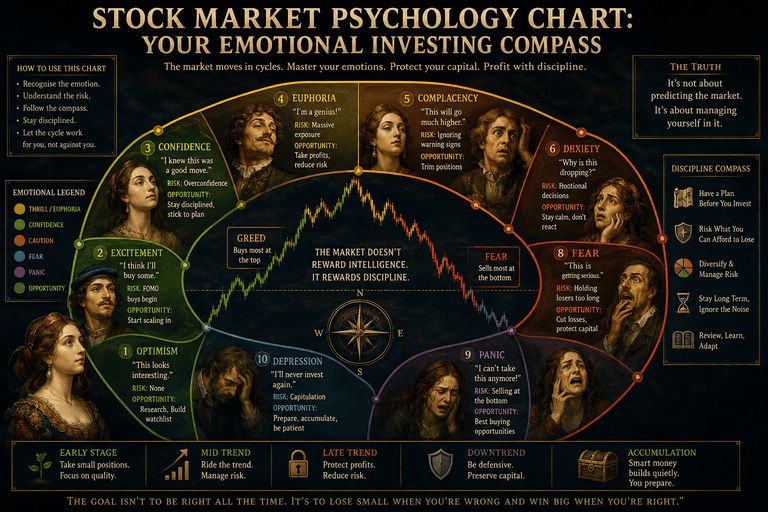
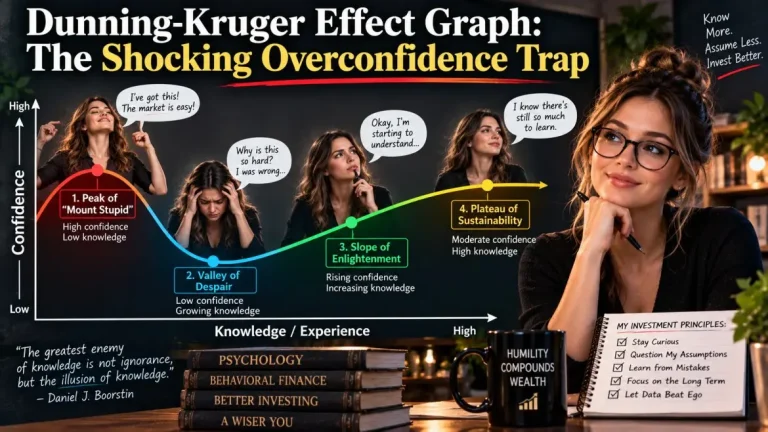
Nothing creates rigidity faster than repeated success because profitable outcomes naturally reinforce the belief that the framework producing them accurately reflects reality. Investors become increasingly confident, gradually reducing the frequency with which they question assumptions that previously required constant verification. What begins as justified confidence slowly transforms into unconscious certainty, and certainty eventually becomes the trap that prevents adaptation.
This is why market reversals frequently surprise the most experienced participants. Their knowledge is genuine, their analysis remains sophisticated and their discipline often exceeds that of newer investors, yet all those strengths become liabilities if they prevent recognising that the environment itself has changed. They continue refining yesterday’s model instead of questioning whether yesterday’s model still deserves to exist.
Markets exploit this tendency relentlessly because they reward flexibility rather than consistency. The greatest investors are rarely those with the strongest opinions. They are those willing to abandon opinions the moment reality stops supporting them.
Markets Don’t Break. Relationships Break.
Volatility is often blamed for market losses, yet volatility is usually nothing more than the visible expression of relationships that were already beginning to fail beneath the surface. Correlations weaken, leadership narrows, familiar patterns become less reliable and price starts responding differently to information that previously produced predictable outcomes. These subtle shifts rarely appear dramatic in isolation, which is precisely why most investors ignore them until the accumulated changes finally erupt into what appears to be a sudden break.
The market itself has not become irrational.
The relationships investors depended upon have quietly evolved.
Every major market disruption follows this pattern. Participants search for a single catalyst because human beings naturally prefer simple explanations, yet the catalyst merely exposes structural changes that have been developing over months or even years. By the time financial media identifies the obvious cause, the adaptive process has already reshaped the landscape, leaving investors responding to yesterday’s explanation instead of today’s reality.
Rare Events Reveal the Rules
Investors often dismiss extreme market events as statistical anomalies, treating flash crashes, melt-ups and violent reversals as exceptions that deserve little attention because they occur infrequently. This mindset overlooks one of the most important lessons markets continually teach. Rare events are not interruptions of the system. They reveal the system.
Extreme moves expose leverage that remained hidden during calm periods, assumptions that appeared unbreakable until tested and behavioural patterns that remain invisible while conditions stay favourable. Just as stress reveals weaknesses in engineering, volatility reveals weaknesses in portfolios, strategies and decision-making processes that ordinary market conditions successfully conceal.
Studying only normal markets therefore creates the illusion of understanding while ignoring the environments that cause the greatest destruction. The average day tells you how a system functions when everything goes according to plan. The exceptional day reveals how it actually behaves when reality begins rewriting the rules.
Adaptation Is the Only Durable Edge
Every investor eventually reaches the same crossroads. One path leads toward increasing certainty, where experience gradually hardens into doctrine and every new market is interpreted through increasingly outdated assumptions. The other leads toward continual adaptation, where every success remains provisional, every strategy carries an expiration date and every conviction exists only until stronger evidence emerges.
The first path feels safer because certainty creates emotional comfort. The second feels uncomfortable because adaptation requires admitting that today’s understanding may become tomorrow’s blind spot. Yet markets have always rewarded the second path because they are themselves adaptive systems, continually evolving through the actions of every participant attempting to exploit them.
The objective, therefore, is not to discover the perfect strategy but to develop the capacity to recognise when a once-profitable framework has begun losing relevance. Investors who master this skill stop asking whether the market is behaving irrationally and begin asking a far more useful question: what has changed that I have not yet recognised? That single shift transforms every setback into information, every disruption into feedback and every market cycle into an opportunity to evolve before the crowd realises the game itself has changed.
In the end, markets do not punish investors for being wrong. They punish them for remaining the same while everything around them continues to evolve.

Interesting Reads