When the Crowd Breathes as One, Storms Gather
August 7, 2026
Introduction
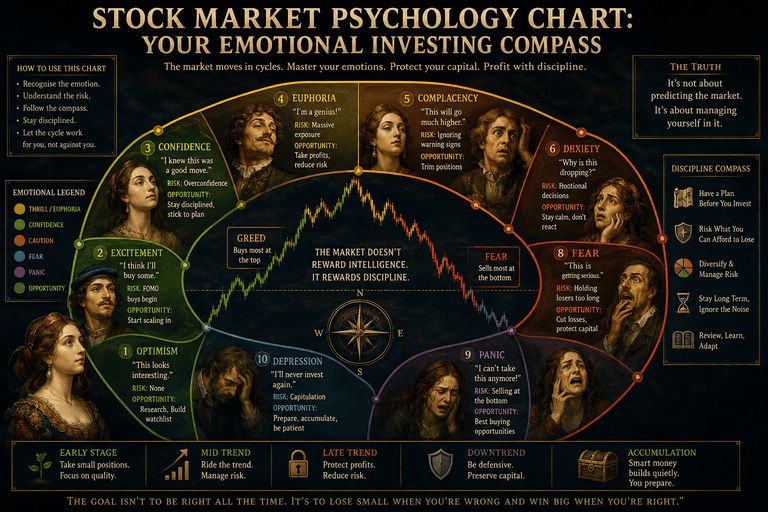
Classical Mass Psychology served investors well for decades because information moved slowly, narratives developed over weeks rather than minutes and the crowd had time to digest events before reacting. Today’s markets operate under an entirely different architecture. Artificial intelligence, algorithmic trading, social media and twenty-four-hour news cycles have compressed the time between information and reaction until they are almost indistinguishable. Attention has become fragmented, conviction forms almost instantly and narratives can spread globally before the underlying facts have even been verified.
The old question, “What does the crowd feel?” no longer captures what actually drives modern markets. Emotion alone has little predictive value unless it acquires direction, momentum and coherence. Fear scattered across millions of unrelated opinions produces noise. Fear converging around a single narrative becomes a force capable of moving trillions of dollars. Modern markets are increasingly governed not by static sentiment but by collective motion, which is why our framework evolved from traditional Mass Psychology into Vector Mass Psychology (VMP).
For practical implementation we refer to the system as the Vector Psychology System (VPS). VMP provides the underlying theoretical framework, while VPS converts that theory into a measurable score capable of identifying when fragmented opinions begin transforming into coordinated market behaviour. The objective is not merely to observe emotion but to measure its direction, intensity and ability to reshape market structure before price fully reflects it.
From Sentiment to Vectors
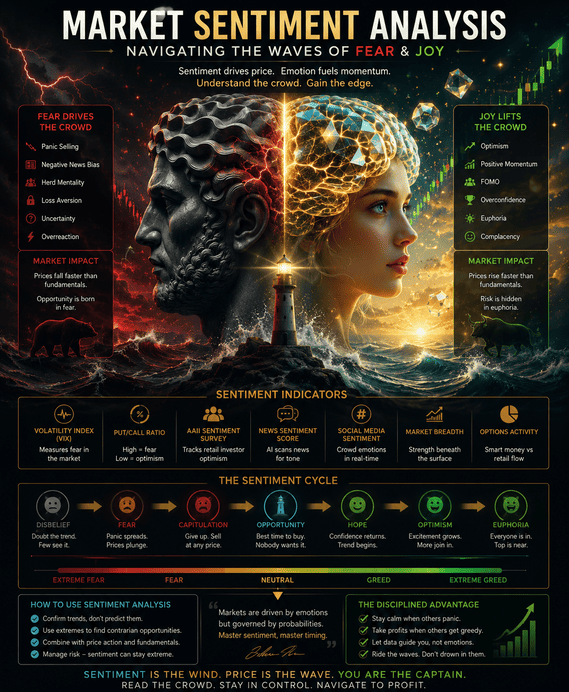
Traditional sentiment indicators measure how investors feel. They tell us whether fear or optimism dominates at a particular moment, but they rarely explain whether those emotions possess sufficient momentum to alter market behaviour. Markets do not move because people simply become fearful or optimistic. They move because individual emotions gradually synchronise until thousands or even millions of independent decisions begin reinforcing one another.
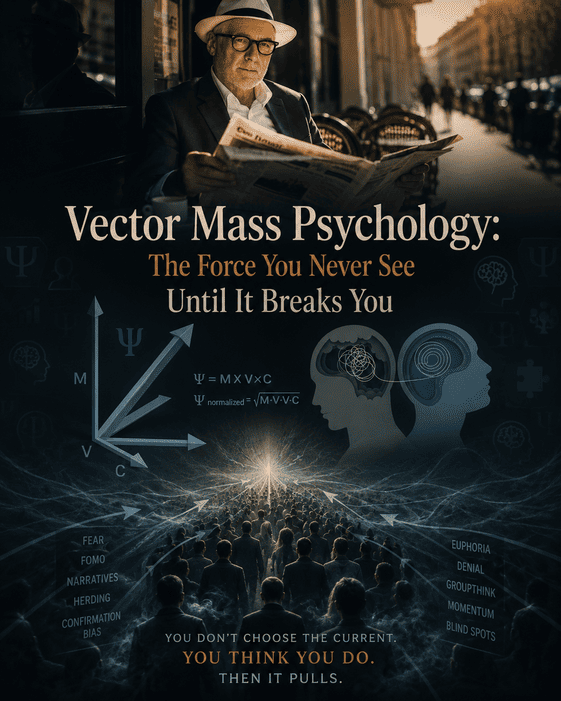
That transition from isolated emotion to coordinated behaviour is the foundation of Vector Mass Psychology. Rather than viewing psychology as a static condition, VMP treats it as a directional force governed by three interacting variables:

Ψ = M × V × C
To keep the signal interpretable, we normalise the result:
Ψₙ = ∛(M × V × C)
where:
- Magnitude (M) measures emotional intensity.
- Vector (V) measures directional bias.
- Coherence (C) measures how synchronised the crowd has become.
The cube root is not a mathematical curiosity but a practical necessity. When magnitude and coherence simultaneously become extreme, the raw product expands exponentially and quickly becomes impossible to compare across different market environments. The cube root compresses those extremes while preserving both scale and direction. Panic remains negative, euphoria remains positive and the resulting score stays comparable across multiple market regimes without sacrificing sensitivity.
Markets Move When Psychology Synchronises
The critical insight behind VMP is that markets rarely respond to emotion alone. They respond when emotion becomes coordinated.
Imagine ten thousand investors worrying about ten thousand different problems. Although fear exists, it lacks coherence and therefore possesses very little market power. Now imagine those same investors focusing simultaneously on a banking crisis, an unexpected war, a sovereign default or a systemic liquidity event. The absolute level of fear may not have changed dramatically, but its coherence has. Independent decisions suddenly become correlated, creating a powerful directional force capable of overwhelming liquidity.
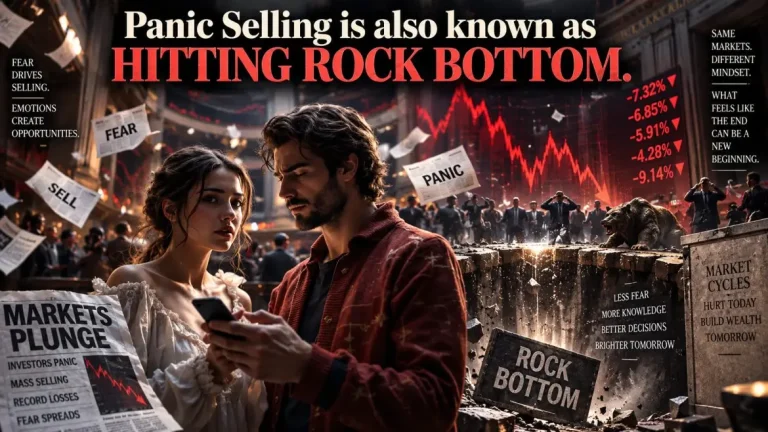
That is why identical levels of fear can produce completely different market outcomes. Scattered fear creates volatility and Coherent fear creates panic.
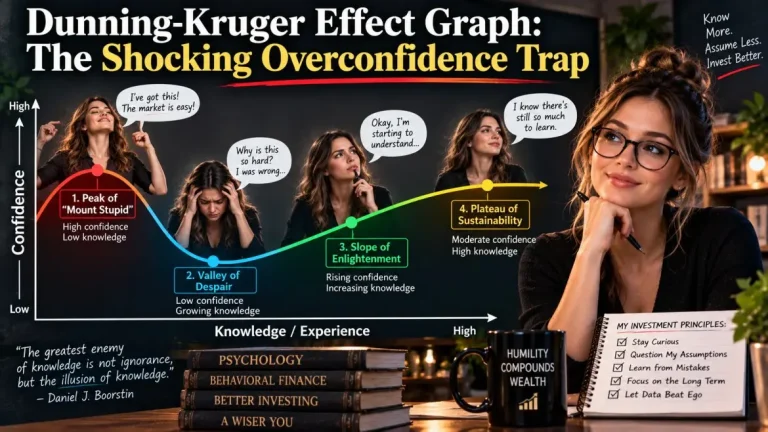
The same principle applies to optimism. Healthy confidence encourages investment. Synchronised optimism produces leverage, speculation and eventually bubbles. Markets rarely become dangerous because investors feel optimistic. They become dangerous because optimism evolves into certainty.
How VPS Converts Psychology into Data
VMP provides the conceptual framework. VPS transforms that framework into an operational system. Rather than relying on surveys alone, VPS continuously evaluates multiple behavioural vectors that collectively reveal whether fear or speculation is becoming increasingly synchronised. Every variable is normalised onto a common scale before being combined into a single directional score ranging from -100 to +100.
The objective is not to predict every market movement. It is to identify the rare periods when multiple independent indicators begin pointing in exactly the same psychological direction.
The system evaluates two opposing forces simultaneously. On the speculative side it monitors variables such as margin debt expansion, leveraged ETF activity, IPO enthusiasm, Bitcoin participation, meme-stock speculation and broader evidence of increasing risk appetite.
On the defensive side it tracks rising financial stress, widening credit spreads, increasing demand for gold, deteriorating investor sentiment, search interest surrounding market crashes and strengthening correlations typically associated with systemic fear.
When both sides remain balanced, the resulting score remains close to neutral because psychology lacks coherence. When multiple indicators begin reinforcing one another, the score accelerates rapidly toward either extreme. That acceleration often matters far more than the absolute reading because synchronisation frequently precedes significant market moves.
Why Coherence Changes Everything
Many traditional sentiment models implicitly assume that every indicator contributes equally to market risk. VPS rejects that assumption. Suppose margin debt reaches record highs while credit spreads remain calm, investor surveys remain balanced and financial stress stays muted. Speculation clearly exists, but the broader market remains internally divided. The resulting signal deserves caution but not alarm.
Now consider a different environment.
Margin debt reaches record highs.
Retail speculation explodes.
Leveraged ETFs dominate inflows.
IPO activity accelerates.
Bitcoin rallies alongside equities.
Options speculation reaches extremes.
Each indicator reinforces the others.
The crowd is no longer merely optimistic. It has become coherent. That distinction changes everything because coherent psychology possesses exponentially greater market impact than fragmented psychology. A divided crowd debates. A unified crowd stampedes.
Market Examples
Earnings Shock
A major technology company reports disappointing earnings. Retail participation spikes, social media converges on an overwhelmingly bearish narrative and institutional selling reinforces the same direction. Magnitude becomes elevated, vector turns decisively negative and coherence approaches one. VPS identifies the emergence of a genuine behavioural cascade rather than an isolated earnings disappointment.
Macro Fear Event
Central bank policy surprises investors, but market participants disagree about its implications. Some interpret the news as inflationary while others view it as evidence of economic resilience. Emotional intensity increases, yet directional coherence remains weak. VPS correctly classifies the event as elevated volatility rather than systemic panic.
Short Squeeze
A heavily shorted stock attracts coordinated buying across multiple online communities. Optimism, participation and directional agreement simultaneously accelerate. The resulting VPS surge captures not merely speculative enthusiasm but the synchronisation required for explosive price movement.
Liquidity Crisis
During rare systemic events such as March 2020, nearly every behavioural indicator aligns. Fear becomes universal, liquidity evaporates and forced selling dominates every asset class. These are precisely the environments where VPS reaches its most negative readings because panic has evolved into complete psychological coherence.
Flash-Crash Panic Example (Rare)
o External shock hits—pandemic headlines, financial plumbing seizing, liquidity vanishing. Magnitude: extreme fear, off the charts.
o Vector: overwhelmingly sell, no counterweight.
o coherence: absolute unity—every sector, every feed, every portfolio dumping in lockstep.
o Score: Ψ hits its rarest extreme; panic crystallised into a single directional thrust. This is when we back the truck up as if there’s no tomorrow. Case in point: the COVID-19 meltdown of March 2020, when forced liquidations created generational buying opportunities for those willing to step into the market.
VPS: Essential Scoring Summary
+90 to +100 | Melt-Up
Collective euphoria approaches exhaustion. Forward risk rises sharply while future returns typically deteriorate.
+50 to +89 | Euphoria
Optimism dominates behaviour. Speculation increasingly replaces disciplined capital allocation.
+10 to +49 | Constructive
Healthy risk appetite supports sustainable advances without widespread speculative excess.
−10 to +10 | Neutral
Psychology remains fragmented. No dominant behavioural vector exists.
−10 to −50 | Defensive
Fear outweighs optimism, but selling remains selective rather than indiscriminate.
−50 to −89 | Panic
Liquidity deteriorates as emotional selling increasingly drives market behaviour.
−90 to −100 | Capitulation
Forced liquidation dominates. These conditions have historically produced some of the most attractive long-term buying opportunities.
Conclusion
The Joy Indicator and VPS measure different dimensions of the same behavioural landscape. Joy measures the market’s emotional climate by revealing whether optimism or pessimism dominates the environment. VPS goes one level deeper by measuring whether those emotions have acquired sufficient direction and coherence to become a genuine market force.
Think of Joy as measuring atmospheric pressure and VPS as measuring wind direction. Calm air tells you little about tomorrow’s weather, but rising pressure combined with strengthening directional winds often signals that conditions are changing. Used together, they transform psychology from a collection of disconnected observations into a dynamic behavioural map capable of identifying when scattered opinions are becoming coordinated action.
Markets do not break because investors become emotional. They break when millions of independent minds begin breathing as one. That is the phenomenon Vector Mass Psychology was built to measure.