
Mass Psychology Investing Signals: Why the Crowd Tells You More Than the Balance Sheet
Aug 7, 2026
Introduction: Markets Don’t Move on Numbers. They Move on Collective Belief.
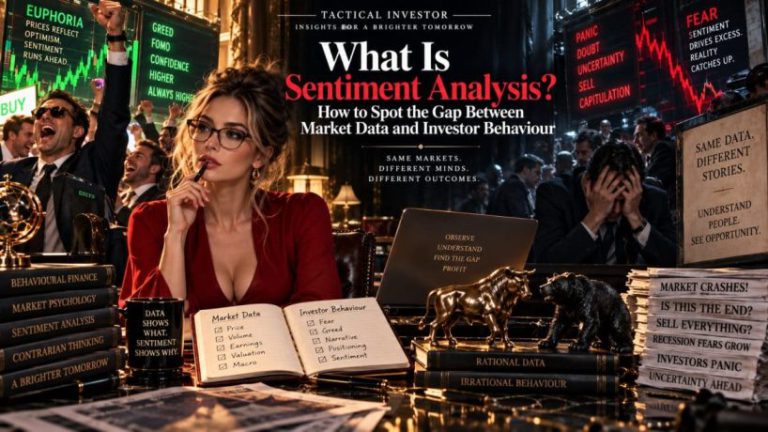
Markets spend most of their time pretending to be about numbers. Earnings, valuation multiples, GDP forecasts, inflation reports, and interest-rate projections dominate financial headlines, creating the illusion that investing is little more than a giant spreadsheet. Those figures matter, but they rarely explain why markets suddenly become euphoric, irrational, or terrified. Price reflects mathematics, but market turning points almost always reflect psychology.
Every major advance and every violent decline begins with a shift in collective perception rather than an immediate change in fundamentals. Investors don’t simply react to information; they react to how they believe everyone else will react. This recursive behaviour transforms markets into adaptive systems where expectations influence prices, rising prices reinforce expectations, and the resulting feedback loop gradually detaches perception from reality. Eventually, the market stops pricing facts and starts pricing belief.
This is where mass psychology investing signals become invaluable. They don’t attempt to measure whether an asset is objectively cheap or expensive. Instead, they measure how synchronised the crowd has become around a particular narrative. Once that synchronisation reaches an extreme, the market often becomes vulnerable because nearly everyone who agrees with the prevailing story has already acted on it.
Today, more than ever, this matters. AI-generated content, algorithmic trading, social media, and twenty-four-hour financial commentary have compressed the time between information, interpretation, and action. Narratives now spread globally within minutes, allowing crowd psychology to form much faster than in previous market cycles. The challenge is no longer gathering information. It is distinguishing genuine information from emotional contagion.
Why Psychology Leads While Fundamentals Follow
Fundamental analysis explains why businesses create value over long periods. It rarely explains why markets suddenly reverse. Corporate earnings arrive quarterly. Economic statistics are revised months later. Analysts gradually adjust forecasts after conditions have already changed. By the time fundamentals confirm a turning point, prices have usually travelled much further than most investors imagined possible.
Psychology operates on a completely different timetable. Fear and greed appear immediately. They emerge in trading volumes, options activity, media narratives, internet searches, social-media discussions, and the willingness of investors to embrace or reject risk. Collective behaviour therefore provides an early warning system that often detects important shifts before they become visible in financial statements.
Behavioural finance reinforces this idea. Daniel Kahneman demonstrated that people rely on mental shortcuts rather than purely rational analysis. Robert Shiller showed how narratives spread through populations much like contagious diseases, influencing financial decisions far beyond what fundamentals justify. George Soros argued that markets are reflexive, meaning perceptions influence reality while reality simultaneously reshapes perception. Together, these ideas reveal why markets frequently overshoot both on the upside and the downside.
Turning points therefore begin emotionally, not fundamentally. Market bottoms form when exhaustion finally overwhelms fear. Market tops develop when confidence evolves into certainty and uncertainty disappears altogether. The numbers merely confirm what psychology has already decided.
The Behavioural Signals That Actually Matter
Thousands of indicators compete for investors’ attention, yet relatively few consistently measure collective behaviour. The most useful signals focus not on price but on participation, expectation, and emotional alignment.
The AAII Sentiment Survey remains valuable because it tracks the balance between bullish and bearish retail investors. Extreme optimism often appears close to market peaks, while extreme pessimism frequently develops near major bottoms. The survey isn’t useful because it predicts exact turning dates. Its value comes from identifying moments when emotional consensus has become unusually one-sided.
The Put/Call Ratio offers another behavioural window. When investors aggressively purchase puts, fear dominates. When speculative call buying overwhelms protective hedging, excessive confidence begins replacing prudent risk management. Neither extreme lasts indefinitely because emotion naturally oscillates between optimism and pessimism.
Search behaviour provides another fascinating signal. Surging Google searches such as “How to buy Bitcoin,” “Best AI stocks,” or “Open a trading account” often indicate that enthusiasm has reached the broader public. Professional capital typically enters much earlier. By the time widespread retail curiosity appears, a significant portion of future demand has frequently already arrived.
Finally, social-media sentiment has become increasingly important. Platforms amplify consensus at extraordinary speed, rewarding certainty while punishing nuance. When every influencer reaches the same conclusion, the market usually becomes far more fragile than it appears because the diversity of opinion required for healthy price discovery has quietly disappeared.
The Magazine Cover Effect and the Silence Nobody Notices
One of the oldest behavioural indicators remains surprisingly effective. When a major mainstream publication places an investment theme on its cover, the trend is often approaching maturity rather than beginning. Editors select stories after they become culturally significant, not before. By the time an investment narrative reaches the front page of a general-interest magazine, institutional investors have usually been positioning themselves for months or even years.
Academic research has repeatedly observed variations of this “Magazine Cover Indicator.” The cover doesn’t cause the reversal. It simply confirms that the narrative has saturated public consciousness. Once everyone already believes the story, few new buyers remain to push prices significantly higher.
Ironically, the opposite phenomenon receives far less attention. One of the strongest behavioural signals often appears when discussion simply disappears.
Markets rarely bottom during maximum panic. They bottom after panic fades into indifference. During this phase, analysts stop covering the sector, financial media loses interest, retail investors move elsewhere, and online discussions become almost silent. Nobody argues because nobody cares anymore. That absence of attention often marks the beginning of opportunity because expectations have already collapsed while underlying conditions quietly begin stabilising.
The crowd first becomes frightened. Later it becomes bored. History suggests boredom frequently offers better opportunities than excitement.
Why the Crowd Becomes the Risk
The effectiveness of mass psychology signals ultimately comes from one characteristic of human nature: synchronisation.
People naturally mirror one another under conditions of uncertainty. Solomon Asch demonstrated how individuals frequently conform even when the group is objectively incorrect. Modern neuroscience shows that emotional states spread rapidly through social networks. Financial markets magnify these tendencies because every participant constantly observes everyone else’s behaviour while simultaneously influencing it.
This creates powerful feedback loops. Rising prices attract buyers. New buyers push prices higher. Higher prices reinforce bullish narratives. Those narratives attract additional participants, who further validate the original belief. The process continues until optimism becomes almost universal.
At that stage, the greatest risk isn’t deteriorating fundamentals. The greatest risk is the absence of disagreement.
Markets require diversity of opinion because buyers need sellers. Once consensus becomes overwhelming, future returns usually become constrained simply because the majority has already committed its capital. The crowd itself becomes the risk.
Contrarian investing therefore isn’t about permanently opposing consensus. It is about recognising when consensus has become so dominant that probabilities begin shifting in the opposite direction.
Turning Crowd Behaviour into an Investment Process
Successful investors don’t trade every sentiment reading. They combine behavioural signals into a structured decision-making process.
No single indicator should ever dictate a major investment decision. Extreme sentiment becomes meaningful only when multiple behavioural measures begin aligning simultaneously. Elevated optimism, speculative options activity, widespread retail participation, expanding leverage, and increasingly euphoric media narratives together provide far stronger evidence than any individual signal viewed in isolation.
Price confirmation also remains essential. Psychology identifies potential turning points. Technical analysis helps determine whether behaviour is actually beginning to change. Divergences, improving breadth, expanding volume, and structural trend breaks often provide the confirmation that pure sentiment cannot.
Position sizing matters equally. Even the strongest behavioural signals rarely identify exact turning dates. Scaling gradually into positions allows investors to benefit from improving probabilities without assuming impossible precision. Markets often remain irrational longer than expected, but emotional extremes rarely persist indefinitely.
Above all, investors must monitor changes rather than static readings. A market moving from extreme optimism toward moderation often conveys more useful information than optimism alone. Direction matters at least as much as level.
Conclusion: The Crowd Is Your Greatest Dataset
Mass psychology investing signals don’t replace fundamental analysis. They complement it by revealing something financial statements cannot: how human beings are interpreting reality in real time.
Markets aren’t mechanical systems driven solely by numbers. They are adaptive networks of expectations, feedback loops, social proof, and emotional synchronisation. Prices fluctuate because beliefs fluctuate. Understanding those beliefs often provides earlier insight than waiting for economic reports to confirm what psychology has already revealed.
The greatest investors rarely outperform because they possess dramatically better information. They outperform because they understand how crowds behave under conditions of uncertainty. They recognise that markets spend long periods discounting optimism before optimism becomes obvious, and discounting fear before fear becomes visible in the data.
The next time you find yourself feeling completely certain about an investment, pause before acting. Look beyond the numbers and study the crowd itself. If nearly everyone shares your conviction, the market has probably already incorporated that belief into the price. The real opportunity usually lies elsewhere, hidden in the narratives the crowd has abandoned, ignored, or simply stopped discussing.
That forgotten corner of the market has always rewarded independent thought far more generously than consensus ever could.