Extraordinary Popular Delusions and the Madness of Crowds: A Contrarian Perspective
July 22, 2026
The Madness Never Dies
Few books have aged as well as Charles Mackay’s Extraordinary Popular Delusions and the Madness of Crowds. Written in the nineteenth century, it catalogued speculative frenzies, financial bubbles, religious panics, and collective delusions that swept through societies long before electronic markets, social media, or artificial intelligence existed. Yet the remarkable lesson is not how different those worlds appear from our own but how little the human mind has changed. Markets have evolved beyond recognition, information now travels at the speed of light, and algorithms execute trades in microseconds, but beneath every technological advance lies the same emotional machinery that drove Dutch merchants to mortgage fortunes for tulip bulbs and investors to believe that prosperity could rise forever without consequence.
Mackay was never really writing about tulips, witches, alchemists, or speculative companies. He was writing about people. His true subject was the recurring failure of human judgement whenever emotion overwhelms reason and collective conviction replaces independent thought. Every generation believes itself more intelligent than the last because it possesses better technology, more information, and more sophisticated institutions. Every generation eventually discovers that intelligence offers surprisingly little protection once individuals dissolve into a crowd. Human beings have an extraordinary ability to think rationally in isolation and an equally extraordinary ability to abandon that rationality the moment social proof begins masquerading as evidence.
That is why this book remains essential reading for investors. Markets are often described as mechanisms for valuing businesses, allocating capital, and discounting future expectations. They are all of those things, but they are something else before they become any of them. They are emotional ecosystems in which millions of individual hopes, fears, ambitions, and anxieties collide every day, producing prices that periodically drift far away from underlying reality. Financial statements explain what a business is worth. Crowd psychology explains why markets repeatedly refuse to price it accordingly.
Understanding this distinction changes the way one sees every major market cycle. Booms cease to look like permanent prosperity. Crashes cease to look like permanent collapse. Both become psychological events long before they become economic ones. Once emotion dominates perception, markets no longer measure value. They measure conviction, and conviction has always been one of the least reliable pricing mechanisms ever invented.
Fear, the Crowd, and the Collapse of Independent Thought
Fear occupies a unique position in financial markets because it is simultaneously one of humanity’s greatest survival mechanisms and one of its greatest financial liabilities. Evolution rewarded rapid responses to danger because hesitation often carried fatal consequences. In the natural world, running first and analysing later was frequently the correct decision. Financial markets invert that logic. Here, the instinct that once protected life often destroys wealth because immediate danger and long-term opportunity frequently arrive together.
When markets begin falling sharply, most investors do not experience declining prices as temporary fluctuations in valuation. They experience them as existential threats. Portfolios become extensions of personal security, and every percentage decline feels like evidence that the future itself has become less certain. The brain responds exactly as evolution designed it to respond, narrowing attention towards immediate survival while suppressing the slower, analytical thinking required for rational decision-making. Investors who spent years constructing disciplined plans often abandon them within days because fear quietly transforms temporary uncertainty into apparent certainty.
This psychological shift rarely occurs in isolation. Loss aversion encourages people to avoid further pain at almost any cost, while confirmation bias ensures they notice every headline, analyst forecast, and market commentator reinforcing their growing pessimism. Information ceases to be evaluated objectively and instead becomes selectively filtered until every new development appears to confirm the same conclusion. What began as caution slowly evolves into conviction, and conviction rapidly becomes panic.
The crowd completes the process. Human beings are profoundly social creatures, conditioned over thousands of generations to interpret collective behaviour as evidence of safety. If everyone else is running, the instinctive assumption is that they must know something we do not. In financial markets, this instinct becomes extraordinarily dangerous because widespread selling itself creates the evidence that appears to justify additional selling. Falling prices generate fear, fear generates more selling, and more selling produces lower prices, creating a feedback loop capable of pushing markets far beyond anything fundamentals alone would support.
Modern technology accelerates this ancient psychology rather than replacing it. Information now spreads instantly across financial media, social platforms, and algorithmically curated feeds designed to maximise engagement rather than understanding. Every alarming headline competes for attention by becoming more dramatic than the last, while automated trading systems increasingly respond to shifts in momentum and sentiment alongside traditional financial data. The result is a marketplace where emotion travels faster than analysis and perception often outruns reality.
Yet hidden within this apparent weakness lies one of investing’s greatest opportunities. Fear is remarkably efficient at producing indiscriminate selling. It rarely distinguishes between exceptional businesses and mediocre ones, between temporary problems and permanent impairment, or between declining prices and declining value. In its desperation to eliminate uncertainty, the crowd often discards quality alongside weakness, creating opportunities that rational markets would never produce. Understanding fear therefore becomes far more than an exercise in behavioural psychology. It becomes the foundation of intelligent capital allocation.
Every Bubble Tells the Same Story
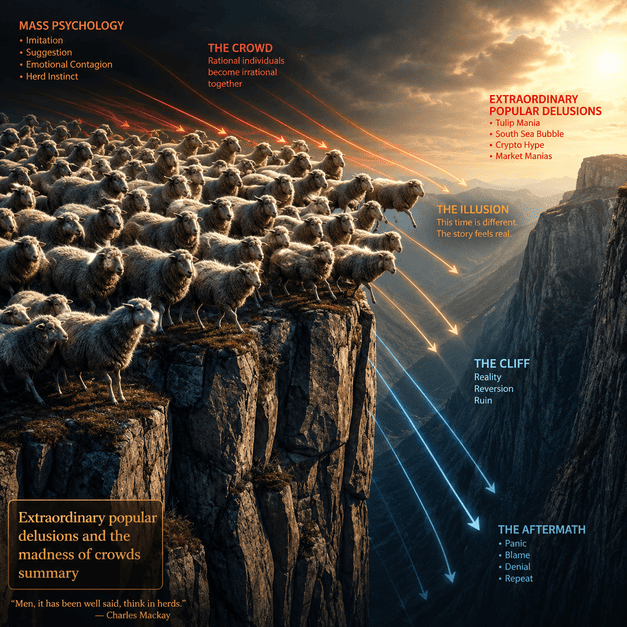
History does not repeat because events unfold identically. It repeats because human beings continue responding to uncertainty in remarkably similar ways. Every speculative mania appears unique while it is unfolding, wrapped in contemporary language, revolutionary technology, or unprecedented economic conditions. Viewed through the lens of history, however, each one reveals the same psychological architecture.
Tulip Mania was never really about flowers. It was about the belief that prices could continue rising simply because they had always risen before. The South Sea Bubble was not fundamentally about maritime commerce but about the seductive power of limitless optimism detached from measurable reality. The crash of 1929 reflected neither automobiles nor industrial expansion as much as it reflected the conviction that prosperity had become self-sustaining. The Global Financial Crisis appeared to revolve around mortgages and derivatives, yet beneath the financial complexity lay an older and simpler belief that risk had somehow disappeared because enough people believed it had.
Even the pandemic-induced panic of 2020 demonstrated the same emotional mechanics. Genuine uncertainty quickly evolved into indiscriminate liquidation as investors rushed to sell almost everything before pausing to distinguish between businesses facing temporary disruption and those confronting genuine existential threats. Prices moved first. Careful analysis followed much later.
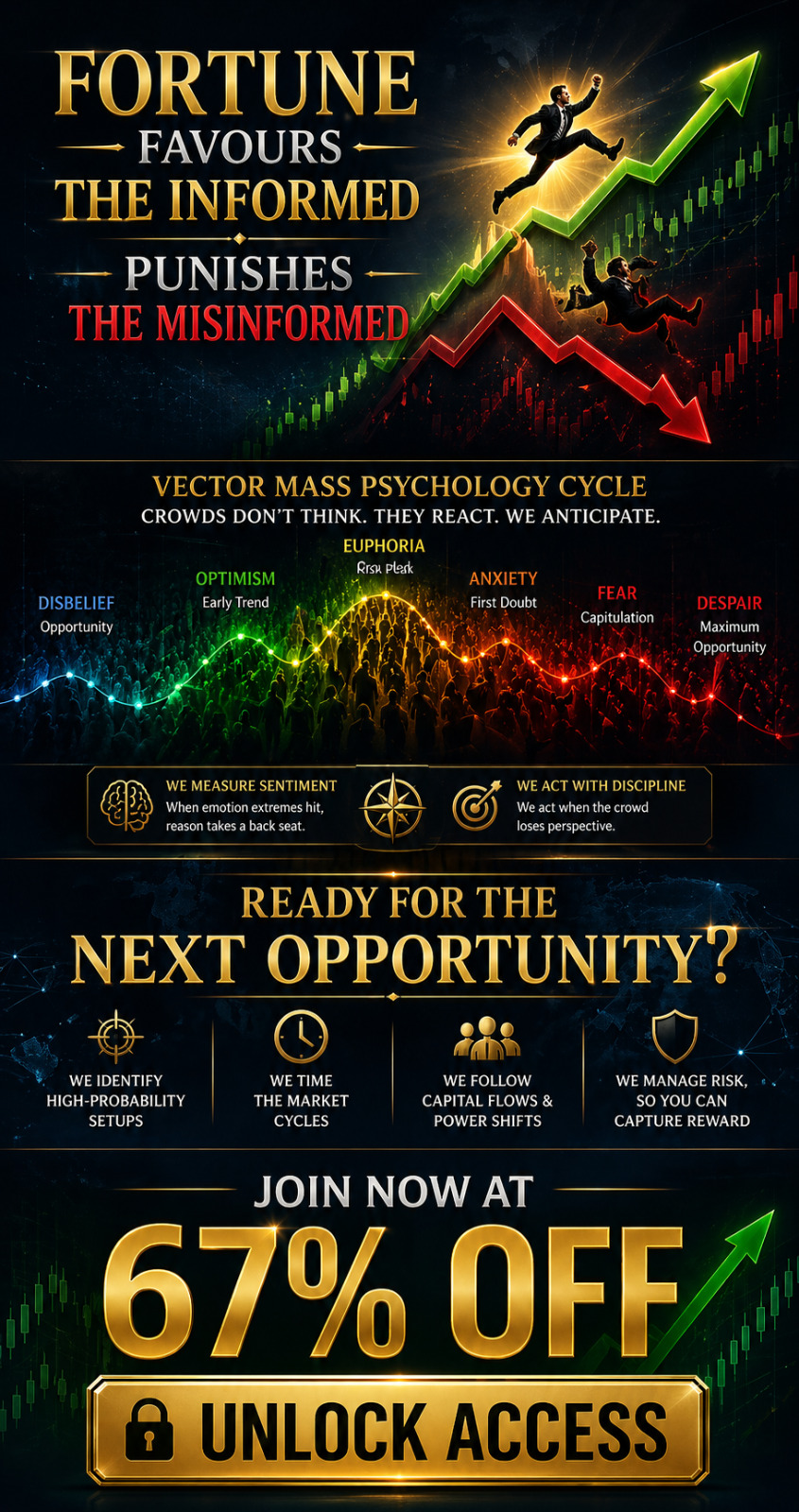
Every cycle follows a remarkably familiar progression. Optimism becomes confidence, confidence becomes certainty, certainty breeds complacency, complacency encourages excess, and excess eventually collides with reality. At that point the emotional engine reverses direction. Confidence becomes doubt, doubt becomes fear, fear becomes panic, and panic eventually pushes prices below any reasonable assessment of intrinsic value. The crowd simply changes direction while maintaining exactly the same emotional intensity.
The tragedy is that each generation believes its own story is different. New technology convinces investors that old valuation methods no longer apply. Financial innovation creates the illusion that risk has been permanently reduced. Political or economic change is presented as the beginning of a completely new era in which previous lessons have somehow become obsolete. The narrative changes. Human psychology does not.
It is this failure to recognise recurring patterns that gives Mackay’s work its extraordinary longevity. He was not documenting isolated historical curiosities. He was describing the permanent operating system of collective behaviour. Markets evolve continuously. Human nature evolves at a glacial pace.
Turning Fear into Opportunity
If Mackay diagnosed the disease, contrarian investing offers the treatment. The central lesson is deceptively simple: markets become most dangerous when emotion replaces analysis, but they also become most rewarding for those capable of remaining analytical while everyone else becomes emotional. The objective is not to oppose the crowd reflexively, nor to wear contrarianism as a badge of honour. Doing the opposite of the majority simply because it is popular is every bit as irrational as following it blindly. Genuine contrarian thinking begins only when collective emotion has pushed prices so far from underlying value that probability shifts decisively in favour of patience and discipline.
This distinction separates successful investors from perpetual speculators. The crowd trades stories; the contrarian evaluates probabilities. The crowd obsesses over today’s headlines; the contrarian asks whether those headlines materially alter the long-term earning power of the underlying business. While the majority searches for certainty, disciplined investors accept that uncertainty is permanent and instead concentrate on whether they are being adequately compensated for bearing it.
This is why the greatest investors rarely appear heroic while events are unfolding. During periods of panic, their decisions often seem reckless because they are purchasing assets everyone else is desperate to abandon. During speculative booms they appear unnecessarily cautious because they refuse to chase the latest narrative. They understand that markets consistently overpay for excitement and consistently underprice fear. The greatest opportunities therefore emerge not from predicting the future more accurately than everyone else but from recognising when emotion has produced a valuation so distorted that even an imperfect forecast offers attractive odds.
Volatility itself should therefore be viewed differently. Most investors treat volatility as synonymous with risk, yet they are fundamentally different concepts. Risk is the permanent impairment of capital caused by overpaying for weak businesses, excessive leverage, deteriorating fundamentals, or flawed analysis. Volatility is simply the market’s emotional expression. It measures the intensity of disagreement, not the quality of the underlying asset. A magnificent business can experience violent price swings without suffering any meaningful deterioration in its intrinsic value, just as a poor business can remain remarkably stable while its long-term prospects quietly erode.
Recognising that distinction changes one’s entire relationship with market declines. Instead of asking whether prices are falling, disciplined investors ask why they are falling. Has the business fundamentally weakened, or has the crowd merely become temporarily incapable of distinguishing between uncertainty and permanent damage? Those are very different questions, yet markets frequently price them as though they were identical.
This philosophy extends naturally into more advanced strategies. During periods of panic, investors often pay extraordinary premiums for downside protection, allowing disciplined participants to monetise fear by selling put options on businesses they would willingly own at lower prices. If those options expire worthless, the elevated premium becomes income. If shares are assigned, they acquire quality companies at attractive valuations while further reducing their effective purchase price through the premium already received. Some investors then deploy those proceeds into long-dated call options, using temporary fear to finance long-term opportunity. The mechanics themselves are secondary. The principle is what matters. Emotional excess repeatedly creates pricing distortions, and disciplined investors learn to convert those distortions into favourable probability.
None of this eliminates the need for rigorous risk management. Contrarian investing is not about reckless courage; it is about controlled conviction. Capital should be deployed incrementally because markets often overshoot both optimism and pessimism. Position sizes should reflect uncertainty rather than ego. Every investment should be judged by the relationship between potential reward and potential loss rather than by the excitement surrounding the opportunity. Emotional discipline without risk management eventually becomes stubbornness, while risk management without emotional discipline degenerates into permanent hesitation. Successful investing requires both.
The Timeless Lesson
The greatest contribution of Extraordinary Popular Delusions and the Madness of Crowds is not its historical catalogue of financial manias but its recognition that collective irrationality is not an occasional malfunction of markets. It is one of their defining characteristics. Every generation convinces itself that better education, improved regulation, faster communication, or more sophisticated financial instruments have finally tamed the excesses that destroyed previous investors. Yet every generation eventually discovers the same uncomfortable truth. Technology evolves rapidly. Human psychology barely evolves at all.
The names of the bubbles change. Tulips become railways, railways become radio companies, radio companies become internet stocks, internet stocks become housing, housing becomes cryptocurrency, artificial intelligence, or whatever narrative captures the imagination of the next generation. The underlying mechanism never changes because the underlying participants never change. Optimism still mutates into euphoria, fear still mutates into panic, and crowds still mistake emotional consensus for objective reality.
The investor who understands this ceases chasing predictions and begins studying behaviour. Instead of asking where the market will be next month, the more important question becomes whether the crowd has reached an emotional extreme that has overwhelmed rational valuation. That subtle shift in perspective changes everything. Markets stop appearing random because recurring psychological patterns become increasingly visible. Corrections cease to feel catastrophic because they are recognised as the inevitable consequence of excessive optimism. Bull markets become easier to navigate because confidence is viewed with healthy scepticism rather than blind enthusiasm.
The real edge in investing has never been superior intelligence alone. It has been the ability to remain rational when emotion becomes contagious. Independent thought, emotional discipline, and patience are remarkably ordinary virtues, yet together they create an advantage that compounds over decades because they allow investors to exploit the one inefficiency markets never permanently eliminate: human nature.
Charles Mackay’s masterpiece endures because it reminds us that the greatest danger in markets has never been volatility, recession, inflation, or technological disruption. It has always been the crowd itself. The same force capable of driving prices to irrational heights can just as easily drive them to irrational lows. Those willing to surrender their judgement to the majority will inevitably share its mistakes. Those willing to think independently, while grounding their decisions in evidence rather than emotion, discover that the madness of crowds is more than a recurring spectacle of financial history. It is one of the greatest and most enduring sources of investment opportunity.
The crowd will always oscillate between euphoria and despair because that is the rhythm of human nature. The disciplined investor need not follow either extreme. Standing apart from the stampede is often uncomfortable, occasionally lonely, and sometimes temporarily painful, but history repeatedly demonstrates that it is also where enduring wealth is quietly built. Mackay understood that nearly two centuries ago. Markets have changed almost beyond recognition since then. His central lesson has not.