Collective Euphoria: When Mass Hysteria Leads to Financial Ruin
July 28, 2026
Introduction: When Optimism Becomes a Liability
“Men willingly believe what they wish.”
Julius Caesar
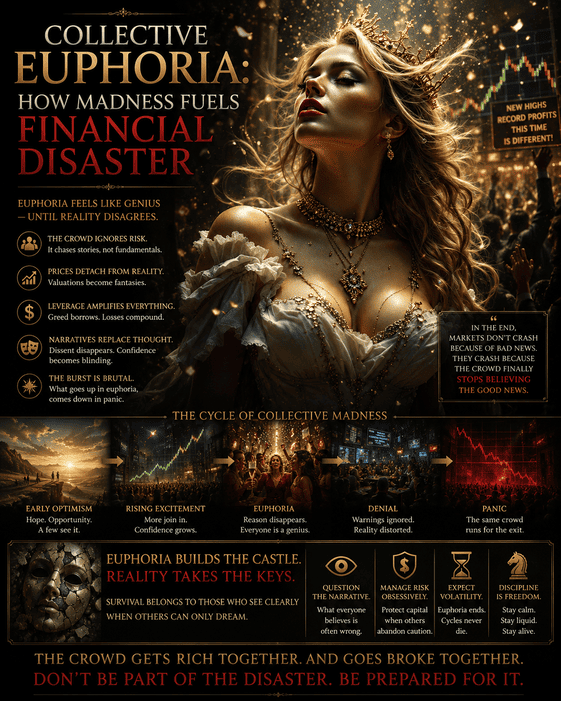
Every great market advance begins with improving fundamentals, but no great bubble has ever ended there. Somewhere along the journey, optimism quietly detaches from reality, expectations become more important than evidence, and investors stop asking what an asset is worth because they become convinced that someone else will always pay more tomorrow. That transformation marks the beginning of collective euphoria, a psychological state in which perception expands far faster than reality, causing prices to drift further from intrinsic value until the gap can no longer sustain itself.
This pattern has repeated for centuries because markets are not merely financial mechanisms. They are social systems where information competes with emotion, and where belief often overwhelms analysis long before fundamentals reassert themselves. Every generation convinces itself that it has discovered a new paradigm, yet the underlying behaviour rarely changes because human nature remains remarkably stable. Technology evolves, institutions become more sophisticated, and financial instruments grow increasingly complex, but fear and greed continue to move through crowds with astonishing consistency.
Collective euphoria is therefore not simply excessive optimism. It is a progressive distortion of judgment in which caution begins to appear irrational, scepticism is dismissed as ignorance, and the refusal to participate becomes socially more painful than the risk of financial loss. By the time this transformation becomes visible, the bubble is already well developed, because the greatest danger in every cycle is not ignorance but confidence masquerading as certainty.
The Crowd Does Not Think. It Synchronizes.
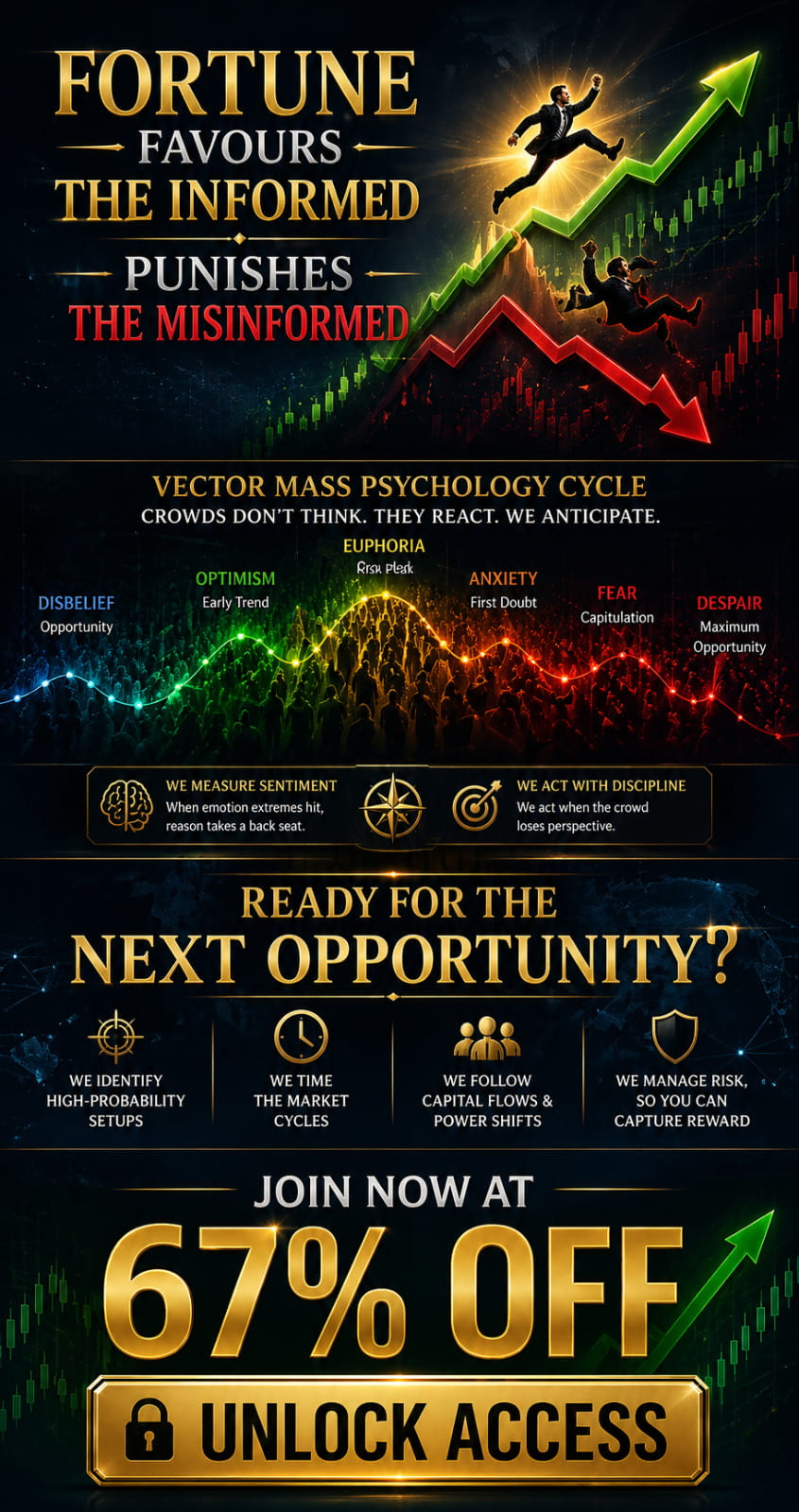
Charles Mackay observed that people go mad together and recover their senses one by one, a statement that remains as relevant today as when it was written because markets continue to demonstrate that collective behaviour follows psychological rather than logical principles. Individuals may believe they are acting independently, yet their decisions increasingly converge as uncertainty rises, producing behaviour that appears coordinated even when no coordination exists.
Gustave Le Bon recognised this long before behavioural finance attempted to formalise it. Once individuals become part of a crowd, personal judgment gradually yields to collective emotion, and decisions that would appear absurd in isolation suddenly become perfectly acceptable because everyone else appears to be making the same choice. Markets magnify this tendency. Rising prices reinforce confidence, confidence attracts additional buyers, and the resulting feedback loop convinces participants that price appreciation itself validates the underlying investment thesis.
This is why bubbles become so difficult to recognise from the inside. Participants are not simply observing prices rise. They are observing millions of other investors validating the same conclusion, creating the illusion that consensus and truth are interchangeable. The crowd mistakes popularity for proof, forgetting that financial history is filled with moments when unanimous conviction preceded spectacular failure.
The irony is unavoidable. Markets reward independent thinking, yet human psychology constantly pushes investors toward conformity precisely when independence becomes most valuable.

Greed Expands Faster Than Reality
Every speculative mania begins with a legitimate opportunity, but no mania ends there. Real innovation gradually gives way to unrealistic expectations, and investors stop pricing businesses according to future cash flows because imagination begins to substitute for analysis. Once that transition occurs, valuation ceases to function as an anchor and becomes little more than an inconvenience.
The South Sea Bubble remains one of history’s clearest illustrations of this process. The company possessed genuine commercial potential, yet expectations eventually detached so completely from economic reality that investors purchased shares with almost no understanding of the underlying business. Wealth appeared effortless, caution became unfashionable, and speculation evolved into a national obsession. Even Isaac Newton, whose intellectual achievements permanently transformed science, could not escape the psychological pull of collective enthusiasm, later admitting that although he could calculate the motion of the heavens, he could not calculate the madness of people.
The lesson extends far beyond eighteenth-century Britain. The dot-com bubble, the housing boom, cryptocurrency manias, meme-stock speculation, and countless smaller episodes all followed the same psychological architecture. Each convinced investors that old rules no longer applied because a new era had supposedly begun, yet every cycle eventually reached the same conclusion. Reality never disappears. It merely arrives later than expected.
The greater the distance between expectation and reality, the greater the eventual correction required to close the gap.
Uncertainty Is the Source of Opportunity
Investors spend enormous amounts of time attempting to eliminate uncertainty, even though uncertainty is the very condition that creates exceptional returns. Perfect clarity rarely offers exceptional opportunities because prices adjust long before certainty arrives, leaving little room for mispricing.
Heraclitus understood that permanence is an illusion, arguing that no person steps into the same river twice because both the river and the individual have changed. Markets operate under the same principle. Conditions evolve continuously, industries mature, technologies emerge, and economies adapt in ways that permanently invalidate static assumptions. Those searching for certainty inevitably remain one step behind because they wait for evidence that the market has already discounted.
Collective euphoria cannot tolerate uncertainty. It demands absolute conviction, absolute narratives, and absolute confidence because doubt threatens the emotional cohesion upon which speculative excess depends. Disciplined investors reach the opposite conclusion. They accept uncertainty as permanent, recognising that probability, rather than certainty, governs every meaningful investment decision.
The objective is therefore not to eliminate uncertainty but to exploit the moments when the crowd’s inability to tolerate it produces substantial pricing errors.
Technology Has Changed Speed, Not Human Nature
Every generation believes its technology has transformed markets beyond historical comparison, yet innovation consistently changes the speed of behaviour far more than the behaviour itself. Telegraphs accelerated information. Television accelerated narratives. The internet accelerated communication. Social media accelerated emotional contagion. Artificial intelligence will almost certainly accelerate decision-making. None of these developments altered the underlying psychological machinery driving human behaviour.
Fear still spreads faster than logic because emotional information demands immediate attention. Optimism still compounds upon itself because rising prices continue to attract additional participants. Rumours still travel further than balanced analysis because certainty remains more emotionally satisfying than nuance.
Modern technology compresses cycles that once unfolded over months into periods measured in days or even hours, yet compression should never be mistaken for transformation. The emotional architecture remains unchanged. Markets still oscillate between excessive optimism and excessive pessimism because human beings continue responding to social signals with instincts that evolved long before financial markets existed.
Technology amplifies psychology, but it does not replace it.
Conventional Wisdom Usually Arrives Too Late
Mark Twain observed that whenever you find yourself on the side of the majority, it is worth pausing to reflect, not because the majority is automatically wrong, but because consensus often reaches its strongest point after opportunity has largely disappeared. Financial markets repeatedly demonstrate this uncomfortable truth. By the time optimism becomes universal, prices already reflect extraordinary expectations, leaving investors exposed to disappointment rather than positioned for future gains.
Media contributes to this process by amplifying prevailing sentiment instead of questioning it. Bull markets produce endless stories explaining why prosperity will continue indefinitely, while bear markets produce equally persuasive narratives explaining why decline has become unavoidable. Neither perspective is intentionally deceptive. Both simply reflect the emotional state of the crowd at a particular moment.
The disciplined investor therefore studies behaviour before headlines. Narratives describe what has already happened, whereas sentiment frequently reveals what may happen next. When everyone shares the same conclusion, the market has usually incorporated that conclusion into prices. Future returns then depend less on what everyone already knows than on what everyone has failed to consider.
Independent thinking does not guarantee success, but following the crowd almost guarantees average outcomes delivered at above-average emotional cost.
Emotional Discipline Is the Ultimate Edge
Benjamin Graham famously argued that the investor’s greatest enemy is likely to be himself, a conclusion supported by virtually every major market cycle because emotional instability consistently destroys more wealth than analytical error. Investors rarely fail because they lack information. They fail because they abandon disciplined processes precisely when emotions become strongest.
Jesse Livermore understood that markets were driven less by mathematics than by recurring patterns of human behaviour. His success emerged not from predicting every movement but from recognising when collective psychology had reached extremes. He appreciated that patience often generates greater returns than activity, and that emotional restraint becomes increasingly valuable as market excitement intensifies.
This principle extends beyond investing. Confucius distinguished between understanding others and understanding oneself, recognising that genuine wisdom begins with self-awareness rather than external observation. Markets expose this truth relentlessly because every cycle eventually confronts investors with the same uncomfortable choice between emotional comfort and rational discipline.
The greatest investment edge is not superior intelligence; It is superior emotional consistency.
The Wisdom of Moderation
Long before stock exchanges existed, philosophers recognised that excess inevitably produces its opposite. Plato understood that every extreme contains the seeds of reversal because imbalance cannot sustain itself indefinitely. Aristotle argued that virtue exists between extremes rather than within them, while the Stoics taught that emotional control determines the quality of judgment under pressure.
These ideas remain profoundly relevant because markets continually reward moderation while simultaneously encouraging excess. During euphoric periods, restraint feels unnecessarily cautious. During panics, optimism appears dangerously naïve. In both cases, emotion attempts to redefine prudence according to prevailing sentiment.
The disciplined investor resists this pressure by recognising that every cycle eventually exhausts itself. Booms encourage overconfidence until expectations become impossible to satisfy. Crashes encourage despair until pessimism becomes equally detached from reality. Neither condition persists because markets ultimately reconnect prices with fundamentals, even if that process takes longer than participants expect.
Conclusion: Behaviour Is the Market’s Hidden Currency
Every generation believes its bubbles are different because each develops its own vocabulary, technologies, and economic narratives, yet beneath those changing surfaces lies the same psychological engine that has powered every speculative episode throughout history. Collective euphoria convinces intelligent people that risk has disappeared, persuades disciplined investors that caution has become obsolete, and transforms rising prices into evidence that even higher prices are inevitable. By the time reality interrupts the illusion, the crowd has already confused belief with truth.
The market has never been an efficient machine processing information alone. It is a living system processing expectation, emotion, and perception, with prices fluctuating according to the distance between what people believe and what reality can ultimately sustain. That distance expands during periods of euphoria, contracts during periods of panic, and creates the opportunities from which exceptional investors build enduring wealth.
The defining question is therefore not whether another speculative cycle will emerge, because history leaves little doubt that it will, but whether you will recognise it while participating in it. The crowd will always offer certainty when caution is needed and despair when opportunity is greatest. It will reward conformity with temporary comfort before demanding permanent payment.
The disciplined investor chooses a different path. Rather than measuring the market by the volume of its enthusiasm, they measure the quality of its judgment. Rather than asking whether everyone agrees, they ask whether expectations remain connected to reality. Most importantly, they understand that wealth is rarely transferred because one group possessed superior information. It is transferred because one group remained coherent while the other became emotionally synchronized.
Markets do not punish optimism or reward pessimism. They punish excess. Those who understand that principle stop chasing the crowd’s confidence and begin studying its behaviour, because behaviour, far more than valuation models or economic forecasts, remains the market’s most reliable leading indicator.