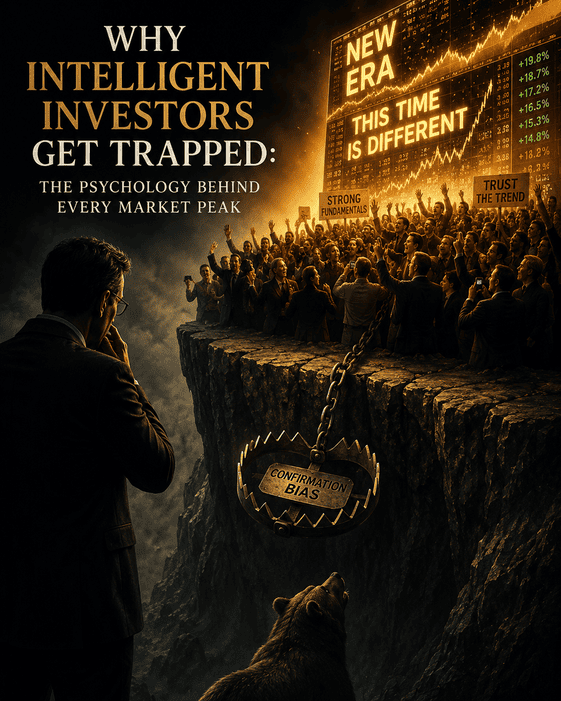
Why Intelligent Investors Get Trapped: The Psychology Behind Every Market Peak
June 30, 2026
The greatest losses in financial history have rarely been caused by ignorance. More often they have been suffered by intelligent investors who understood the risks, recognised the warning signs and still found themselves fully invested when the cycle finally turned. That paradox sits at the heart of every speculative boom. If bubbles were driven solely by uninformed investors, they would never grow large enough to threaten the financial system. Instead, they expand because experienced professionals, seasoned fund managers and disciplined private investors gradually begin behaving like the crowd they once criticised. The real puzzle is therefore not why naïve investors chase rising markets but why intelligent investors repeatedly abandon the very disciplines that made them successful.
The answer lies in the way markets reshape incentives rather than beliefs. During the early stages of a bull market, discipline is rewarded because valuations remain reasonable and optimism is grounded in improving fundamentals. As the cycle matures, however, prices begin rising faster than underlying value. Investors who remain cautious initially appear prudent, but as gains accelerate, caution starts looking increasingly expensive.
Every week spent waiting becomes another week of underperformance. Every friend boasting about effortless profits becomes another reminder that discipline appears to be losing. The pressure builds slowly enough that most investors never notice their standards changing. They do not suddenly become reckless. Instead, they make a series of small compromises, stretching valuation assumptions a little further, accepting greater concentration, adding modest leverage or convincing themselves that one more position cannot materially increase risk. Each decision appears rational in isolation, yet together they produce portfolios that would have seemed unacceptably aggressive only months earlier.
This gradual erosion of discipline explains why intelligence alone provides remarkably little protection. Knowledge informs judgement, but incentives influence behaviour. When markets consistently reward risk-taking, the opportunity cost of remaining patient begins to feel greater than the risk of participating. Eventually, intelligent investors stop asking whether prices still reflect value and begin asking how much longer they can afford to remain cautious. That subtle change marks the beginning of the trap because the objective has shifted from preserving capital to avoiding the discomfort of watching others become richer.
The Crowd Doesn’t Change Reality. It Changes Incentives
This process is driven by one of the oldest features of human psychology: social proof. Throughout most of human history, widespread agreement increased the probability of survival. Groups generally recognised danger more effectively than isolated individuals, making conformity an adaptive strategy. Financial markets reverse that logic because prices anticipate rather than follow consensus. By the time nearly everyone agrees that markets can only move higher, much of the buying power that created those gains has already been deployed. Popularity no longer signals opportunity. It often signals saturation.
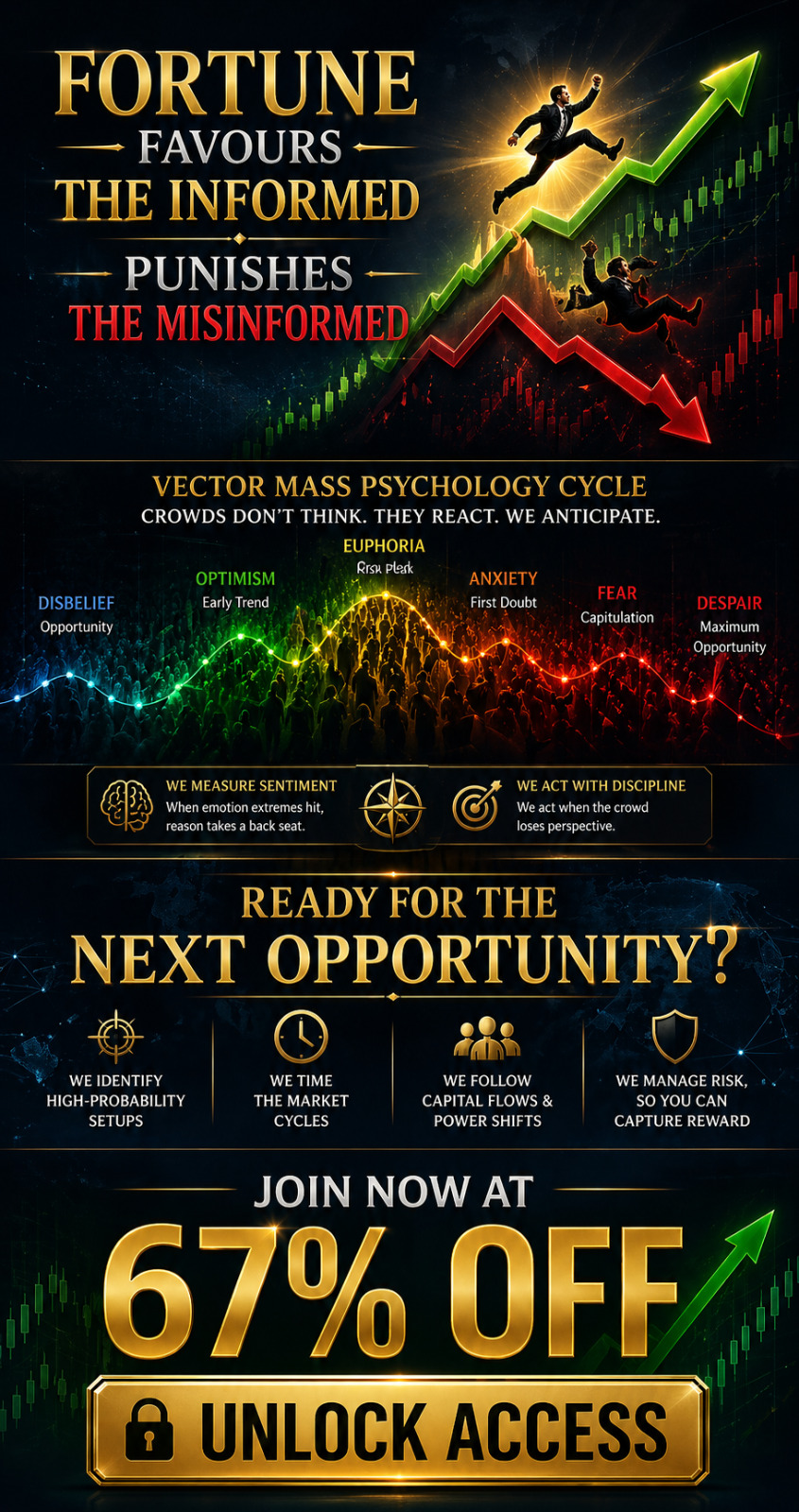
Yet our psychology struggles to recognise that reversal. Rising prices create confidence, confidence attracts additional participants and expanding participation reinforces the belief that the original thesis must have been correct. Every new investor appears to validate those who arrived earlier, producing a self-reinforcing cycle in which consensus becomes mistaken for evidence. The crowd does not merely influence expectations; it gradually reshapes incentives until remaining independent feels increasingly irrational.
Professional investors face an even stronger version of this pressure because their careers depend on relative rather than absolute performance. A fund manager who protects capital by avoiding an expensive market may still lose clients after several quarters of underperformance. Investors rarely reward managers for avoiding losses that have not yet occurred. They compare returns against benchmarks and competitors who continue benefiting from rising markets. As a result, institutions often participate in speculative excesses they privately recognise as dangerous because the career risk of being early outweighs the reputational risk of being wrong alongside everyone else. Herd behaviour therefore becomes embedded within the financial system itself, not because professionals fail to recognise bubbles but because institutional incentives encourage participation long after private conviction has weakened.
When Markets Stop Processing Information
One of the clearest signs that intelligent investors have become trapped is not found in valuation metrics but in the market’s relationship with information. Healthy markets continuously update expectations as new evidence emerges. Bullish developments support prices, while disappointing news forces investors to reassess future returns. The constant interaction between expectations and evidence allows prices to incorporate changing realities.
Late-stage bull markets behave very differently. Information no longer changes opinions because opinions have become fixed before the information arrives. Weak earnings become temporary setbacks. Tighter monetary policy becomes evidence that future easing is inevitable. Geopolitical instability becomes another buying opportunity because governments will supposedly provide additional stimulus. Slowing economic growth becomes bullish because lower interest rates are expected to follow. Every headline, regardless of its content, somehow reinforces the existing narrative.
The market has quietly shifted from discovering reality to defending belief. Investors are no longer evaluating evidence but searching for arguments that preserve existing positions. Confirmation bias, anchoring and overconfidence reinforce one another until contradictory information is dismissed almost automatically. This explains why speculative peaks often appear strongest immediately before they reverse. Confidence has become so complete that there are very few participants left capable of questioning the prevailing narrative. The market has not eliminated risk. It has simply stopped recognising it.
History repeatedly demonstrates that crashes rarely introduce entirely new information. More often they force investors to acknowledge evidence that had already been accumulating beneath the surface. Financial crises therefore appear sudden only because markets spent months, and sometimes years, rationalising away developments that eventually became impossible to ignore.
Preparation Beats Prediction
Recognising these psychological dynamics does not mean attempting to predict the precise moment the market will peak. That level of precision remains beyond the reach of even the most accomplished investors. The objective is far simpler and considerably more practical: recognise when conviction has become excessive and ensure that portfolio construction reflects changing probabilities rather than expanding optimism.
Preparation begins with maintaining optionality. As valuations become increasingly detached from long-term fundamentals, investors should gradually reduce exposure to positions whose future returns depend upon ever-higher valuations rather than improving business performance. That does not require liquidating an entire portfolio or abandoning long-term investments. It usually means trimming oversized winners, reducing leverage and allowing cash balances to rise naturally as attractive opportunities become increasingly scarce. Cash should not be viewed as idle capital. It represents future purchasing power that becomes exceptionally valuable when widespread optimism eventually gives way to widespread fear.
The same philosophy applies to research. Intelligent investors use the final stages of bull markets to prepare for the next cycle rather than extending the current one. They identify exceptional businesses, estimate intrinsic value, establish desired entry prices and patiently wait for volatility to create opportunities that enthusiasm previously eliminated. Their objective is not to maximise gains during the final months of a speculative advance but to preserve the flexibility required to exploit the opportunities that emerge once sentiment reverses.
This approach almost always feels premature because discipline carries an immediate psychological cost. Investors who reduce exposure typically watch markets continue rising for some time afterwards, creating the uncomfortable impression that caution was unnecessary. That discomfort should not automatically be interpreted as evidence of poor judgement. More often, it represents the premium paid for avoiding decisions that become far more expensive once optimism reaches its inevitable limits.
The Exit Always Feels Too Early
Every generation believes its bull market is fundamentally different because every generation experiences new technologies, new financial innovations and new explanations for why traditional valuation methods supposedly no longer apply. Yet beneath those changing narratives, the psychological structure remains remarkably consistent. Confidence gradually expands into conviction, conviction hardens into certainty and certainty quietly transforms strength into fragility. By the time investors begin asking what could possibly go wrong, they have usually stopped asking whether current prices already assume everything will continue going right.
The investors who survive multiple market cycles understand that markets rarely punish optimism. Optimism encourages participation in productive businesses and long-term wealth creation. What markets consistently punish is certainty. Certainty removes caution precisely when caution offers the greatest value because it convinces investors that future outcomes have become more predictable than they truly are. The objective is therefore not to forecast the exact market peak but to recognise when collective confidence has become so complete that uncertainty is no longer being priced.
That is why intelligent investors still get trapped. Their mistake is not a lack of knowledge or analytical ability. It is allowing prolonged success, social reinforcement and institutional incentives to gradually replace independent judgement with collective conviction. By the time they recognise they are defending beliefs instead of evaluating evidence, the trap has already been set. Those who leave a little earlier than everyone else may sacrifice the final stage of the advance, but they preserve something far more valuable than a few additional percentage points of return: the capital, flexibility and psychological independence needed to seize the opportunities that always emerge after certainty gives way to reality.

Insights Worth Your Time