
METC Stock: When Mirages Pass for Truth
Jan 26, 2026
A market does not collapse because of a single fact. It collapses because a story loses its spell. METC lived inside that spell for months, fed by a rally that felt unstoppable, reinforced by charts that curled upward with the confidence of a chosen stock. The move was not irrational. It was the kind of momentum that seduces even the disciplined. Coal margins improved, metallurgical prices held steady, and the transition narrative toward rare earths promised a fresh identity that seemed built for a world trying to escape China’s chokehold. Every ingredient for a runaway move sat in place. Then reality arrived, quiet at first, then sharp, then unforgiving.
METC’s arc shows how a mirage can look like fact when the crowd is thirsty enough. And how fast that vision turns into heat distortion once sentiment snaps. This is not about one company. This is about the physiology of a rally, the anatomy of a collapse, and the strange way traders mistake acceleration for destiny.
The Shape of the Rise: Why METC Started Moving Like a Chosen One
Metallurgical coal is not glamorous, but steel still rules the physical world. METC rode a clean set of fundamentals early in its move. Demand for steel held steady, supply disruptions pushed spot prices higher, and miners with leaner cost structures looked attractive. METC ranked among them. It posted strong shipments, expanded operations, and carried a balance sheet that, while not shining, was not diseased either. The crowd wants simplicity, and for a while, the story delivered.
Then came the rare earth pivot. That was the accelerant.
The shift from pure coal producer to a hybrid company targeting magnetic-grade critical minerals landed at the perfect moment. The world fixated on Chinese export controls, strained supply chains, and the geopolitical premium placed on independence. The United States needed alternative sources. Investors wanted new winners. METC claimed it could supply part of that future, and even a small chance of success was enough to spark imagination.
Momentum caught fire. Every rally needs a story behind the candles, and the rare earth angle became that story. Rallies do not survive on data alone. They require narrative, drama, and a promise that tomorrow will look nothing like yesterday. METC provided all three. The price expanded because the narrative expanded. Traders saw a coal company turning into a future-minerals play, a laggard becoming a leader, a small outfit stepping into a global gap. When the story grows faster than the numbers, the chart becomes a mirror for the crowd’s expectations, not the company’s reality.
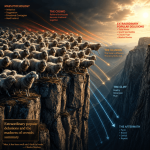
The move from under ten dollars to the high teens felt smooth at first, then aggressive. Volume expanded. Breakouts held. Pullbacks stayed shallow. This is the classic signature of narrative-driven strength. It is how the crowd builds its cathedral. Every candle becomes a vote. Every breakout becomes scripture. The herd stops asking “what is true” and starts chanting “what must be true.”
How Technicals Reinforced the Mirage
Charts do not just reflect price. They reflect belief. METC flashed every technical pattern that confirms belief. Higher lows formed a staircase that looked engineered. Moving averages opened like a fan that signaled healthy trend strength. Momentum indicators built clean waves without distortion. Funds and algorithms saw the pattern, joined the move, and strengthened the illusion of stability.
The first phase of a rally feels rational. The second phase feels inevitable. The third phase feels holy. METC crossed all three phases. In the third phase the chart stops being a diagnostic tool. It becomes a stage. Traders project every dream onto it. Anyone who questioned the trajectory sounded like a pessimist who could not see the “new direction.” When a chart behaves this well for this long, traders mistake precision for prophecy and that is how mirages win.
The First Crack: Earnings That Could Not Carry the Weight
The collapse began with something plain. Losses widened. Earnings missed. Expectations outran operational reality. While the story moved toward minerals, the balance sheet remained tied to coal, and coal economics do not care about narratives. They care about margins, shipping rhythms, pricing bands, and production discipline.
The market wanted METC to transform, but transformation requires capital, stability, and timing. You cannot pivot on hope alone. You need financial muscle to withstand delays and setbacks. METC did not show that muscle. The promises ran ahead of the profits. The future kept drifting away from the present.
When the earnings report hit, the first wave of believers paused. Momentum does not forgive pauses. It moves from acceleration to friction very fast. Breakouts failed. Volume shifted. The candles lost their uniformity. Traders who rode the rally for technical reasons saw the trend fracture and headed for the exits. This is the moment when the mirage loses color. The crowd sees it. The crowd senses it. The crowd runs.
The Collapse: From Confidence to Dislocation
The decline was anything but random. It followed the familiar anatomy of every momentum unwind, beginning with an earnings disappointment that triggered the first wave of stop-loss selling before broader concerns accelerated the decline. Rising geopolitical tensions surrounding rare earth supply chains, escalating friction between the United States and China, and increased regulatory scrutiny combined to undermine the narrative that had fuelled the rally. The story that once made METC attractive suddenly worked against it as investors recognised they were still valuing a coal producer with an unproven minerals business rather than an established critical-minerals company.
As confidence faded, the technical picture deteriorated rapidly. Moving averages rolled over, key support levels failed with little resistance, and buyers who had eagerly chased the advance struggled to identify credible re-entry points. Strong trends are built on broad participation and orderly consolidation, while weaker rallies often contain little more than optimism and momentum. Once selling begins, those empty spaces quickly become air pockets, and prices fall far faster than they rose. When the chart lost its rhythm, the narrative lost its credibility.
This is the psychology of every momentum collapse. Crowds move from conviction to doubt and eventually to complete disengagement, leaving traders who bought near the highs scrambling to protect capital rather than defend their original thesis. They sell not because the business has necessarily failed, but because they fear becoming the liquidity for someone else’s exit. METC followed that pattern almost perfectly.
Why Chasing Kills: A Case Study in Market Psychology
Chasing is not a technical mistake but a psychological one because investors mistake price movement for information, assuming those who bought earlier possessed knowledge they lacked. That belief creates urgency, urgency suppresses scepticism, and the fear of missing out eventually overwhelms rational analysis.
METC demonstrated this progression with remarkable clarity. As momentum accelerated, investors stopped evaluating balance sheets, execution risk, and the practical challenges of transforming a coal producer into a critical-minerals business. Instead, they became captivated by the speed of the advance, allowing confidence generated by the crowd to replace independent judgement. Charts, however, record changing sentiment rather than create it, and when conviction evaporates they merely reflect the shift already taking place beneath the surface.
The result is a familiar cycle in which traders enter late, exit early, and mistake popularity for resilience. Momentum can carry prices well beyond fundamentals, but it cannot sustain them once belief begins to fade. The more disciplined investor therefore focuses less on the excitement surrounding the story and more on the assumptions required for that story to succeed. When continued gains depend on flawless execution, perfect timing, or increasingly optimistic expectations, caution becomes the more rational position. METC ultimately proved to be driven more by imagination than execution, and the market eventually recognised the difference.
The Mirage Effect: When Hope Looks Like Proof
Market mirages emerge when investors desperately want a new success story and every signal appears to confirm that desire. A compelling narrative, favourable technicals, accelerating momentum, and the absence of immediate setbacks combine to create the illusion that possibility has already become reality.
METC possessed every ingredient. It offered investors an escape from the traditional coal narrative, positioned itself within the rapidly expanding rare-earth story at a time of heightened geopolitical interest, and produced a technically impressive advance that appeared both early and transformative. Like many speculative rallies, the combination proved persuasive because strong momentum often resembles genuine fundamental improvement during its early stages.
The difference only becomes apparent under pressure. Durable trends strengthen as new information emerges, while narrative-driven rallies weaken once expectations are tested. METC failed that test because belief had advanced much faster than execution.
What METC Really Shows: Hope Is Not a Catalyst
METC continues to operate, produce coal, and pursue its minerals strategy. What disappeared was not the business but the conviction that the transition would be smooth, rapid, and transformative. Markets eventually recognised that hope cannot generate earnings, ambitious plans cannot finance capital expenditure, and vision alone cannot replace measurable progress. Investors were pricing certainty while the company could only offer possibility, and when that distinction became impossible to ignore, the rally inevitably gave way to reality.
Lessons for Traders Who Prefer Survival to Excitement
METC’s rise and collapse offers several lessons for investors drawn to momentum and narrative-driven stocks. The first is never to confuse narrative expansion with business expansion because when the story grows faster than revenue, you are trading sentiment rather than value. Momentum can amplify gains while the crowd remains convinced, but once that conviction begins to fracture, technical strength usually disappears with surprising speed. Every transformation story also requires financial resilience because companies cannot reinvent themselves without sufficient capital to absorb setbacks, delays, and inevitable execution risk.
Perhaps the most expensive mistake, however, is chasing price rather than opportunity. Most traders understand the dangers of buying late, yet fear of missing out repeatedly overrides discipline, encouraging investors to mistake popularity for validation. Strong technicals can reinforce that illusion, but an attractive chart is no substitute for improving fundamentals, particularly when expectations have already become unrealistic. The risk becomes even greater when a company sits at the intersection of multiple speculative narratives because geopolitical uncertainty, regulatory changes, or shifting sentiment can unwind those expectations far faster than operational progress can rebuild them.
Ultimately, markets reward discipline rather than desire. Crowds naturally gravitate towards the stories that promise the greatest rewards, only to reverse course when confidence begins to weaken. METC simply compressed that familiar psychological cycle into a remarkably short period, demonstrating once again that sentiment can lift prices much faster than fundamentals, but it can also abandon them with equal speed.
Conclusion: Mirages Last Until Reality Arrives
METC is neither a villain nor an isolated case study. It illustrates what happens whenever emotion outruns patience and expectation outruns execution. Market mirages become dangerous because investors mistake direction for durability, assuming momentum alone can sustain a rally long after the underlying assumptions deserve closer scrutiny. Yet every lasting advance ultimately requires more than optimism. It requires execution, financial strength, and measurable progress capable of supporting increasingly ambitious expectations.
METC serves as a reminder that investors rarely lose because they lack intelligence. More often, they lose because they allow conviction to replace discipline, momentum to replace analysis, and excitement to replace evidence. In markets, as in the desert, the mirage almost always appears before the water, and those who mistake the illusion for reality inevitably discover the difference too late.