
FOMO Selling: How Loss Aversion Turns Fear Into Opportunity
Sept 10, 2026
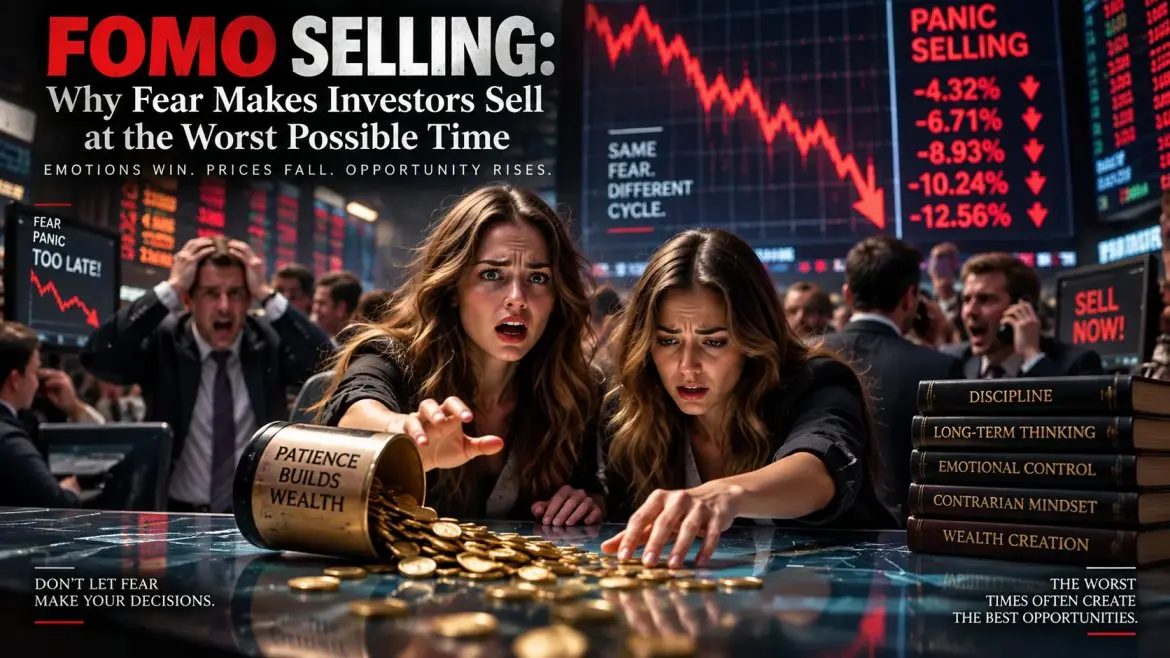
FOMO is normally associated with buying because investors fear missing the next big move, but there is another form of FOMO that becomes far more destructive when markets turn downward. It appears when investors become afraid of missing their last chance to escape, and that fear can transform an ordinary decline into a psychological stampede as each successive drop convinces more people that they must sell immediately.
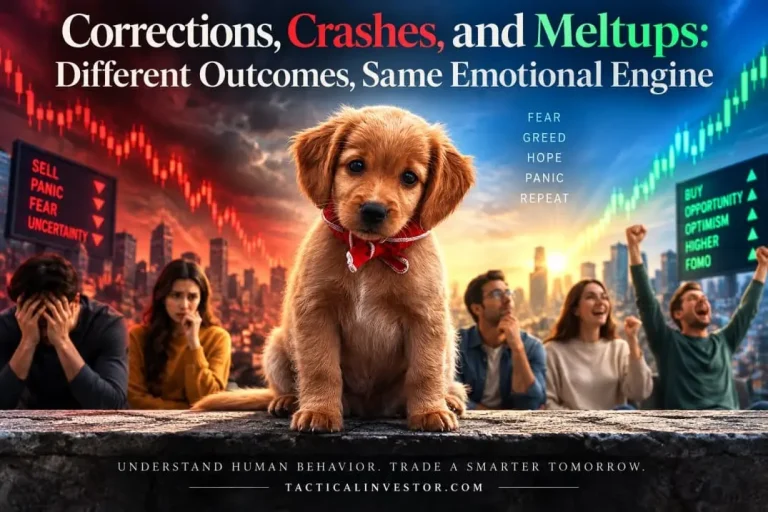
The underlying force is loss aversion, the tendency to experience losses more intensely than equivalent gains, and once that instinct spreads through a crowd it becomes something larger than individual psychology. Investors stop asking what an asset is worth and start asking what everyone else is doing, which is where herd behaviour begins to overpower independent judgment and mass psychology starts driving the market.
The critical question is therefore not simply, “Why is the stock falling?” The more important question is whether the falling price reflects a genuine deterioration in value or whether emotional selling has become the dominant force moving price, because that distinction determines whether a falling market represents danger or opportunity.
Loss Aversion Creates the First Wave
Loss aversion is one of the most powerful forces in financial markets because investors do not experience price movements in a purely mathematical manner. A position that was purchased at $100 and falls to $80 does not merely represent a 20% numerical decline, because the investor begins to think about the money already lost, the possibility of further losses, and the psychological pain associated with being wrong.
That discomfort changes behaviour. Instead of evaluating earnings, cash flow, competitive position, valuation, and long-term prospects, the investor becomes increasingly focused on avoiding additional pain, and selling appears to provide immediate psychological relief even when the underlying investment thesis has not materially changed.
This is where emotional selling begins. The investor sells because the price is falling, and then feels temporarily safer because the position is gone. The problem is that thousands or millions of investors can experience the same psychological reaction simultaneously, turning an individual desire for safety into a collective force capable of pushing prices dramatically lower.
Herd Behaviour Turns Fear Into Mass Psychology
Markets are social systems as much as they are financial systems. Investors watch prices, headlines, analysts, social media, economic data, and one another, which means that fear does not remain isolated when the market begins moving sharply in one direction.
One investor sees another investor selling, interprets that selling as information, and sells as well. The next investor sees both actions and reaches the same conclusion, creating a feedback loop in which falling prices become the evidence used to justify further selling.
This is herd behaviour. The crowd does not need to be correct for the crowd to become powerful. It only needs to become sufficiently synchronized, because once enough participants respond to the same fear, their combined actions begin changing the market itself. This is the essence of mass psychology in financial markets. The crowd creates the behaviour it is reacting to.
Vector Psychology: What Actually Changed?
This is where vector psychology becomes more useful than simply labeling a market “bullish” or “bearish.” A market vector represents the dominant directional force produced by the interaction of buyers, sellers, liquidity, expectations, valuation, and psychology. When fear begins overwhelming confidence, the vector shifts, and that shift can occur before the underlying fundamentals have fully reflected the change in sentiment.
The important question is therefore not merely whether price is declining. It is whether the force behind the decline is strengthening, weakening, or approaching exhaustion. A decline driven by deteriorating earnings, collapsing cash flow, excessive leverage, or permanent impairment is fundamentally different from a decline driven primarily by forced liquidation, fear, leverage unwinding, and indiscriminate selling. Both can produce a falling chart, but they create very different investment opportunities.
This distinction is frequently ignored because investors confuse price movement with fundamental reality. Price tells you what the crowd is doing at a particular moment, while valuation attempts to determine what the underlying asset may actually be worth.
When Emotional Selling Disconnects Price From Value
This is where the opportunity appears. Fear can become so intense that investors stop distinguishing between good companies and bad companies. Funds may reduce exposure across entire sectors, leveraged investors may be forced to liquidate, individuals may sell simply because everyone around them is selling, and negative headlines can reinforce the perception that prices must continue falling.
At that point, price can move considerably faster than value. That does not mean every falling stock becomes a bargain. A declining company can continue declining because its intrinsic value is also deteriorating, and buying simply because something has fallen 50% is not contrarian investing.
The opportunity exists when emotional intensity becomes disproportionate to fundamental deterioration. When fear becomes extreme while the underlying business remains economically viable, the gap between price and reasonable value can become unusually large. That is the dislocation the disciplined investor wants to identify.
Capitulation Is the Psychological Turning Point
Capitulation represents something different from an ordinary decline because it reflects exhaustion within the selling process. Investors who were willing to tolerate losses have finally reached their psychological limit, and the desire to eliminate uncertainty becomes stronger than the desire to preserve long-term exposure.
Volume can surge, volatility can become extreme, and prices can move violently as investors abandon positions with little regard for valuation. Headlines often become most frightening around these periods because the emotional narrative tends to become most convincing precisely when the crowd is most distressed.
Capitulation does not guarantee that the exact bottom has arrived. It does, however, tell us something important about the psychology of the market because extreme selling can indicate that a large portion of the fearful population has already acted.
This is why the concept of a selling climax matters. The objective is not to predict the precise low tick, but to recognize when emotional liquidation has reached an extreme and then determine whether the evidence supports the beginning of stabilization.
Technical Analysis Reveals the Behaviour
Technical analysis becomes useful here when it is treated as a method for observing behaviour rather than a collection of magical buy and sell signals. RSI can reveal when downside momentum has become unusually stretched. Stochastic indicators can identify extreme short-term conditions, while volume can show whether selling intensity is expanding or beginning to exhaust itself. Moving averages, breadth, and momentum can then help determine whether the broader market vector remains decisively negative or is beginning to stabilize.
None of these indicators can tell you with certainty that the bottom is in. Their real value is that they provide additional evidence about the behaviour of the crowd. The technical picture becomes particularly interesting when extreme selling is accompanied by improving momentum, stabilization in breadth, or a failure of additional negative news to generate proportionate downside. That combination can suggest that the psychological force responsible for the decline is losing strength.
The Contrarian Investor Does Not Fight the Crowd Blindly
Contrarian investing is often misunderstood as doing the opposite of whatever everyone else is doing. That is not contrarianism. It is simply reflexive opposition, and markets can remain irrational far longer than an investor can remain solvent.
The disciplined contrarian instead asks why the crowd is moving, whether the underlying thesis has changed, and whether the emotional response is proportional to the fundamental reality. If the fundamentals have genuinely deteriorated, selling may be rational regardless of how frightened the crowd appears.
But if the fundamental damage is limited while fear has become extreme, the crowd may be creating an opportunity precisely because it is acting on emotion rather than valuation.
This is where patience becomes an investment advantage. You do not need to catch the exact bottom, and you do not need to prove that the crowd is wrong immediately. You need enough liquidity, discipline, and analytical clarity to act when the relationship between price and value becomes unusually favourable.

Getting Paid While You Wait
There is also a strategic way to approach extreme selling without immediately committing all available capital. For investors who genuinely want to own a particular stock at a lower price, selling a cash-secured put can provide a way to get paid while waiting. If the stock remains above the strike, the premium is retained, while assignment provides an opportunity to acquire shares at the strike price with the premium reducing the effective entry cost.
This fits naturally into a psychology-based framework because the investor is not being forced to chase the market. Instead, the investor establishes a price at which ownership makes sense and allows the market to come to that price.
The principle is simple: get paid to enter, get paid while holding, and get paid to sell. The strategy still requires valuation discipline and an underlying company that the investor genuinely wants to own, because option premium does not transform a poor business into a good investment.
The Real Cost of Emotional Selling
The greatest damage from FOMO selling is not always the loss taken on the original position. The larger cost can be selling during maximum fear and then remaining outside the market when psychology begins to normalize. An investor who sells at $70 after buying at $100 may feel safer, but if the stock eventually recovers to $110, the investor has converted temporary emotional discomfort into a permanent loss and then faces the psychological problem of deciding whether to buy back at a higher price.
This creates another behavioural trap. The investor who sold because of fear often waits for confirmation that the market is safe before returning, but by the time safety feels obvious, prices may already have recovered substantially.
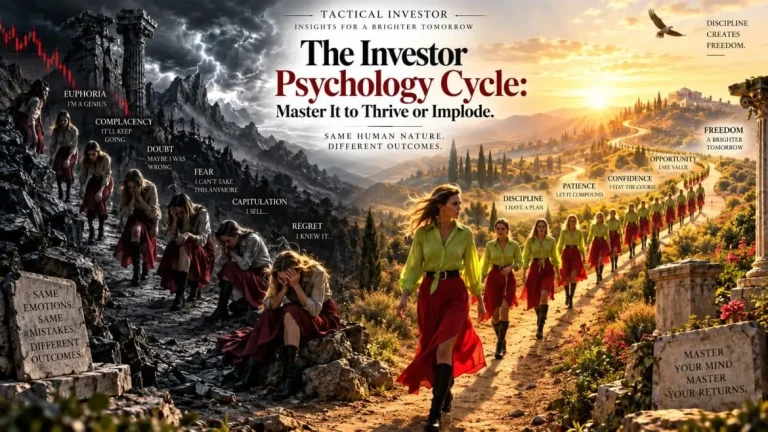
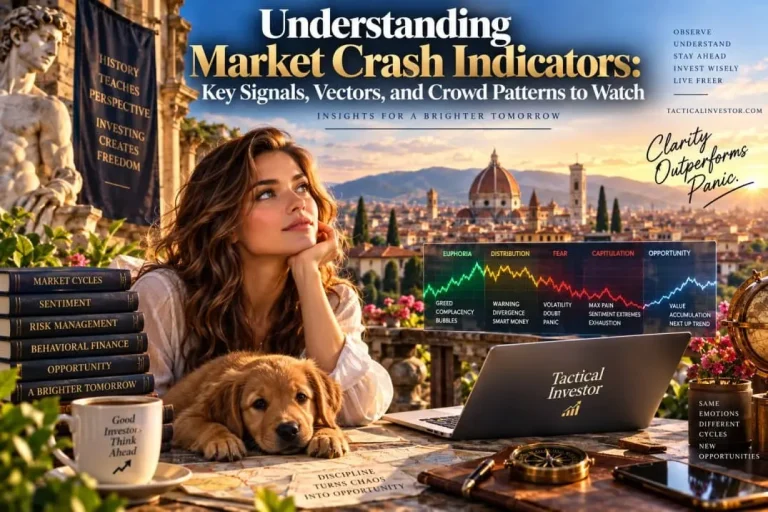
The cycle therefore becomes predictable: confidence produces complacency, falling prices produce fear, fear produces selling, selling produces capitulation, and eventual recovery produces regret among those who exited at the emotional extreme.
The Steadfast Investor
The objective is not to eliminate emotion because that is impossible. The objective is to prevent emotion from becoming the decision-making mechanism. When prices fall sharply, separate the price vector from the value vector. Ask whether the business has genuinely deteriorated, whether the crowd is reacting disproportionately, whether selling pressure is accelerating or exhausting itself, and whether the valuation now compensates for the risks that remain.
That framework changes the meaning of a market decline. A falling market is not automatically a buying opportunity, just as a rising market is not automatically a reason to sell. The opportunity emerges when mass psychology becomes extreme enough to create a meaningful disconnect between what investors are willing to pay and what a fundamentally sound asset may reasonably be worth.
Conclusion: Understand the Crowd, Not the Fear
FOMO selling is ultimately a story about human behaviour. Loss aversion creates the emotional pressure, herd behaviour spreads that pressure, mass psychology amplifies it, and the resulting selling can shift the market vector far beyond what fundamentals alone would justify.
Capitulation is where the process becomes particularly interesting because emotional exhaustion can create the conditions for price and value to separate dramatically. The investor who understands this process does not blindly buy every collapse, but watches for the point where fear becomes excessive, selling begins to exhaust itself, and quality assets are offered at prices created more by emotion than by rational valuation.
That is the real advantage of vector psychology. You are not trying to predict the future; you are trying to understand the force moving the present. The crowd will always experience fear, greed, loss aversion, and the urge to follow. The disciplined investor learns to recognize those forces before acting on them, because when emotional selling disconnects price from value, the crisis that terrifies the crowd can become the opportunity that rewards the prepared.