
China’s Agricultural Electrification: The Structural Shift Away From Diesel
Sept 18, 2026
The Chongqing Combine: A Small Machine With a Larger Economic Signal
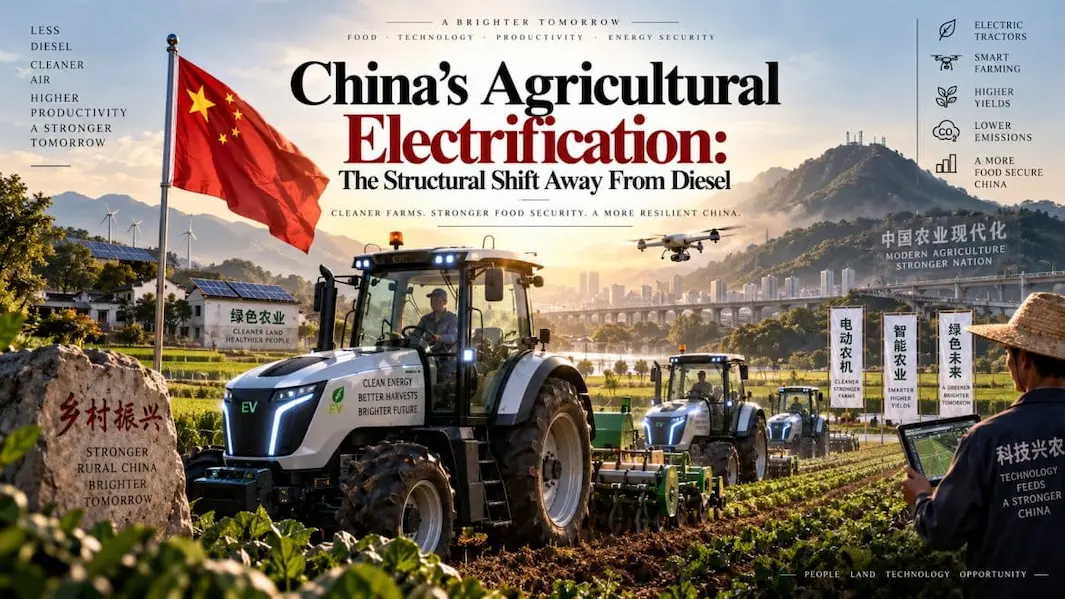
The reported Chongqing electric rice-and-wheat combine deserves attention because harvesting is a demanding real-world application, not a laboratory demonstration involving a small cultivator. The machine reportedly uses a battery of approximately 14 kWh, operates for around five hours, harvests roughly 8–10 mu, and costs about ¥7 for a full recharge under the reported local conditions. If the comparison of less than ¥1 per mu in electricity against ¥14–¥20 per mu in diesel expenditure is representative of suitable applications, the operating-cost advantage is substantial, although it does not establish that electric farming as a whole is 95% cheaper.
The distinction matters because energy expenditure is only one component of the economics, alongside purchase price, depreciation, financing, maintenance, battery replacement, labour, insurance and charging infrastructure. Yet fuel is a recurring cost, and a machine used repeatedly over many seasons can accumulate meaningful savings if battery durability and utilization hold up. The important signal is therefore not that electric machinery has already won every agricultural application, but that some operations may be approaching a point where diesel’s established cost advantage begins to weaken.
Electrification Will Advance Through Applications, Not a Sudden Replacement
The popular narrative often asks whether electric tractors can replace large diesel machines across China’s agricultural sector, but that framing overlooks how technological transitions usually develop. Smaller farms, orchards, greenhouses, repetitive operations and machinery with predictable duty cycles may be easier to electrify than heavy equipment working continuously across large fields, where battery weight, energy density, charging time and utilization create genuine constraints. A systematic rview of electric tractor economics similarly identifies the potential for lower operating costs while recognizing purchase prices and battery limitations as barriers to broader adoption.
The likely progression is therefore selective, moving from applications where the economics already work toward machinery requiring greater power, longer operating windows and more demanding infrastructure. Small electric equipment can establish demand, specialized harvesters can expand the range of practical uses, and charging or swapping networks can reduce the downtime that limits adoption. The strategic question is not whether every diesel tractor will disappear, but how quickly the range of agricultural work that can be performed economically with electricity expands.
Battery Swapping Could Solve the Downtime Problem
Agriculture operates under constraints that ordinary electric-vehicle comparisons can overlook, because planting and harvesting often depend on narrow weather windows and machinery cannot always sit idle while batteries recharge. A depleted combine during a critical harvest period can impose a cost far greater than the electricity required to operate it, making energy replenishment and machine utilization central to the economics. Battery swapping offers one possible solution by allowing equipment to exchange depleted batteries for charged units, while the removed batteries recharge separately.
Research is examining swapping systems designed for agricultural machinery, including coordinated tractor operations and the interaction between swapping infrastructure and electricity networks. Other work explores rural energy-service models combining charging, battery swapping, distributed renewable energy and battery leasing, potentially allowing farmers to use machinery without independently financing and managing every battery. See research on agricultural battery swapping and integrated rural agricultural energy systems.
This opens the possibility of separating ownership of the machine from ownership of its energy-storage system, with farmers purchasing or leasing equipment while a service provider manages battery availability and replenishment. Such a model could reduce upfront capital requirements and improve utilization, although its success would depend on battery standardization, station coverage, logistics and the economics of maintaining spare batteries. The infrastructure could become as consequential as the machinery itself.
The Larger Disruption May Be Autonomous Electric Machinery
The conventional model of mechanized farming concentrates substantial power in a large diesel tractor operated by one person, but electrification may eventually support a different arrangement involving several smaller machines working under coordinated control. Smaller electric equipment can be easier to replenish, may operate shorter cycles, and could return automatically to charging or swapping stations, while autonomy may allow machines to work with less direct human supervision. Research into fully electric farming with on-field energy replenishment examines how addressing the energy-replenishment problem can improve the operational viability of electric agricultural systems.
The potential shift is not simply from one diesel tractor to an electric version of the same machine, but from a single large machine and operator toward coordinated fleets of smaller electric equipment. That model is not yet a universal replacement for conventional machinery, particularly in demanding field conditions, but it changes the long-term question from whether batteries can replicate diesel horsepower to whether a different operating architecture can deliver comparable productivity at a lower total cost. Technological disruption often occurs when the system changes, rather than when the incumbent product is copied perfectly.
The Real Economic Story Is Reduced Exposure to Petroleum
China’s agricultural sector remains exposed to diesel through tractors, combines, pumps, transport vehicles and other machinery, so it would be inaccurate to suggest that electrification has already insulated Chinese farmers from oil-price shocks. The structural opportunity is that electric equipment can shift some recurring energy demand from petroleum toward electricity produced through China’s wider domestic power system. That electricity can come from coal, hydro, nuclear, wind and solar, although the precise emissions and energy-security benefits depend on the generation mix, grid conditions and how the equipment is operated.
Electrification can potentially reduce direct diesel purchases, exposure to oil-price volatility, engine servicing and some maintenance requirements, while automation may eventually reduce labour demands in selected operations. These savings must be weighed against battery costs, equipment prices, infrastructure and replacement cycles, rather than assumed to arrive automatically. Earlier research on the economics of converting diesel agricultural tractors to electric power likewise finds that lifetime economics depend on assumptions such as electricity prices, battery costs and machinery utilization.
The strategic implication is gradual rather than immediate: each viable conversion reduces petroleum demand at the margin, while widespread adoption would be needed before the effect became significant at the national level. China’s battery manufacturing capacity, electric-vehicle supply chains and broader power infrastructure may support this transition, but industrial capacity alone does not guarantee that every agricultural application will become economical. Adoption will ultimately depend on whether the machinery performs adequately and delivers a compelling lifetime cost.
The Investment Opportunity Extends Beyond the Tractor
The largest mistake would be to treat agricultural electrification as a narrow contest between diesel and electric tractor manufacturers, because the transition potentially involves machinery, batteries, power systems, software and energy services developing together. Specialized electric harvesters and cultivators may create initial demand, while charging networks, swapping stations, battery leasing and centralized energy management could determine whether those machines are practical at scale. If autonomous fleets become commercially viable, the supporting systems could expand further into robotics, coordination software and integrated farm-energy infrastructure.
The opportunity is therefore an ecosystem rather than a single product category, but the distinction between technological possibility and investable value remains essential. A company can participate in a promising transition and still be a poor investment if its valuation already assumes rapid adoption, margins remain weak, or the business lacks a defensible position in the supply chain. The relevant analysis must identify which companies capture recurring revenue, which merely sell equipment into a competitive market, and which depend on adoption rates that have yet to be demonstrated.
The Boundary Between Diesel and Electricity Is the Key Metric
The most useful question is not how many electric tractors China has today, but which agricultural operations have reached the point where electricity is both cheaper and operationally practical than diesel. Once that boundary moves through a category of machinery, adoption can reinforce itself through lower operating costs, greater production scale, improved infrastructure and better equipment, although the process can stall where batteries, downtime or upfront costs remain prohibitive. The Chongqing combine is interesting because its reported operating-cost comparison suggests that this boundary may already be moving in at least some applications.
The central shift is not simply that electric tractors are coming, but that diesel may be becoming economically unnecessary for a growing range of agricultural tasks. As battery costs, machine efficiency, swapping infrastructure and autonomous systems improve, the territory in which diesel remains the obvious choice could gradually contract, even if heavy-duty machinery continues to rely on conventional fuels for years. The long-term significance lies in agriculture becoming more deeply integrated with China’s electrification, automation and domestic-energy systems, not in the premature claim that diesel farming is about to disappear.

Other Articles of Interest