

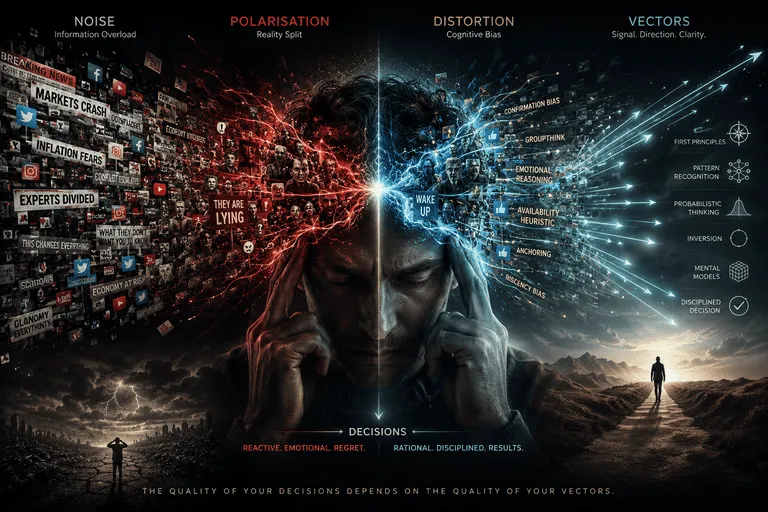
How Polarisation Distorts Information Processing and Decision-Making
Aug 23, 2026
The shift toward vector thinking did not emerge from theory or from an attempt to create another analytical framework with a more sophisticated name; it came from watching how quickly ordinary discussion can deteriorate into conflict, how rapidly information becomes secondary to identity, and how little of the resulting noise actually improves the quality of anyone’s decision-making. Polarisation has always existed, but it once had clearer boundaries, allowing people to disagree, step away and continue functioning without carrying the emotional residue of every argument into every other part of their lives, whereas that boundary has gradually weakened and been replaced by a near-constant state of reaction in which almost every issue appears to demand alignment before understanding.
That shift matters because it changes the way information is processed, particularly when the surrounding environment becomes emotionally charged enough for facts to stop being evaluated primarily on their own merits and instead become filtered through the identity, loyalties and assumptions of the person receiving them. Once the line between aligned and opposed has been drawn, evidence that supports an existing position is more easily absorbed while evidence that challenges it encounters resistance, creating the appearance of engagement even when the process is little more than the reinforcement of views that were already in place, with the result being more noise, less clarity and decisions that feel increasingly certain despite resting on increasingly unstable ground.
What Is Vector Thinking in Market Analysis
Vector thinking developed as a way of stepping outside that trap by shifting attention away from the narrative surrounding an event and towards the direction, magnitude and pressure beneath it, asking where capital is moving, how quickly that movement is developing and what changes in behaviour are beginning to emerge before the commentary surrounding those changes becomes overwhelming. Rather than attempting to win an argument about what a particular event should mean, the framework focuses on what can actually be observed, measured and tracked over time, reducing the influence of commentary that invites division and replacing it with a structure capable of identifying movement even when the explanation for that movement remains uncertain.
The objective is not to eliminate interpretation, because markets are driven by human beings and any attempt to remove interpretation entirely would simply replace one distortion with another, but to prevent interpretation from becoming so emotionally dominant that it obscures the underlying pattern. In technical environments, similar approaches are used to translate sentiment, positioning and narrative into measurable signals precisely because raw opinion is too inconsistent to act upon, and the principle here is essentially the same: interpretation may still matter, but observable behaviour should carry more weight than the emotional confidence with which a particular narrative is being delivered.
Filtering Market Noise: Why Selective Attention Beats Constant Engagement
This is also why many high-profile events receive relatively little attention in our work, because Gaza, immigration enforcement, Venezuela and similar subjects carry enormous emotional weight while the modern news cycle continuously amplifies that weight, creating the impression that every major event must immediately become the centre of analysis even when its relevance to the market structure remains uncertain. Adding another layer of commentary to an already overcrowded conversation rarely improves understanding, particularly when millions of people are already arguing over the same facts from positions that were largely established before those facts were even examined, and in many cases it simply adds more volume to a system already struggling to distinguish information from emotional reinforcement.
The decision to step around such topics is therefore not indifference but prioritisation, because if an event begins to alter a trend, changes the behaviour of capital or signals the emergence of a structural shift that can influence markets, it becomes relevant and should be examined through that lens, whereas engaging with every emotionally charged development simply because it dominates the news cycle consumes attention that could be directed towards identifying changes with measurable consequences. Markets do not reward participation in every conversation, and the investor who attempts to remain emotionally current with every crisis may discover that constant engagement has left less room for the slower, more demanding work of separating temporary noise from genuine structural change.
There is also a secondary effect that receives far less attention than it deserves, because constant exposure to emotionally charged information gradually alters behaviour even when the individual believes he remains unaffected, fragmenting attention, shortening reaction time and eroding the patience required to distinguish between something that feels urgent and something that actually matters. This is not primarily a moral problem but a functional one, because once focus begins deteriorating, decisions become increasingly driven by immediacy rather than structure, and even highly capable individuals can find themselves reacting to the intensity of the moment instead of examining the forces that will still matter after the emotional temperature has fallen.
Investor Sentiment Analysis: Measuring Behaviour Instead of Absorbing Narrative
Going forward, the framework remains deliberately simple: facts come first, structure takes priority over narrative and emotion is acknowledged without being allowed to dominate the process whenever that can be avoided, with the understanding that perfect execution is impossible because the system is operated by human beings rather than machines. The objective is not perfection but consistency, because repeated exposure to the same analytical discipline gradually makes it easier to recognise when an emotional vector is beginning to influence judgement and when a developing pattern deserves attention because the underlying behaviour supports it rather than merely because the surrounding narrative has become louder.
Vector analysis helps create that consistency by reducing dependence on interpretation and placing greater emphasis on observable changes in participation, liquidity and sentiment, which is closer to the mechanism through which markets actually move than the assumption that headlines alone determine direction. Sentiment can influence short-term market behaviour and can push prices beyond what underlying fundamentals might initially justify, but that influence becomes analytically useful only when it is measured as a behavioural force rather than absorbed as an emotional experience, because the investor who becomes caught inside the same sentiment he is attempting to analyse has already lost the distance required to interpret it clearly.
The intent is not to eliminate humour, personality or perspective, because analysis stripped of all human texture can become as sterile and detached from reality as the emotionally charged commentary it seeks to avoid; when satire appears, however, its purpose should be to release tension rather than manufacture more of it, allowing the reader to step back from the emotional intensity surrounding an event rather than becoming more deeply absorbed by it.
Ultimately, the market does not respond to whether an opinion is popular, morally satisfying or aligned with the dominant narrative of the day, because price responds to the interaction between pressure, positioning, liquidity and behaviour, all of which can continue moving in directions that contradict the explanation currently receiving the most attention. The closer an analytical framework remains to those underlying forces, while still recognising that human beings will never be entirely free from emotion or bias, the less likely it is to be pulled off course by noise that feels important in the moment but leaves little measurable trace once the emotional current has moved elsewhere.