
Corrections, Crashes, and Meltups: Different Outcomes, Same Emotional Engine
June 18, 2026
Most people believe markets move because of news. News matters, but usually as a trigger rather than the primary force. The deeper force is emotion, and more specifically, the crowd’s inability to deal comfortably with uncertainty.
Corrections, crashes, and meltups appear different on the surface, but they are all driven by the same emotional machinery operating under different conditions.
A correction begins when confidence becomes excessive.
Investors stop asking what can go wrong because recent success convinces them that risk has largely disappeared. Expectations begin rising faster than reality. When reality inevitably fails to keep pace with those expectations, prices adjust.
A crash follows the same emotional path, only with greater intensity.
Confidence disappears and fear takes its place. Investors who previously ignored risk begin seeing it everywhere. The same people who could not buy enough at elevated prices suddenly cannot sell fast enough at lower prices. The event changes, but the emotional pattern remains familiar.
A meltup is simply the opposite expression of the same force.
Investors watch prices rise and initially hesitate. Eventually fear shifts direction. Instead of fearing losses, they begin fearing exclusion. The fear of missing out replaces caution. Rising prices generate excitement, excitement attracts new buyers, and those buyers push prices higher still. Logic gradually loses influence as emotion gains control.
Beneath all three outcomes sits the same source of discomfort.
Uncertainty.
The crowd constantly seeks emotional relief from uncertainty. During corrections, relief comes from reducing exposure. During crashes, relief comes from escaping altogether. During meltups, relief comes from joining the herd.
The market merely records those emotional decisions in real time.
This becomes particularly important when analysing modern markets because many investors remain trapped inside the event itself rather than examining the emotional force behind it.
Consider recent years.
Political conflict intensified. Trade disputes expanded. Tariffs appeared. Geopolitical tensions increased. New crises emerged with remarkable frequency. Conventional analysis repeatedly suggested that markets should collapse under the weight of so much uncertainty.
Yet they did not.
That outcome confused many observers because they focused on events rather than emotional positioning.
The crowd became increasingly convinced that disaster was inevitable. Fear expanded. Uncertainty intensified. Bearish narratives multiplied. Ironically, the more certain investors became that markets had to fall, the less likely that outcome became.
The fear had already been discounted.
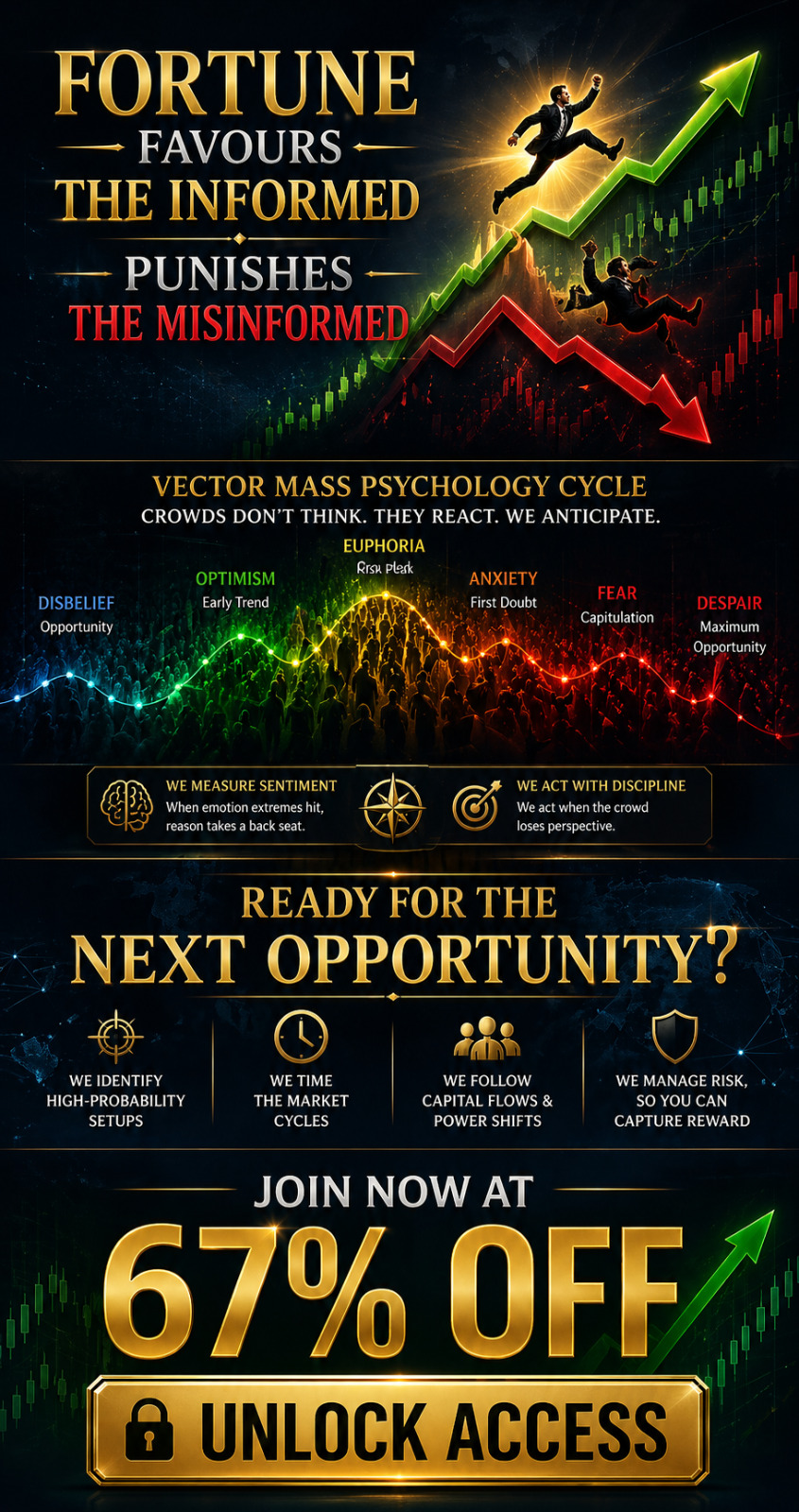
This is where Vector Mass Psychology diverges from traditional approaches.
Traditional analysis tends to focus on events. Vector Mass Psychology focuses on the direction, magnitude, and intensity of the emotional forces created by those events.
The event itself becomes secondary.
What matters is how investors respond to it.
If fear is already widespread, additional negative news may produce surprisingly little damage because the crowd has already adjusted emotionally. If optimism becomes excessive, even minor disappointments can trigger significant declines because expectations have drifted too far from reality.
The market frequently delivers outcomes that appear irrational precisely because investors focus on logic while ignoring emotional positioning.
Certainty often becomes the most dangerous emotion in the market.
When investors become convinced that conditions can only worsen, the seeds of a rally are often being planted. When investors become convinced that conditions can only improve, the foundations of a reversal are frequently taking shape.
This explains why fear often functions as fuel rather than a warning sign.
A true crash generally requires widespread optimism beforehand. The crowd must become comfortable. Confidence must become excessive. Risk must be ignored. Until that condition develops, bearish sentiment often provides support rather than danger.
That does not mean declines cannot occur. Corrections remain normal. Volatility remains normal. Uncertainty remains normal.
What matters is understanding the emotional engine driving them.
The investor focused exclusively on events spends life reacting.
The investor focused on sentiment spends life observing.
One follows the crowd.
The other studies it.
That distinction often determines who panics during uncertainty and who discovers opportunity inside it.