Vector Psychology: From Particles to Civilizations
Aug 7, 2026
Beyond Reductionism
Every discipline eventually encounters the same temptation. After discovering a successful explanatory model, it begins applying that model everywhere. Economists reduce society to incentives. Biologists reduce behaviour to genes. Psychologists reduce politics to cognition. Physicists occasionally reduce consciousness to quantum mechanics. Most of these attempts fail, not because the underlying sciences are wrong, but because explanation does not automatically scale across domains. A mechanism operating inside one system cannot simply be transplanted into another.
Rejecting causal reduction, however, does not require rejecting structural similarity. That distinction has quietly shaped the previous three essays. Physics does not explain psychology. Neuroscience does not explain financial markets. Artificial intelligence does not explain civilisation. Each system operates under its own constraints, governed by its own mechanisms and tested against its own evidence. Yet when viewed from sufficient distance, remarkably different systems often converge upon strikingly similar organisational principles. They solve different problems, but repeatedly arrive at comparable architectures because adaptation itself imposes recurring constraints regardless of scale.
This is where Vector Psychology begins. Vector Psychology is not another theory of personality, nor is it an attempt to force quantum mechanics into human behaviour. It is a framework for understanding how adaptive systems evolve, organise and change under pressure by asking a deceptively simple question.
When multiple possibilities compete inside a constrained environment, what determines the direction the system eventually takes? Notice the emphasis. The question is not what the system is or what it contains, but where it is moving.
Why Categories Eventually Fail
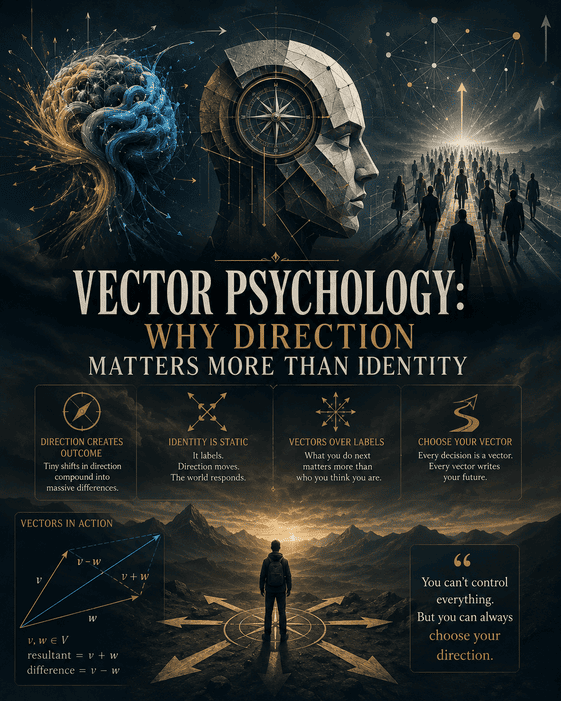
Traditional psychology tends to classify people. Introvert or extrovert. Conservative or progressive. Optimist or pessimist. Rational or emotional. These labels possess descriptive value, but they frequently mistake temporary equilibrium for permanent identity.
Markets expose the weakness of that approach every cycle. Investors described as disciplined become reckless near speculative peaks, lifelong pessimists become euphoric after prolonged advances and institutions celebrated for prudence embrace extraordinary leverage shortly before collapse. The labels remain fixed while behaviour continues to evolve, revealing precisely what vectors explain and categories cannot.
A vector contains both magnitude and direction, acknowledging movement rather than merely description. It assumes adaptive systems rarely remain static because incentives, information, constraints and feedback never remain static, which is why human beings are better understood as evolving trajectories than fixed collections of traits.
The same principle applies to crowds. One individual purchasing an overvalued stock tells us very little. Ten million individuals doing the same thing simultaneously tells us something profound, because somewhere between isolated decisions and collective behaviour a new level of organisation emerges. No participant consciously decides to create a speculative bubble, yet bubbles continue appearing with astonishing regularity throughout history. The South Sea Bubble, the railway manias, the Roaring Twenties, the dot-com boom, the housing bubble and the cryptocurrency cycles all differed in their assets, technologies and historical settings.
The vectors were remarkably similar. Money did not create those bubbles. It amplified psychological vectors already moving through society. Likewise, fear does not suddenly appear during financial crashes. It has always existed as a latent probability, suppressed while optimism dominated the informational environment. As confidence weakens, the probability distribution reorganises, and panic appears spontaneous only because observers mistake the collapse for the cause. More often, the collapse simply reveals forces that had been quietly accumulating beneath the surface for years.
Traditional analysis asks what happened. Vector analysis asks what direction the adaptive system had already begun taking before anyone noticed, treating the visible event as confirmation rather than origin.
The Architecture of Change
This perspective extends far beyond financial markets. Political revolutions rarely begin with the triggering event historians later celebrate because the assassination, election, protest or economic crisis usually functions as the catalyst rather than the cause. Beneath every apparent turning point lies a prolonged reorganisation of incentives, expectations, institutional trust and collective identity, so that by the time the visible event arrives the underlying vector has often become extremely difficult to reverse.
Religious movements display similar dynamics. They spread not simply because doctrines persuade people, but because they organise uncertainty into coherent narratives after older frameworks lose their explanatory power. Technological revolutions follow comparable paths. The internet succeeded not merely because it represented superior engineering, but because existing social, economic and informational vectors had already prepared civilisation for distributed communication.
Complexity science helps explain why different mechanisms repeatedly converge upon remarkably similar architectures. Researchers such as Ilya Prigogine demonstrated that systems operating far from equilibrium frequently generate entirely new forms of order rather than descending inevitably into chaos, showing that instability can become productive because pressure forces reorganisation. Likewise, John Holland’s work on complex adaptive systems showed how countless local interactions generate coherent global behaviour without requiring central coordination. Markets behave this way, languages evolve this way, biological ecosystems adapt this way and civilisations transform this way because the mechanisms differ while the underlying architecture remains remarkably familiar.
Attractors and Basins of Behaviour
Complex systems rarely wander through every possible state with equal probability. Instead, they tend to organise themselves around relatively stable regions known in dynamical systems as attractors, where countless local interactions repeatedly converge without requiring any central authority directing the outcome. An attractor does not determine every individual action, but it quietly shapes the direction toward which the system increasingly moves, making some futures progressively more likely than others.
Human societies appear to exhibit remarkably similar behaviour. Financial euphoria, political polarisation, institutional trust, social cooperation and collective fear often behave less like isolated events than temporary attractor states produced by millions of interacting decisions. Individuals retain freedom, yet the probability of particular collective outcomes changes dramatically once the surrounding architecture begins favouring one direction over another, allowing seemingly spontaneous social movements to emerge from long periods of gradual reorganisation.
Vector Psychology therefore concerns itself not merely with where a system is moving, but with the landscape through which it is moving, because different environments contain different attractors, and those attractors quietly reshape what becomes increasingly likely long before the outcome itself appears inevitable. Vectors describe movement, while attractors explain why that movement repeatedly converges toward recognisable forms instead of wandering indefinitely through every possible state, making direction and destination complementary rather than competing ways of understanding adaptive systems.
Patterns That Repeat Across Scale
Mathematics quietly reinforces the same pattern. Benoit Mandelbrot demonstrated that apparent irregularity often conceals deeper self-similarity across different scales. Coastlines, financial volatility and countless natural phenomena resist simple linear description because complexity frequently reproduces recognisable structures regardless of the level at which they are observed. Fractals do not suggest that everything is identical. They demonstrate that organisation itself often repeats despite dramatic differences in scale.
Human behaviour appears to exhibit something remarkably similar. Just as fractals reveal recurring organisational patterns without requiring identical forms, adaptive systems repeatedly generate familiar behavioural structures despite enormous differences in scale, participants and mechanism.
A family argument, corporate politics, an election campaign and international diplomacy all involve different participants, different institutions and dramatically different consequences, yet each represents adaptive systems attempting to reduce uncertainty while maximising survival under incomplete information. Once again, different mechanisms converge upon remarkably similar organisational solutions, and the same pattern continues revealing itself across scale.
Why Crowds Matter More Than Individuals
This is why crowds deserve far greater attention than they usually receive. Individuals reveal possibilities, whereas crowds reveal vectors. One person behaving irrationally tells us very little, but millions behaving irrationally at precisely the same moment almost always indicate that deeper adaptive forces have aligned beneath the surface. The crowd therefore becomes less a collection of opinions than a measurement instrument, not because the majority is necessarily correct, but because synchronised behaviour often exposes structural pressures that remain invisible at the level of isolated individuals.
This observation sits quietly at the heart of every major financial bubble, political movement and cultural shift, because by the time newspapers explain the visible event the underlying vector has usually been developing for years. Conventional analysis therefore mistakes confirmation for causation, explaining the spark while overlooking the conditions that made ignition increasingly likely.
Here the work of Daniel Kahneman, Carl Jung and Albert Bandura intersects despite emerging from entirely different disciplines. Kahneman demonstrated that judgement is shaped by systematic cognitive biases, Jung explored symbolic structures that repeatedly emerge across cultures and individuals, and Bandura showed how observation continually modifies behaviour through social learning. None proposed Vector Psychology, yet together they point towards a broader organisational principle in which human behaviour rarely develops independently, but instead emerges through the continuous interaction of internal prediction, external observation and collective feedback.
The individual shapes the crowd, and the crowd reshapes the individual. The process never truly stops.
The Hierarchy of Emergence
This brings us back to where the journey began. Physics suggested that relationships often matter more than isolated objects. Artificial intelligence suggested that organisation matters more than accumulation. Psychology suggested that identity behaves more like a dynamic probability distribution than a permanent object. Vector Psychology simply extends that same organisational insight into collective behaviour, because once the focus shifts away from isolated components and towards the relationships connecting them, the hierarchy begins to reveal a remarkably consistent structure repeating across every scale we have examined. Relationships generate information, information organises prediction, prediction shapes behaviour, behaviour gradually organises crowds, crowds reshape institutions and institutions, over time, redirect the trajectory of entire civilisations.
The mechanisms operating at each level differ enormously, yet the underlying architecture remains remarkably consistent because interaction continually precedes emergence, allowing increasingly complex forms of organisation to arise through successive layers of relational structure rather than through any single governing component. It is equally important to recognise what this framework does not claim. It does not suggest that particles think like people or that markets obey quantum mechanics. Those arguments collapse because they confuse analogy with causation. The observation here is both narrower and considerably stronger.
Independent adaptive systems repeatedly converge upon similar organisational principles because they confront comparable constraints while operating under finite energy budgets. Survival favours architectures that compress information, minimise unnecessary computation, adapt continuously and preserve stability without becoming rigid. The remarkable similarity between cells, brains, markets, institutions and ecosystems is therefore not coincidence or imitation but convergence upon solutions that deliver the greatest increase in agency for the lowest energetic cost. The convergence, more than any individual mechanism, is the real story
The Cost of Knowing
The remarkable convergence observed across adaptive systems arises not only because they confront similar constraints but because they confront those constraints while operating under finite energetic budgets. Every organism, every intelligence and every institution must continually decide not only what information matters but whether acquiring, processing and acting upon that information is worth the energy required. Reality contains vastly more information than any system can fully represent. Survival therefore depends less upon exhaustive knowledge than upon building representations that are sufficiently accurate while remaining energetically affordable.
Consider something as ordinary as an ant crossing a patch of garden. In principle, its path could be predicted by modelling every photon striking its body, every molecular collision in the surrounding air, every vibration travelling through the soil and every biochemical process unfolding within its nervous system. Such a calculation might approach perfect accuracy, yet the energy required to perform it would exceed the value of the prediction itself. Long before the computation finished, both the observer and the ant would likely have perished. The limitation is therefore not simply information but the energetic cost of obtaining and processing it.
This is why compression repeatedly emerges across nature. Language compresses experience into symbols. Mathematics compresses relationships into equations. Scientific theories compress countless observations into a small number of explanatory principles. Markets compress dispersed expectations into prices. Institutions compress innumerable individual interactions into rules and conventions. Even memory is not a perfect archive but an efficient reconstruction of what experience suggests is most likely to matter. Compression is not merely convenient. It is an adaptive response to finite energy.
Seen from this perspective, intelligence cannot be defined simply as accurate prediction. It must also be judged by the energetic cost of achieving that prediction. Systems that survive are not those that know everything, but those that discover the smallest amount of information capable of producing the greatest increase in effective action. Independent adaptive systems therefore converge because they repeatedly discover similar solutions to the same optimisation problem: maximise useful prediction while minimising energetic cost.
Seeing the Invisible Vector
Perhaps this observation proves more valuable than any individual scientific theory because it shifts our attention from what systems are made of to how relationships organise under the constraints of limited information and finite energy. For centuries we searched for the smallest building block, believing that explanation required discovering the final component from which everything else emerged. Modern science increasingly suggests a complementary perspective. Enduring patterns are often found less within individual components than within the relationships connecting them. Components change, relationships reorganise and structures evolve, yet remarkably similar adaptive principles continue to emerge from biology to markets, from intelligence to institutions and from individual minds to entire civilisations.
Perhaps the most useful question is therefore no longer, “What is this system made of?” Instead, it becomes, “What vector is this system already following, and which invisible relationships are quietly determining its next direction before the rest of the world notices?”
That question applies equally to investors, governments, organisations, artificial intelligence and individuals because it is less interested in predicting isolated events than in identifying the underlying currents that make those events increasingly probable. History rarely changes because of a single moment. More often, the moment merely reveals a direction that had been gathering strength long before anyone thought to measure it.
Once you begin seeing vectors instead of categories, relationships instead of objects and organisation instead of accumulation, the world starts looking very different. Markets cease to be collections of prices, institutions become networks of incentives, civilisations reveal themselves as adaptive systems and even identity becomes less a fixed possession than a trajectory continually negotiating with its environment. The individual pieces never disappear. You begin seeing the architecture connecting them, the underlying relationships quietly directing the flow of energy, information and adaptation long before their consequences become obvious. Agency itself also takes on a different meaning. It is no longer simply the capacity to choose, but the capacity to transform limited energy into increasingly effective action through progressively more efficient representations of reality. The more effectively a system converts limited energy into agency, the larger the space of futures it can realistically influence. Once that architecture becomes visible, it becomes remarkably difficult to look at any complex system in quite the same way again

Fresh Viewpoints