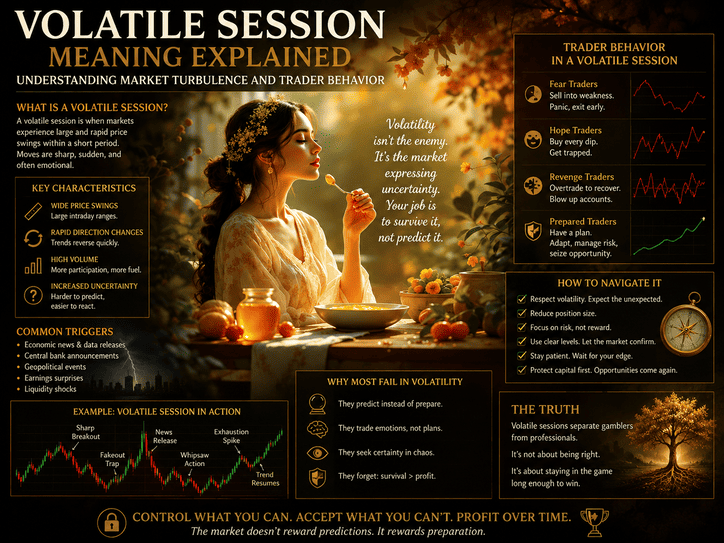
Volatile Session Meaning Explained: Understanding Market Turbulence and Trader Behavior

Volatile Session Meaning Explained

Trapdoor: The Abyss Hiding Beneath Your Certainty

Mar 10, 2026

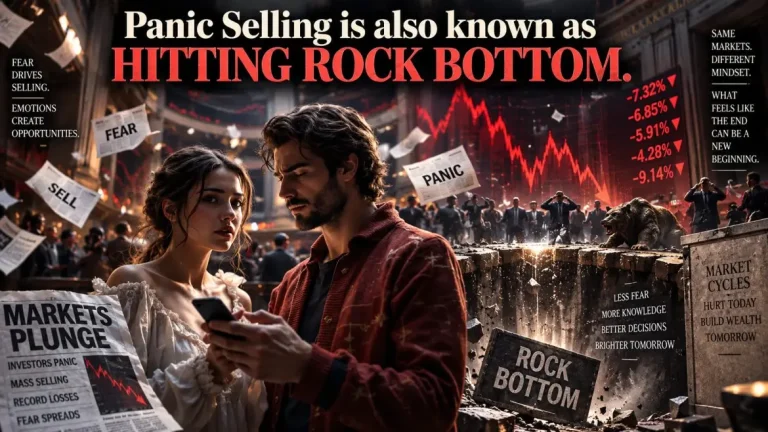
The floor was never solid. You convinced yourself it was — modeled it, stress-tested it, wrapped it in the language of conviction, and labeled it “support.” But underneath that foundation was vapor, patient and weightless, just waiting for the moment you leaned your full weight on it. That sickening lurch — the half-second where rock-solid conviction dissolves into bewildered free fall — isn’t some freak accident. It’s a feature of a system that feeds on rigidity like oxygen.

A volatile session doesn’t send invitations. It doesn’t clear its throat or tap you on the shoulder. It watches. It studies the patterns you’ve grown comfortable with, the assumptions you’ve stopped questioning. Then it moves — with the surgical indifference of a predator that doesn’t distinguish between the experienced and the naive. The instant you navigate by yesterday’s map, the landscape rearranges itself. Traders lock up. Not because they lack knowledge — most of them have plenty — but because of something far more fundamental: the unexamined belief that expertise is the same thing as control. That’s the trapdoor. Certainty dressed up as competence, standing on a floor made of air.

What drives price in those moments isn’t randomness. It’s something colder and more deliberate than chaos: intelligence operating without a conscience. Patterns don’t simply fail — they invert. Setups that printed money for months become perfectly engineered bait. And in that rupture, the majority do what crowds always do: they cling harder to the strategies that stopped working, unable to metabolize the possibility that the rules were provisional all along. That they were never carved in stone. Just written in pencil.

The handful who navigate these sessions intact don’t operate on bravado. They move the way a trauma surgeon works under artillery fire — hyperaware, adaptive, steady-handed in conditions that would paralyze most people. They don’t need the floor beneath them to hold. They only need the instinct to reposition while they’re still falling. Because they’ve internalized something the rest refuse to accept: when the structure gives way, it’s not just prices that collapse. It’s every comfortable illusion you built your confidence on.

Quantum Storms: When Markets Exist in Two States at Once

The market has no interest in what you believe. It owes you neither clarity nor a logical sequence of events. And volatility — despite what your intro-to-trading course taught you — isn’t disorder. It’s compressed meaning. Conflicting signals jammed into the same candle, the same minute, the same breath. A violent price spike isn’t “bullish.” It isn’t “bearish.” It’s both simultaneously and neither conclusively. The answer depends entirely on who’s watching, from what timeframe, and with what positioning. You’re not interpreting data. You’re collapsing a cloud of probability — and the act of observing it changes what you see.

This is where traders make a critical error: they confuse the speed of their reaction with the quality of their thinking. They believe that acting fast makes them skilled. But velocity is worthless when your underlying logic was borrowed from a calm, orderly market. And this isn’t calm. This is entanglement. A geopolitical tremor in one sector sends shockwaves rippling through another that has no obvious connection. A single phrase from a central banker detonates simultaneously across currencies, bonds, and equities. Cause and effect become tangled beyond recognition.

There is no singular truth hiding in the noise. Only multiple competing realities, each valid until one achieves dominance. But by the time it does — by the time the picture sharpens enough for the crowd to see it clearly — the edge has already evaporated. You’re trading echoes of a move that’s already happened, not the signal itself. The volatility was never the actual problem. The problem was always the mind that needs events to unfold in a straight line before it feels safe enough to act.

Navigating storms like these demands something most traders never develop: fluency in contradiction. Not a rigid playbook, but genuine mental flexibility — the capacity to hold opposing ideas in your head without needing to resolve them immediately. The ones who come through aren’t the loudest voices in the room or the fastest fingers on the keyboard. They’re the quietest. They’re reading the interference patterns, picking up the faint tremor in correlations that most participants miss entirely. Because at some point they stopped hunting for answers and started watching for something subtler: shifts in the nature of the question itself.

Alchemy of Nerves: The Chemistry That Separates the Living from the Liquidated

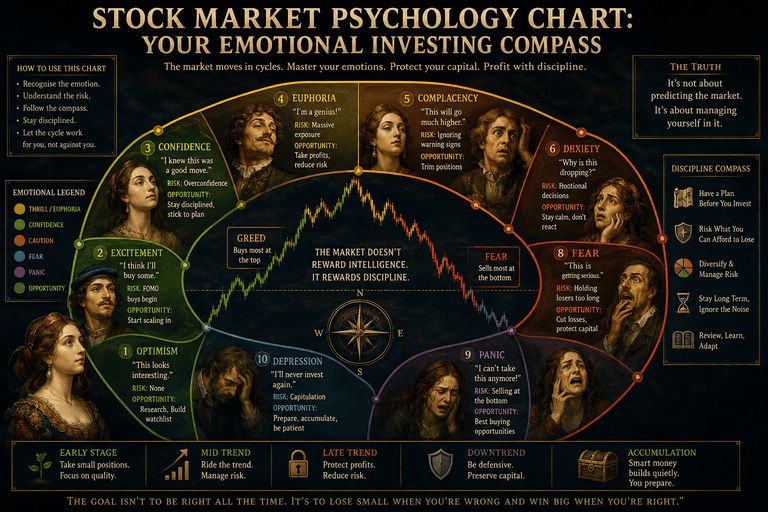
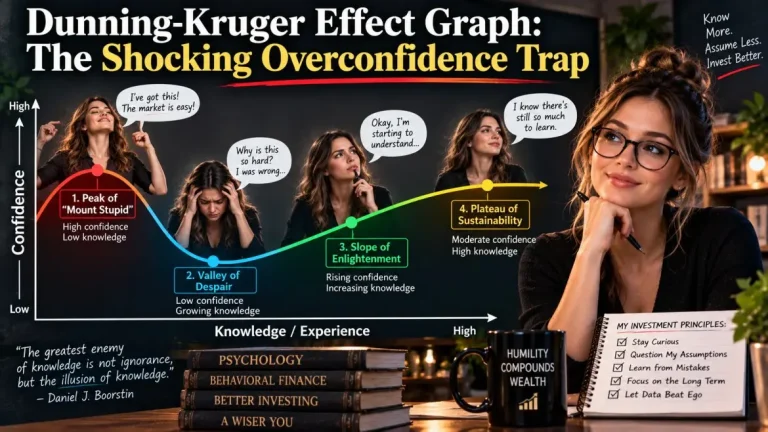
Most traders react. A smaller number respond. And a vanishingly rare few do something else entirely — they transmute. A volatile session isn’t a battlefield. It’s a laboratory. And the overwhelming majority walk through the door carrying nothing but hope and a handful of borrowed convictions. That isn’t courage. It’s a suicide pact with their own assumptions, signed in the ink of overconfidence.

The differentiator isn’t emotional control — not in the way most people use that phrase. It’s emotional utility. When volatility spikes, fear arrives for everyone. That’s non-negotiable neurochemistry. But for a select few, that fear doesn’t paralyze — it sharpens. What they experience in those moments isn’t panic. It’s something closer to chemical clarity, a heightened state where perception narrows and precision becomes possible. While the majority are drowning in their own adrenaline, these few are converting that same surge into calculation. The trick isn’t suppressing the fear. It’s measuring it — using it as fuel rather than letting it become the fire.

There’s nothing romantic about this. It isn’t swashbuckling contrarianism or thrill-seeking dressed up as strategy. It’s dosage. Knowing when to act. Knowing when to sit on your hands and let the market incinerate the weak positions. Knowing when to hold perfectly still so you can pick your entry clean from the wreckage, with the kind of precision that’s only available to someone who wasn’t thrashing around when the worst of it hit. The alchemist isn’t brave because they jump. They’re brave because they wait — calmly, deliberately — inside the furnace itself.

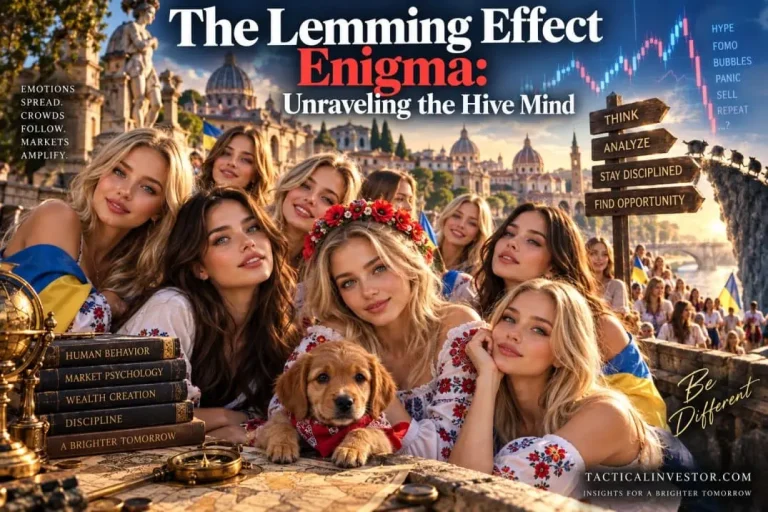
Masses flock to safety in numbers, operating on the ancient assumption that size equals protection. But in volatile markets, size is inertia. It slows reaction time. It calcifies thinking. And when the tape turns violent, the bonds holding the herd together don’t protect — they become liabilities. The unraveling is fast, and for many, it’s permanent.

The alchemist understands a truth the crowd can’t stomach: one well-timed position, assembled in silence and executed at the moment of maximum distortion, can rewrite the entire ledger. But one misread — one overreaction born from ego rather than evidence — and they’re vapor. That’s the cost of operating in this space, and it’s non-negotiable. They carry it willingly. Not because they crave risk for its own sake, but because they’ve made peace with what risk reveals about the person taking it.


Singularity: Where the Exceptions Write the Rules

Most market participants spend their careers huddled near the center of the bell curve, seduced by averages, comforted by repeatability, lulled by the false warmth of “normal” distributions. But the market’s deepest truths don’t live in the middle. They pulse at the extremities — out where the models fracture, the backtests become fiction, and the carefully constructed rules dissolve like wet paper.

Volatile sessions don’t emerge from predictability. They erupt from the exception — the event that wasn’t supposed to happen, the correlation that wasn’t supposed to break, the level that was supposed to hold. And this is precisely where traders crack open. Not from a deficit of intelligence, but from a stubborn refusal to accept that intelligence routinely misreads the tail ends of the distribution. They hedge obsessively, layering on protection, only to discover they’ve exposed themselves to a sharper, stranger blade they never imagined. The harder they grip for control, the faster the game shape-shifts beneath their fingers.

Singularity isn’t an abstraction from a physics textbook. It’s viscerally lived — those fractured seconds where the tape unspools, your stops get vaporized, and what was “impossible” sixty seconds ago has suddenly become the new baseline everyone has to navigate from. Flash crashes. Melt-ups. Parabolic moves that defy every model calibrated to the recent past. These aren’t outliers to be trimmed from your dataset. They’re origin points. The anomalies that illuminate the deeper mechanics you spent your career pretending didn’t exist.

To trade in these conditions is to voluntarily abandon comfort. It means walking, eyes wide open, into the gravitational core of genuine uncertainty — where your strategy either stretches to accommodate what’s happening or becomes instantly irrelevant. There is no “normal” waiting on the other side. No reversion to a familiar mean. There’s only the next rupture, and the question of whether you’ll be ready for it or buried by it.

Emergence: The Hidden Architecture Behind the Explosion

Volatility doesn’t arrive waving a banner. It crawls in through cracks you didn’t know existed — an accumulation of minor variables, most too small to flag and too strange to model. But they build on each other. They interact. They bind into something with its own momentum. And then, without any single identifiable cause, they detonate.

The market isn’t actually chaotic. It just ruthlessly punishes anyone who needs neat, linear cause-and-effect before they can act. A central bank official stumbles through an ambiguous phrase and a small-cap technology stock spikes twelve percent. A rumor surfaces in an obscure online forum and crude oil rips nine percent in an hour. These aren’t isolated, disconnected incidents. They’re feedback loops — emergent phenomena generated by millions of minor decisions, interactions, and reactions that no individual participant ever saw coming and no model ever captured.

The few who flourish in these conditions don’t try to predict the eruptions. They interpret them in real time. They sense underlying structure inside what everyone else perceives as pure distortion. They don’t need a Bloomberg headline to justify a move they’re already seeing in the order flow. They recognize the architecture of what’s unfolding before it fully crystallizes — and that skill isn’t something you learn from a textbook or a webinar. It’s pattern intuition forged through years of direct exposure, scar tissue, and the kind of experience that leaves marks.

In this environment, contradictions don’t resolve themselves into tidy narratives. They coexist, stubbornly and indefinitely. A rally begins inside a crash. A textbook bearish engulfing candle becomes a launchpad for the most ferocious move of the session. Traders imprisoned by binary logic — up or down, risk-on or risk-off — get shredded by the complexity. The ones who survive, and occasionally thrive, have internalized something the majority can’t accept: volatility isn’t an adversary to be defeated. It’s an expression of hidden order that the surface-level view can’t decode. The signals are always present. But they speak in riddles and half-truths. Your job is to hear them anyway — even when they don’t make sense yet.

Metamorphosis: Volatility as Identity Crucible

Nobody walks into a volatile session and comes out the same person. You bleed. You adapt. You burn away the parts of yourself that depended on certainty for comfort, and whatever survives gets tempered into something harder and more functional. A volatile session isn’t a market condition to be endured. It’s a test of identity — one that most participants fail not because they lack talent, but because they refuse to let go of who they were before the session started.

The average trader operates through repetition, mimicry, and formulas inherited from a market regime that may have expired months ago. But the ones who endure — the ones who are still standing and still solvent after the worst sessions — have figured out that the game was never about being right. It’s about becoming unrecognizable to the person you were last week. In volatile markets, reinvention isn’t a luxury or a self-help cliché. It’s a survival requirement. Stop evolving and the market evolves past you, leaving your outdated playbook as the only epitaph.

There’s a strange and counterintuitive discipline hidden inside this apparent chaos. It doesn’t come from positive thinking or the motivational theater that saturates trading social media. It comes from something far less photogenic: pain catalogued meticulously, mistakes dissected without ego protection, instincts honed under conditions that would break most people’s nerve. The traders who come through aren’t louder than the rest. They aren’t flashier. They’re quieter. More deliberate. While everyone else is bleeding ego into the tape — announcing positions, seeking validation, performing confidence — these few are building something internally that doesn’t require an audience.

Volatility doesn’t hand out success. What it offers is something rawer: the chance to become something sharper, more precise, and harder to kill. Operating in this space means treating your mind the way a craftsman treats a blade — constantly honed, never allowed to dull, never assumed to be finished. Because surviving here isn’t about heroism or dramatic gestures. It’s about repetition without going blind. Adaptation without letting ego steer. Movement without noise. And doing all three simultaneously, session after session, when every instinct screams at you to stop.

Dominion: What Mastery Actually Looks Like Under Fire

Mastery isn’t serenity. Forget that image. In volatile markets, mastery is dominion — over impulse, over illusion, over the desperate craving for things to make logical sense before you’re forced to act. Traders aren’t rewarded during these sessions for noble intentions or sophisticated theories. They’re judged — instantly and without appeal — by their ability to operate in contradiction. To strike when every nerve screams retreat. To hold perfectly still when the herd is stampeding past. The line separating devastation from dominance isn’t luck, no matter how often the survivors get called lucky. It’s control — cultivated internally, deployed externally, and tested in conditions designed to shatter both.

There’s a Confucian principle buried in this: know your role, govern your reactions, move with integrity. But volatility has a way of laughing at surface-level virtue. It doesn’t care what you claim to believe about discipline when markets are calm. It forces you to earn your equilibrium in real time, under fire, with real capital at stake. Only those who’ve internalized discipline so deeply that it functions as instinct — not as a conscious choice they have to make fresh each time — walk out of these sessions with both their dignity and their account balance intact.

Machiavelli would recognize the dynamic immediately: perception is power, certainly, but so is the discipline to conceal your edges. The trader who survives a volatile session doesn’t broadcast every advantage. They let the market tip its hand first. They let others overcommit, overreact, and reveal their positioning. Then they strike — precisely, cleanly — where weakness has bloomed and the crowd is too disoriented to defend. Call it precision warfare if you want. The session doesn’t care whether your methods are noble. It cares whether they’re effective.

And then comes the moment that makes every scar worth carrying: when the session is raging at its worst, when structure has fractured and visibility has collapsed to zero, and you realize you’re not guessing anymore. You’re not reacting. You’re leading. While the majority spirals into paralysis or panic, you breathe deeper. Each tick becomes a lever. Each signal becomes a weapon. You stop riding the volatility and start bending it — not through force, but through the accumulated weight of every lesson you absorbed, every loss you dissected, every instinct you refined when nobody was watching.

Because the volatile session was never sent to destroy you. It was sent to reveal — with pitiless clarity — whether you’ve done the work required to shape it.

In the end, the market holds no memory of who you were when you walked in. It only measures what you became on the way through.

Ideas That Shake Foundations and Build Empires