

Agitation Comes First. Clarity Arrives Too Late
July 15, 2026
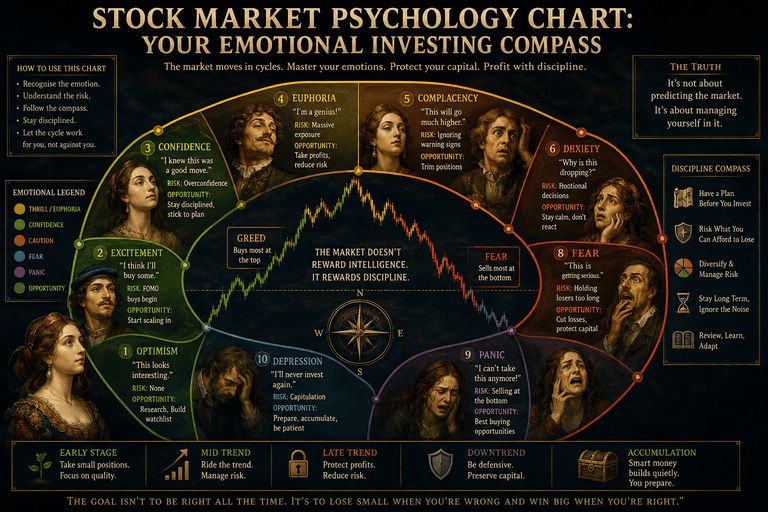
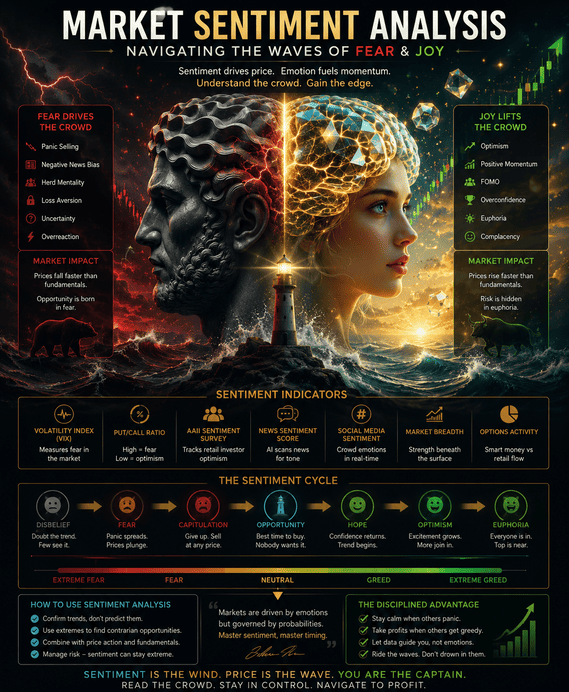
One of the great misconceptions about crowds is that they move after reaching clarity, carefully weighing evidence before deciding upon a direction. The opposite is almost always true. Crowds move first because something captures their attention, disturbs their emotional equilibrium or creates the feeling that immediate action is required, and only afterwards do they construct narratives explaining why their reaction was perfectly rational. Agitation comes first. Explanation follows. By the time clarity finally arrives, capital has already been committed, positions established and opportunities largely exhausted.
That sequence explains why repetition is so much more powerful than evidence. Most people assume ideas spread because they are persuasive, yet history suggests they spread because they become familiar. Every repetition lowers resistance until what initially sounded speculative begins feeling obvious, not because additional proof has appeared but because the mind gradually mistakes familiarity for truth. Jonathan Swift understood this instinctively when he mocked humanity’s talent for believing comfortable absurdities, while Mark Twain observed the same phenomenon from another angle, recognising that people seldom abandon a popular illusion until reality makes the cost of believing it impossible to ignore.
Crowds Do Not Think Collectively. They Synchronise Collectively.
The mechanics behind this process were mapped long before the arrival of social media or twenty-four-hour financial news. Gustave Le Bon argued that individuals entering a crowd surrender much of their independent judgement, responding increasingly to emotion, suggestion and shared identity rather than careful reasoning. Gabriel Tarde reached a similar conclusion through imitation, observing that ideas spread because people copy one another far more readily than they verify information for themselves. Émile Durkheim extended the argument further by showing that collective states acquire a force exceeding the intentions of any individual participant, creating social realities that shape behaviour even when privately doubted.
Viewed together, these ideas reveal a remarkably consistent structure. Agitation captures attention. Imitation spreads the response. Collective emotion then reinforces the behaviour until it begins appearing self-evident. At that point the original trigger becomes almost irrelevant because the crowd is no longer reacting to the event itself. It is reacting to everyone else’s reaction.
Markets operate in precisely the same way. Investors rarely buy because they have independently reached identical conclusions. They buy because rising prices validate existing optimism, attracting additional buyers whose participation further validates the narrative, creating the self-reinforcing feedback loops that define both bubbles and panics. The crowd mistakes synchronisation for independent confirmation, even though each participant is increasingly responding to the behaviour of others rather than to underlying reality.
Every Cycle Promises Change. Most Reproduce the Same Structure.
This is why every financial and political cycle feels simultaneously new and strangely familiar. Each arrives promising to correct the mistakes of the previous era, introducing new leaders, fresh language and apparently revolutionary ideas, yet gradually settles into the same incentive structures that shaped its predecessor. The personalities change, the slogans evolve and the technologies advance, but human psychology remains remarkably constant because the forces governing collective behaviour have changed very little across centuries.
The comparison to Groundhog Day is therefore more than a convenient metaphor. Markets, institutions and political systems repeatedly generate the same behavioural patterns because the underlying geometry never disappears. Optimism expands into certainty, certainty encourages concentration, concentration increases fragility and fragility eventually produces disappointment, clearing the ground for the next cycle to begin. What changes is not the structure but the narrative explaining why this time the outcome will somehow be different.
That is one of the crowd’s oldest illusions. Every generation believes it has escaped history because it possesses better information, more sophisticated institutions or superior technology, yet innovation changes the speed of the cycle far more often than it changes the psychology driving it. Railroads, radio, television, the internet and artificial intelligence all transformed civilisation, but each also became the centre of speculative excess because technological progress consistently outpaces emotional discipline.
The System Depends on Participation More Than Force
Modern technology has not altered this mechanism so much as compressed it. Information now travels globally within seconds, narratives form almost instantly and social reinforcement arrives before most people have had time to think independently. What once unfolded over months can now develop within hours because digital networks reward emotional engagement far more efficiently than deliberate analysis. Outrage spreads faster than nuance, certainty receives more attention than doubt and repetition becomes almost impossible to distinguish from verification.
That acceleration matters because the system depends less on coercion than participation. Markets require buyers and sellers willing to act on shared beliefs. Political movements require citizens willing to internalise common narratives. Media ecosystems require audiences willing to amplify emotionally engaging stories. None of these systems function because individuals are forced to participate. They function because participation feels voluntary while collective behaviour quietly narrows the range of perceived alternatives.
This is why mass psychology remains one of the most powerful forces in markets. Prices rarely move because everyone suddenly discovers new information. They move because enough participants begin interpreting existing information through the same emotional lens. Expectations converge, positioning converges with them and what initially appeared to be independent judgement gradually becomes collective synchronisation. The crowd experiences confidence precisely when systemic fragility is quietly reaching its peak because unanimous agreement eliminates the diversity of opinion that normally stabilises markets.
Seeing the Pattern Changes Your Relationship to It
The cycle itself never disappears because human psychology is unlikely to change in any meaningful way. What changes is the observer. Once you recognise that agitation almost always precedes clarity, that repetition creates familiarity rather than truth and that crowds synchronise far more often than they reason collectively, the emotional pull of each new cycle begins losing much of its force. You stop asking whether the latest narrative feels convincing and begin asking why it feels so convincing to everyone at exactly the same moment.
That shift is subtle but profound because it moves your attention away from the story and toward the structure producing the story. Instead of following headlines, you observe expectations. Instead of reacting to confidence, you measure positioning. Instead of assuming consensus confirms reality, you recognise that consensus often marks the point where independent thought has largely disappeared.
The crowd moves as one because each individual believes everyone else has already done the thinking. The investor who understands that geometry gains an enduring advantage, not by predicting the next narrative, but by recognising when collective conviction has expanded so far beyond independent analysis that the smallest disruption can send the entire structure searching for a new story to believe.