
The Euphoria Trap: When Greed Drowns Out Every Warning
Mar 11, 2026
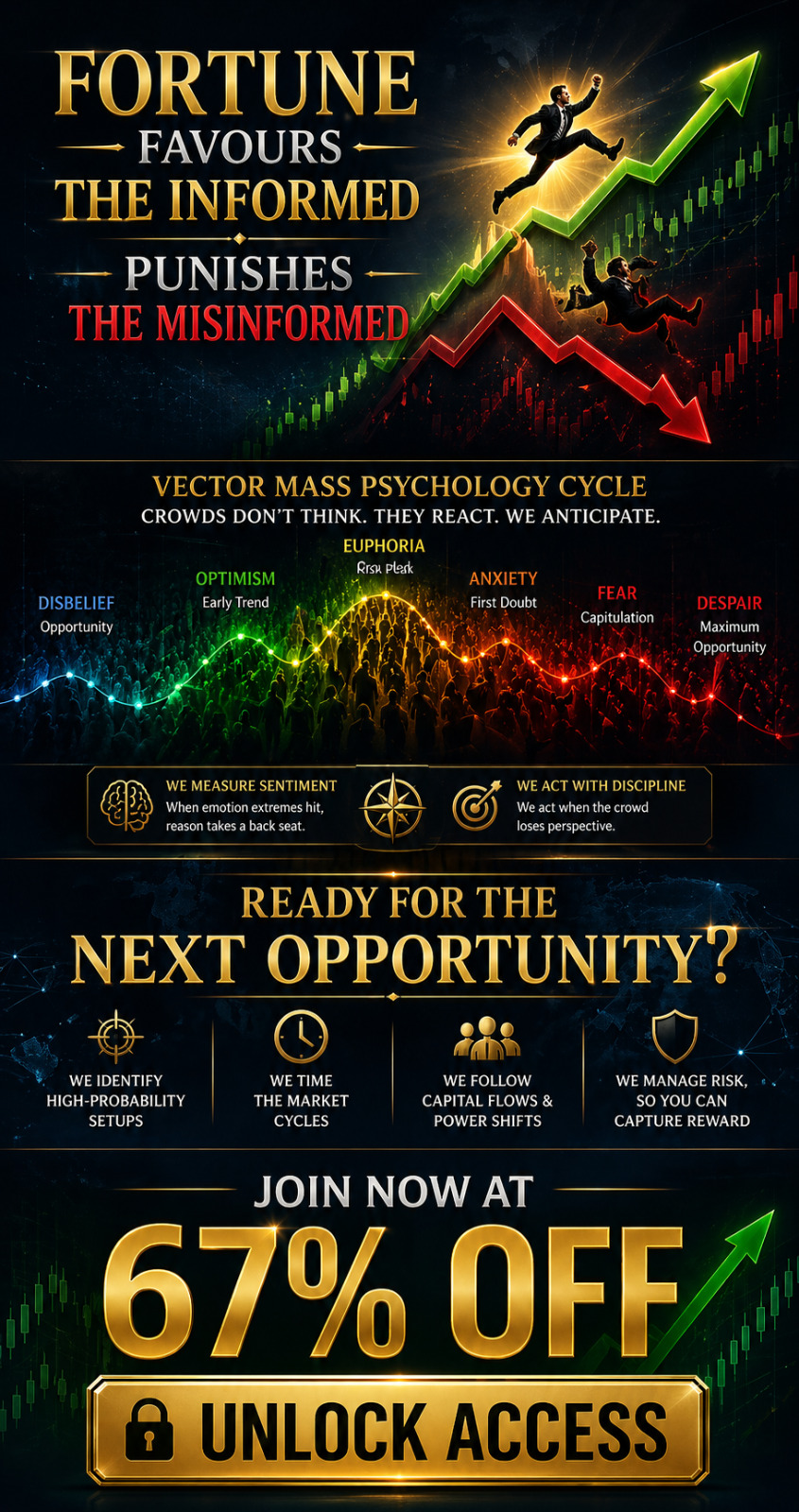
Nobody ever sees the mess until the party’s over. The empty bottles, the broken furniture, the decisions that seemed brilliant at midnight and catastrophic by morning — all of it invisible while the music’s still playing. Bull markets operate on the same principle. When stocks are surging, everyone’s a genius. Risk feels like a quaint concept from a less enlightened era. And suggesting that things might go sideways? That’s not just unwelcome — it’s practically offensive. You become the person at the celebration telling everyone the building might be on fire.
But what’s happening beneath the surface isn’t simple optimism. It’s something deeper and more dangerous: genuine psychological rewiring. During prolonged bull runs, our brains physically adapt to expect continued gains. The neural circuits that normally fire when we contemplate potential loss get progressively muted by months — sometimes years — of relentless positive reinforcement. We begin treating 20% annual returns as a baseline rather than a gift. Corrections stop looking like warning shots and start looking like sales events. Anyone counseling caution gets dismissed as a dinosaur who doesn’t understand the new paradigm.
This normalization of risk isn’t a moral failing or a character defect. It’s the way human beings are built. But understanding why investors systematically ignore risk during collective euphoria — really understanding it, not just nodding along — can mean the difference between riding the wave to shore and drowning in the undertow when it finally breaks.
Yesterday’s Profits Become Tomorrow’s Blind Spots
Human memory makes a terrible historian. We instinctively weight recent events far more heavily than distant ones, which means a string of profitable quarters can quietly erase decades of hard-won market wisdom. This recency bias is the engine behind investors piling into technology stocks after a 50% run-up, behind cryptocurrency mania peaking just weeks before devastating crashes, and behind “this time is different” becoming the unofficial anthem of every speculative bubble in recorded financial history.
Think about the dot-com era. By 1999, investors had watched nearly a decade of explosive technology-sector growth. Companies burning cash with no path to profitability commanded billion-dollar market capitalizations, and nobody blinked — because recent experience had taught them that profits were optional. Growth was the only metric that mattered. When the crash arrived between 2000 and 2002, it felt like a bolt from the blue. But it shouldn’t have. Financial history was already littered with nearly identical episodes, from seventeenth-century tulip mania to the South Sea Bubble to the railroad speculation of the 1800s.
The pattern keeps repeating for a deceptively simple reason: each new generation of investors experiences their first major bull market as though nothing like it has ever happened before. They haven’t lived through the complete cycle — the euphoria, the denial, the crash, the slow recovery — so they extrapolate from radically incomplete data. Recent wins feel permanent and structural. Distant crashes feel like ancient history that happened to different people under different circumstances. Until, of course, it happens to them.
The Gravitational Pull of the Crowd
Bull markets generate their own gravity, and it’s powerful enough to bend the behavior of even disciplined investors. As prices climb, more participants join. Their buying pushes prices higher still, which attracts another wave of capital, which drives another leg up. This feedback loop can sustain itself for years, building momentum so formidable that taking on additional risk doesn’t just feel profitable — it feels prudent. Responsible, even. Like you’d be negligent not to participate.
Social proof supercharges the effect. When your neighbor won’t stop talking about his Tesla gains at the backyard barbecue, when financial television celebrates each new all-time high with confetti graphics, when colleagues swap cryptocurrency war stories over lunch like they’re discussing last night’s game — staying cautious doesn’t feel wise. It feels like you’re voluntarily sitting out a generational wealth-creation event. The fear of missing out doesn’t just compete with the fear of loss. It overwhelms it completely.
Professional money managers aren’t immune to this gravity, either. Fund managers who underperform during raging bull markets face redemptions, uncomfortable board meetings, and genuine career risk. This creates a perverse incentive structure where taking on more risk during the most objectively dangerous periods becomes a professional survival mechanism. As Chuck Prince, then CEO of Citigroup, put it with remarkable candor shortly before the 2008 crisis: “As long as the music is playing, you’ve got to get up and dance.” He wasn’t being reckless. He was describing the institutional reality that traps even the people who should know better.
The Information Diet That Feeds Delusion
During bull markets, investors become world-class cherry-pickers without even realizing they’re doing it. They gravitate toward media, analysts, and social feeds that confirm their optimistic outlook while instinctively filtering out contrary evidence as outdated thinking, sour grapes, or the complaints of people who missed the rally. This confirmation bias constructs an information bubble so seamless that risk warnings simply stop penetrating.
The artificial intelligence investment boom of 2023 and 2024 offered a textbook illustration. As AI-related stocks surged, investors fixated on the revolutionary potential — the productivity gains, the new business models, the trillion-dollar addressable markets — while waving away mundane concerns like stretched valuations, intensifying competitive dynamics, or the growing drumbeat of regulatory scrutiny. Every positive development — a new corporate partnership, a product launch, a quarterly earnings beat — got absorbed as validation of the broader thesis. Negative developments? Temporary setbacks. Buying opportunities. Background noise.
This selective attention isn’t deliberate dishonesty. It’s psychological self-preservation operating below the level of conscious awareness. Once you’ve committed real capital and real ego to a particular market view, contradictory evidence doesn’t feel like useful information. It feels like a threat. The brain resolves that discomfort the only way it knows how: by minimizing what challenges the narrative and amplifying whatever supports it. You don’t decide to ignore the warning signs. Your mind does it for you, automatically, and then congratulates you for staying focused.
When Luck Puts on a Skill Costume
Nothing breeds overconfidence quite like a bull market. A string of profitable trades — even ones made with questionable logic or no logic at all — gradually convinces investors that they’ve cracked the code. That their returns reflect genuine analytical skill rather than the simple fact that a rising tide was lifting everything with a ticker symbol. This illusion of control leads directly to larger position sizes, higher leverage, and reduced hedging — precisely the opposite of what sound risk management demands when valuations are extended.
The pandemic-era day trading explosion illustrated this dynamic with almost painful clarity. Millions of new investors, stuck at home with government stimulus checks and commission-free brokerage apps, dove headfirst into meme stocks and options trading. For months, nearly any approach worked. GameStop, AMC, and a rotating cast of “stonks” delivered lottery-ticket returns to amateur traders who genuinely believed they’d stumbled onto something the professionals had missed. Forums buzzed with conviction. Screenshots of six-figure gains went viral. A new generation concluded that Wall Street had been gatekeeping easy money all along.
The correction that followed served as a brutal refresher course in a lesson the market teaches every cycle: bull markets don’t discriminate on the way up. They lift almost everything — the brilliant and the reckless alike. When the tide eventually recedes, as Warren Buffett observed, you find out who was swimming without clothes. The skill that so many traders attributed to themselves turned out to be nothing more than market beta wearing a flattering disguise.
The Anchor That Drags You Under
Once a stock reaches a new high, that number embeds itself in the investor’s mind as a reference point — a psychological anchor that distorts every subsequent valuation judgment. A stock that traded at $100 and falls to $80 feels cheap, almost irresistibly so, even if $80 is still wildly expensive relative to the company’s actual earnings, cash flow, or book value. This anchoring bias makes investors chronically vulnerable to catching falling knives, convinced they’re scooping up bargains when they’re really just purchasing slightly less overpriced versions of the same overpriced asset.
The mid-2000s housing bubble demonstrated anchoring at its most destructive scale. As residential prices spiraled upward, buyers anchored to recent comparable sales in their neighborhoods. A house that changed hands for $500,000 in 2005 felt like a steal at $400,000 in early 2007 — even though both prices were grotesquely disconnected from underlying income levels and rental yields. The anchor made irrational pricing feel not just rational but obvious. People weren’t just buying houses. They were buying the comforting illusion that recent prices represented some kind of floor.
Wall Street analysts fall into the same trap with remarkable consistency. Price targets tend to cluster around recent highs rather than fundamental valuations. When a stock trades at $200, the target goes to $250. When it reaches $300, the target gets revised to $350. The anchor keeps drifting higher, and each upward revision makes increasingly stretched valuations appear justified — because the reference point has moved, even if the underlying business hasn’t changed nearly as much as the stock price suggests.
When Success Stories Crowd Out Survival Lessons
We judge probability based on how easily relevant examples come to mind. During bull markets, success stories saturate our mental database while cautionary tales fade into irrelevance. This availability heuristic makes continued gains feel probable — almost inevitable — while major losses feel like theoretical abstractions that happen to other people in other eras.
Consider investors who entered the market after 2009. For more than a decade, they experienced almost nothing but upward price action. The 2008 financial crisis existed in their awareness as a historical event — something that happened to a previous generation under fundamentally different conditions. Ancient history. This experiential gap explains why leverage, margin trading, and highly speculative investment strategies became mainstream again with such speed. The painful lessons of prior crashes weren’t stored in recent memory. They were filed away in a cabinet nobody opened.
Media coverage amplifies this distortion relentlessly. Winners get profiled. Their strategies get dissected. Their timelines get celebrated. Meanwhile, the investors who got destroyed — the ones who leveraged into the wrong sector, held too long, or confused a bull market for personal genius — vanish from the narrative entirely. The resulting picture makes risk-taking appear substantially more rewarding and substantially less dangerous than a sober reading of historical data would ever support.
Breaking the Spell: Practical Contrarian Discipline for Bull Markets
Recognizing why investors ignore risk during euphoric periods is necessary but not sufficient. Recognition alone won’t save your portfolio when every fiber of your psychology is screaming at you to stay fully invested, add leverage, and dismiss the bears. What you need are deliberate, structural counterweights — systems that operate independently of your emotional state.
Start by making failure vivid. Study investors who went broke during previous bubbles — not casually, but in detail. Understand how intelligent, experienced people made catastrophic decisions under the influence of collective euphoria. Read their interviews. Study their reasoning. Make bear market history as psychologically available and emotionally real as the bull market gains currently lighting up your brokerage statement.
Implement mechanical rebalancing rules that force you to trim winners and reduce exposure as prices climb. Establish specific triggers in advance: when your portfolio allocation drifts beyond predetermined bands, when sector valuations reach historical extremes, when aggregate margin debt hits warning levels. Systematic rules remove emotion from decisions that feel genuinely impossible to make rationally during euphoric periods. You won’t want to sell. The rules make you sell anyway. That’s the entire point.
Actively seek out contrarian analysis and bearish arguments — especially when encountering them makes you angry or dismissive. If reading a negative assessment of your favorite holding triggers irritation rather than curiosity, that emotional reaction is itself a diagnostic signal. It means your ego has fused with your position, and that fusion is exactly the vulnerability bull markets exploit most effectively.
Above all, internalize one truth that requires no prediction and no timing: bull markets end. Not because of any specific catalyst or foreseeable trigger, but because they always have. Every single one. The cycle of euphoria and collapse isn’t a flaw in the market’s design — it’s a permanent feature of any system driven by human psychology. Understanding this doesn’t require you to call the top. It only requires you to prepare for the inevitability that a top exists.
The Cruel Paradox: Why Winning Sets Up Losing
Here’s the irony that makes bull markets so treacherous: they make you wealthier and more careless at the same time, through the same mechanisms. The identical psychological forces that help you ride trends upward — confidence, pattern recognition, willingness to commit capital — become the vulnerabilities that destroy you when those trends reverse. Success doesn’t just precede failure. It actively cultivates the conditions for it.
The investors who survive multiple complete cycles aren’t the ones who squeeze every last dollar out of every rally. They’re the ones who never forget that rallies have ceilings, even when those ceilings are invisible. They take profits not because they possess some mystical ability to call tops, but because they’ve accepted — deep in their bones, not just intellectually — that tops arrive eventually and without invitation. They maintain hedges not because they’re pessimistic by temperament, but because they’re realistic about human nature and honest about what financial history actually teaches.
Bull markets test discipline far more severely than bear markets do. When everything is falling apart, caution comes naturally. Fear does the work for you. But maintaining perspective when your portfolio is surging, when your neighbor is getting rich, when risk feels like a dusty concept from a more primitive financial era — that requires something much harder than intelligence. It requires the willingness to feel uncomfortable while everyone around you feels invincible.
The question isn’t whether you’ll feel the euphoric pull of the next great bull market. You will. Every investor does. The question is whether you’ll remember — in that intoxicating moment of collective certainty, when caution feels foolish and greed feels like wisdom — that every party eventually ends. And that someone, inevitably, gets stuck cleaning up the wreckage.