
Silence Is the New Strategy
Oct 15, 2025
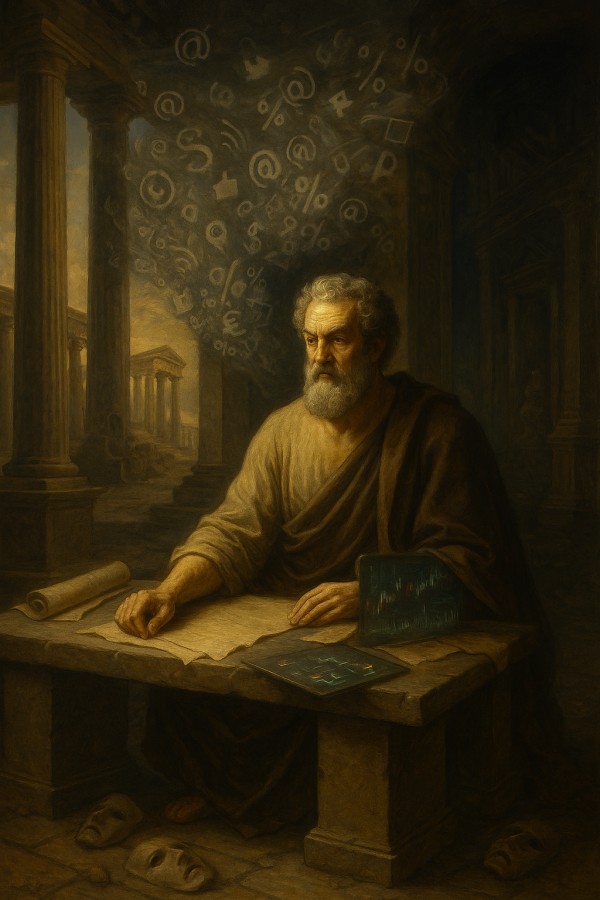
Silence, that endangered species, still roams in small herds among those who remember the value of thought before speech. The rest have traded it for comment sections, dopamine, and algorithmic applause. Yet in markets, as in life, Noise is the poison that masquerades as nourishment. People think they’re consuming information, but they’re actually being consumed by it.
I’ve learned this the hard way. Every time I opened too many tabs, too many charts, too many opinions, my clarity sank like a stone tied to a pundit’s tongue. Twain once said, “Noise proves nothing. Often a hen who has merely laid an egg cackles as if she laid an asteroid.” He wrote it in jest, but he’d make a fine market strategist today—though he’d probably short every media company first.
Most analysts think quantity equals depth. They vomit graphs and adjectives until the reader mistakes exhaustion for enlightenment. But silence, my friend, is sharper than a dozen PDFs. Silence forces you to look—really look—at what the market is doing, not what you want it to be doing. It’s a mirror, not a megaphone.
The fewer words I write, the more weight each carries. That’s not an aesthetic choice; it’s survival. Because in finance, like in gastronomy, indulgence is ruin disguised as luxury. People binge on “content” the way gluttons binge on shrimp at a buffet. They forget that digestion, not consumption, is what sustains. The body pays for excess with discomfort; the mind pays with confusion.
The trick is not to starve—but to curate. When I go to a buffet now, I no longer pile my plate high like a man expecting the end of civilisation. I look for one exquisite dish, one plate worth remembering. That’s what you should do with market data. One signal, not fifty. One thesis, not twenty. And when it’s done—stop eating.
The art of silence is not withdrawal. It’s preparation. When generals stop speaking, it’s not because they’ve surrendered—it’s because they’re aligning the artillery. The same holds for us. When we go quiet, it’s not because we’re lost. It’s because we’re listening. The best trades are not born from constant Noise, but from rare stillness—the moment when you can hear the world think.
Right now, our silence has paid. LMRXF, MGAFF, EROS—all hit targets cleanly. Even the Lazarus play on LAC, which looked dead enough to bury, rose from the grave just to remind the market it still had a pulse.
Twain would’ve loved that one: the corpse that sold premium.
Noise would have ruined it. If we had flooded you with daily “updates,” you’d have panicked out of position long before the reward. The market preys on attention addicts. It whispers to them constantly: trade again, read more, refresh the chart. Every click is a confession of impatience. Every unnecessary trade is a tax on restlessness.
Silence, in contrast, builds asymmetry. It sharpens patience into a weapon. It gives you the space to spot the opportunity that everyone else drowned under a wave of headlines. And when the time comes to strike, you strike without hesitation—because you were never distracted.
High-Premium Put Plays: The MSTR-TSLA Duel
Now, let’s break the silence. Two opportunities flicker in the distance: MSTR and TSLA. Both are ripe for tactical put plays, costly, yes, but with teeth. These aren’t the cheap thrill options you grab like candy at checkout. They’re the high-grade cigars you light only when you’re certain the night deserves ceremony.
If you don’t have enough funds, take only one. We’re not in the business of doubling stupidity; we’re in the company of doubling precision. The premiums on these plays are steep, but that’s the point. Expensive options keep fools away. High barriers attract disciplined minds. And discipline, though it rarely trends on social media, is what separates the survivors from the sermonizers.
We’ll divide allocations into two or three tranches, not five. Why? Because risk is not an abstract concept; it’s a debit line waiting to eat your capital if you overindulge. This is a tactical strike, not a full war. You hit hard, then step back. Like Rabelais said of feasts: “Do not fill your belly so full that your brain must be evacuated to make space.” He was speaking of food, but he could’ve been speaking of leverage.
Markets, after all, are feasts of temptation. The table is long, the dishes endless, and every one of them claims to be “the next big thing.” Most traders walk away broke, not because they were wrong, but because they were gluttonous.
That’s why we talk about silence. Silence before action, silence after profit, silence when everyone else is shouting. Silence is the investor’s version of fasting: it clears the system.
The China Factor: A Quiet Giant Wakes
There’s a difference between noise and movement, and China understands it better than anyone. While the West is still hosting symposiums about “strategic resilience,” China is quietly manufacturing the future—without narrating a single frame of it. The pundits call it “the China threat,” as if Beijing’s deadliest weapon were a headline. It isn’t. The real weapon is silence.
China doesn’t announce revolutions; it assembles them. While one hemisphere tweets, the other welds. No panels, no “stakeholder dialogues,” no ESG lullabies, just endless labour under fluorescent light. The West throws sanctions like confetti; China throws engineers like spears. Guess which one lands first.
The day China cracks the NVDA code won’t arrive with fireworks or a press release. It will slip in quietly, like gravity—unseen yet absolute. A single efficient chip, replicated a billion times, will redraw the global balance sheet. The centre of AI will drift east, not through conquest, but through competence.
You can’t sanction velocity, and you can’t embargo focus.
While others are busy drafting narratives, China is drafting schematics.
Somewhere right now, in a nondescript building with flickering lights, a silent team is already years ahead of every Western press conference combined. The empire will not lose with a crash; it will lose with a hum—a quiet server room purring somewhere beyond its moral vocabulary.
Silence, once again, does what rhetoric cannot: it builds.
Noise, Madness, and the Art of Tactical Speech
Noise is the currency of the 21st century. Everyone’s minting it, no one’s auditing it. What used to be private thought has become public spam, streamed in real time, algorithmically blessed, and promptly forgotten. We’ve confused output with insight, mistaking motion for progress, speed for direction, and quantity for intelligence.
Every minute, a thousand analysts discover “new reasons” for what just happened five minutes ago. They sound confident, but confidence has never paid a bill. It’s just theatre. Twain would have called them “the most dangerous men alive, for they mistake their own echo for revelation.” He’d be right. The modern market commentator doesn’t predict the future; he narrates the past faster than anyone else.
And then sells you a course about it.
The real danger isn’t the Noise itself; it’s the addiction. We’ve built economies, identities, and ideologies around permanent chatter. Social media has made silence feel like failure. The trader who doesn’t post his every thought is accused of being “out of touch.” The analyst who doesn’t release a weekly “hot take” is “losing relevance.” But relevance to whom? The crowd? The same crowd that panic-buys garbage and then blames “manipulation” when the garbage rots?
Noise is democracy at its worst: every fool gets a microphone, and every wise man gets talked over. The loudest are the least correct, and the most accurate are the least heard—because they pause before speaking, and pauses don’t trend.
We have engineered an attention market where silence has no exchange rate. But that’s precisely why it’s the last remaining edge. In a world of unfiltered output, withholding thought becomes power. It’s not a mystery; it’s signal refinement.
The Cult of Commentary
If Rabelais were alive, he’d describe our era as a feast of fools. Picture it: a hall of pundits, everyone chewing data, drooling forecasts, farting certainty, and refilling the plate before swallowing the last bite. He’d have loved Bloomberg panels. “Good sirs,” he’d say, “you dine on noise as pigs dine on truffles—nose down, never once questioning who planted the forest.”
We’ve become so dependent on commentary that the absence of it feels apocalyptic. When we don’t post, people message: Is everything okay? As if silence equals catastrophe. As if the only proof of intelligence is a constant display. The modern mind, conditioned by feeds and alerts, can no longer sit still without twitching for validation.
This is why silence, today, is not just rare—it’s rebellion. When you stop talking, you declare sovereignty over your cognition. You reclaim bandwidth. You become, for a brief moment, untrackable. Try it: log off, trade once a week, say nothing. Watch how the world loses its mind trying to interpret your quiet.
Because silence forces others to project, they start imagining your moves, your thoughts, your plays. The void becomes a mirror. And when the crowd guesses, it always guesses wrong. That’s how silence beats the Noise—psychologically, not just intellectually.
Markets are psychological theatres. Every tick, every headline, every influencer with a ring light and a chart is trying to invade your prefrontal cortex. Their goal isn’t truth—it’s capture. Attention is capital, and once they own your attention, your money follows. The only defence is absence.
How to Speak Like a Strategist
Silence alone, however, is not enough. Total withdrawal turns you into a monk, not a tactician. The art is in selective speech: when you break the silence, make it count. Strategic speech is rare. It’s the verbal equivalent of sniper fire—one shot, one result. A strategist speaks only when the probability curve demands it. Every word is weighted for effect. Twain mastered this in prose; Rabelais mastered it in satire. They both understood timing: the gap before the punchline is as vital as the punch itself.
Apply that to markets. You don’t comment on every wiggle of the S&P or every rumour about rate cuts. You wait until the setup forms, the asymmetry clears, and then—bang. One move, decisive, unemotional. The rest of the time: quiet.
This is how war rooms work, how poker tables are won, and how fortunes are made. Most traders lose not because they’re stupid but because they’re noisy. They leak intent through chatter, doubt through commentary, bias through reaction. Noise exposes. Silence conceals. And what is strategy if not the art of concealment until execution?
That’s why the coming wave of our plays will feel sudden. We don’t move with chatter; we move with convergence. When the vectors align—momentum, psychology, data, liquidity—you’ll hear the signal break the silence. Until then, enjoy the calm. It’s not idleness; it’s alignment.
The Return of Rational Silence
There’s a strange beauty in watching the market burn itself out on overanalysis. The more people talk, the less they know. Every trader becomes a philosopher, every influencer a prophet. They spin tales about macroeconomic destiny while missing the price action in front of them. It’s theatre for the insecure.
But something else is brewing beneath that Noise: fatigue. A quiet class of rational actors is emerging—people who no longer trust the stream, who crave clarity, not clamour. They understand that the next edge won’t come from faster data, but from cleaner minds. From silence as a system, not as an accident.
This is the paradox of intelligence in an age of infinite communication: the smartest thing you can do is say nothing. The second smartest is to speak rarely but precisely. Every other form of intelligence—AI, analyst, influencer—is drowning in its own verbosity. The market doesn’t need more talkers; it needs listeners.
When China cracked robotics, it didn’t announce it—it just built. When it catches up to NVDA, it won’t declare victory—it’ll just sell chips. Meanwhile, the West will still be debating “semiconductor democracy” in panel discussions with branded coffee cups. The empire will lose not to malice, but to Noise. That’s the larger lesson here. Whether you trade stocks, run nations, or write newsletters: silence is not absence. It’s an asymmetric advantage.
Final Note: The Discipline of Nothing
If you take one thing from these random thoughts, let it be this: stop performing. The market isn’t your audience, and your portfolio isn’t a stage. Every time you narrate your next move, you feed the swarm that profits from your predictability. They crave your Noise the way parasites crave warmth—purely for survival.
Keep your analysis tight, your trades rare, your words rarer still. Speak only when silence would cost you money. Every other utterance is a leak. The sharpest minds don’t broadcast; they accumulate. Their calm is mistaken for ignorance until the exit—quiet, clean, and profitable—when everyone else is still refreshing the feed, wondering what just happened.
The loud trade attention; the silent trade asymmetry.
One dies of dopamine, the other compounds quietly.
In this century of manic commentary, mediocrity screams for validation while intelligence sits in the corner, counting. Silence has become the final luxury good, unavailable to those who can’t afford restraint.
The age of Noise belongs to the mediocre, and the age of silence belongs to the cunning.