Greed and Volatility: Why Emotion, Not News, Drives the Market
Aug 18, 2026
Introduction: Volatility Is an Emotional Event, Not a Market Event
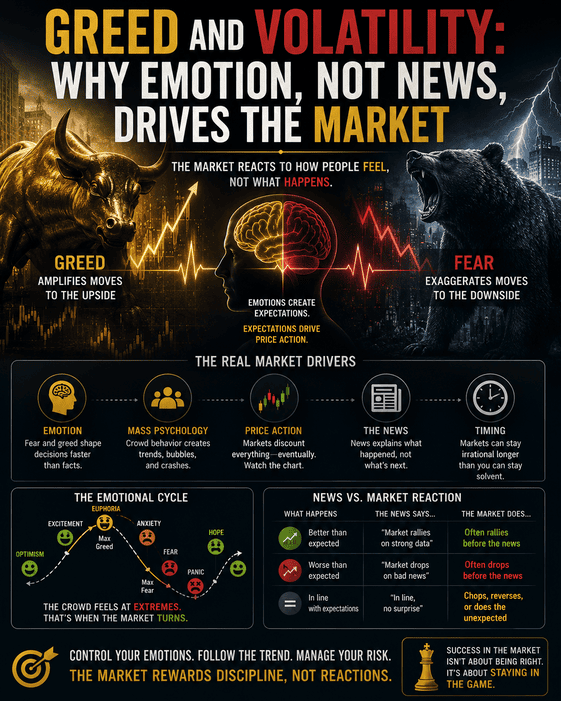
Volatility is often blamed on economic data, geopolitical events, interest-rate decisions, or unexpected headlines, yet these explanations merely describe the catalyst rather than the underlying cause. Markets have absorbed wars, recessions, financial crises, political upheavals, and technological revolutions throughout history, but the magnitude of the reaction has never depended solely on the event itself; it has depended on the emotional state of the participants before the event occurred. The same piece of news can trigger a minor pullback in one market and a full-scale panic in another because the market’s psychological condition determines how information is interpreted long before prices begin to move.
This distinction is important because investors frequently confuse information with emotion, believing that prices fluctuate because facts change when, in reality, facts simply provide the excuse for investors to express emotions that have been building beneath the surface for weeks or even months. A market dominated by confidence will dismiss bad news as temporary, while a market consumed by fear will interpret even encouraging developments with suspicion, demonstrating that psychology almost always leads and fundamentals merely provide the narrative after the fact. Understanding volatility therefore requires understanding the emotional architecture supporting the market rather than focusing exclusively on the headlines appearing each morning.
Greed Is the Hidden Engine Behind Bull Market Volatility
Fear receives most of the attention because it produces dramatic declines, but greed is the emotion that quietly creates the conditions for those declines long before anyone notices the danger. Greed rarely announces itself openly because it disguises itself as confidence, optimism, or belief in a new economic paradigm, allowing investors to convince themselves they are making rational decisions even as they abandon the discipline that protected them only months earlier. Every successful trade reinforces the belief that buying higher prices carries little risk, and every new high encourages additional participants to join the advance, not because valuations have improved but because the fear of missing future gains becomes stronger than the fear of losing money.
As this process continues, leverage gradually increases, speculative activity expands, and investors become increasingly willing to pay prices they would have considered absurd only a short time earlier. Risk does not disappear during these periods; it merely becomes more concentrated because a growing number of participants are pursuing the same objective using remarkably similar strategies. Eventually, the market reaches a point where a relatively modest decline forces investors to confront risks they had stopped acknowledging, and that is when greed rapidly transforms into fear, producing the very volatility that many mistakenly attribute to the news itself.
Fear Does Not Create Opportunity; It Reveals It
Fear has always been viewed as the enemy of investors, yet history repeatedly demonstrates that it is often the beginning of opportunity rather than the end of it. During periods of panic, investors cease making decisions based on probability and instead become preoccupied with eliminating emotional discomfort, causing them to liquidate positions at prices that bear little relationship to long-term value. The urgency to escape becomes more important than the quality of the decision, and that emotional urgency is precisely what creates the discounts that disciplined investors seek.
Professional investors understand that panic temporarily destroys pricing efficiency because sellers become motivated by emotion instead of analysis. While the crowd interprets falling prices as evidence that conditions will continue deteriorating indefinitely, experienced investors recognise that extreme emotional behaviour often produces extraordinary opportunities precisely because expectations have become detached from reality. Fear therefore does not automatically justify buying, just as greed does not automatically justify selling, but both emotions provide valuable information about the psychological condition of the market and the probability that prices have diverged from intrinsic value.
Uncertainty Generates the Greatest Volatility
Although fear and greed dominate most discussions of market psychology, uncertainty is arguably the most disruptive emotional state because it combines both emotions without allowing either one to establish lasting control. Investors become optimistic enough to chase rallies but remain fearful enough to abandon positions at the first sign of weakness, creating a repetitive cycle of buying enthusiasm followed almost immediately by defensive selling. The market therefore experiences rapid swings in both directions, not because conviction is strong but because conviction is almost completely absent.
This explains why uncertainty often produces the most frustrating trading environments, as prices oscillate within broad ranges while convincing participants that a decisive breakout has finally arrived, only to reverse direction shortly afterwards. Investors repeatedly mistake temporary momentum for the beginning of a lasting trend because they interpret every movement through the lens of their most recent emotional experience rather than through an objective assessment of the broader psychological landscape. Volatility during these periods should not be interpreted as evidence that a major bull or bear market has begun; instead, it reflects the market’s inability to establish a stable emotional consensus.
For disciplined investors, uncertainty requires a very different approach from either fear or greed because neither aggressive buying nor wholesale selling is likely to produce consistent results. A more effective strategy is to recognise that uncertainty naturally creates trading ranges, gradually reducing exposure into emotionally driven rallies while rebuilding positions during emotionally driven declines, thereby allowing volatility itself to become an ally instead of an adversary.
The Crowd Sees Sentiment; We See Emotion
Most market commentary revolves around sentiment indicators, surveys, and positioning data, yet sentiment is merely the outward expression of a much deeper emotional process. Greed, fear, confidence, complacency, and uncertainty are the forces that actually shape behaviour, while sentiment simply provides a measurable reflection of those underlying emotions. Investors who focus exclusively on sentiment often mistake the measurement for the cause, much as someone might mistake a fever for the disease rather than recognising it as a symptom.
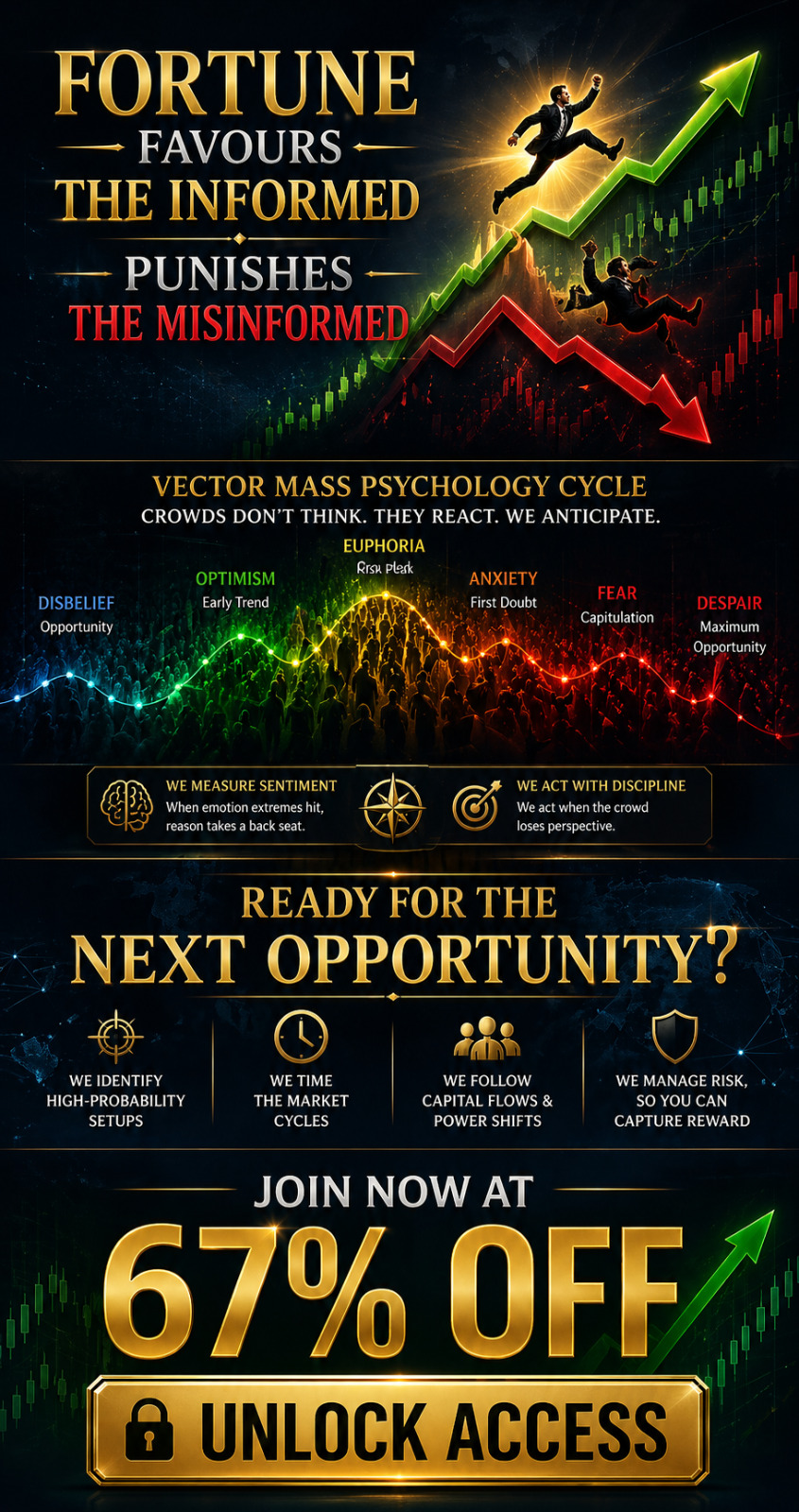
This distinction explains why our work places greater emphasis on Vector Mass Psychology than on conventional sentiment analysis alone. The objective is not simply to determine whether investors are optimistic or pessimistic, but to identify the degree of emotional coherence within the market and whether that emotional structure is becoming dangerously one-sided. Markets rarely collapse because investors are optimistic; they collapse because optimism becomes so dominant that almost everyone who intends to buy has already done so, leaving increasingly little demand to sustain the advance.
Why the Current Bull Market Is Different
One of the more fascinating characteristics of the current advance is that it has occurred without the widespread emotional excess normally associated with powerful bull markets. Despite more than two years of impressive gains, traditional bullish sentiment readings have remained remarkably restrained, while the Vector Mass Psychology model has likewise failed to signal the type of emotional extremes that typically precede major market tops. Bullish readings have consistently struggled to move beyond the upper-fifties, an unusually subdued outcome for a market that has appreciated as strongly and as persistently as this one.
This relatively modest level of optimism has important implications because it suggests that the advance has not yet attracted the kind of speculative euphoria that historically accompanies major peaks. Investors remain cautious, corrections continue to generate widespread concern, and many participants still expect an imminent collapse despite the market’s ongoing resilience. Paradoxically, this lingering scepticism strengthens the bull market because it indicates that emotional fuel has not yet been exhausted, leaving ample room for additional buyers to enter as confidence gradually improves.
When Volatility Should Be Embraced and When It Should Be Respected
Volatility should never be viewed in isolation because its significance depends entirely upon the emotional environment in which it develops. If optimism remains relatively subdued and bullish sentiment has yet to reach historical extremes, periods of volatility are often little more than emotional resets that create opportunities for disciplined investors willing to accumulate quality assets during temporary bouts of pessimism. In these environments, volatility is performing its natural function by transferring shares from impatient participants to those with a longer investment horizon.
The situation changes once optimism becomes excessive and complacency begins replacing healthy scepticism because volatility occurring under those conditions frequently signals distribution rather than accumulation. Professional investors understand that the easiest time to reduce exposure is when public enthusiasm is strongest, since abundant demand allows them to exit positions without significantly affecting prices. What appears to be strength on the surface may therefore represent the quiet transfer of risk from informed investors to increasingly emotional participants who have become convinced that the trend can only continue.
The objective is not to fear volatility or celebrate it blindly, but to interpret it within the broader emotional context of the market. Emotion always precedes action, action ultimately determines price, and price eventually becomes the story that dominates the financial headlines, which is why investors who learn to recognise emotional extremes before they become obvious place themselves in a fundamentally different position from those who continue reacting only after volatility has already made its appearance.
The greatest investment opportunities have rarely emerged when the news was comforting or when the crowd felt secure, and the greatest dangers have rarely appeared while investors remained cautious and sceptical. They have emerged when emotion became so dominant that rational judgement quietly disappeared, leaving the majority convinced that recent experience represented permanent reality. Those who understand this principle stop treating volatility as something to predict or fear and begin viewing it for what it really is: the market’s most honest expression of collective human psychology, constantly revealing where emotion has replaced reason and where the next significant opportunity is most likely to emerge.

In Case You Missed It