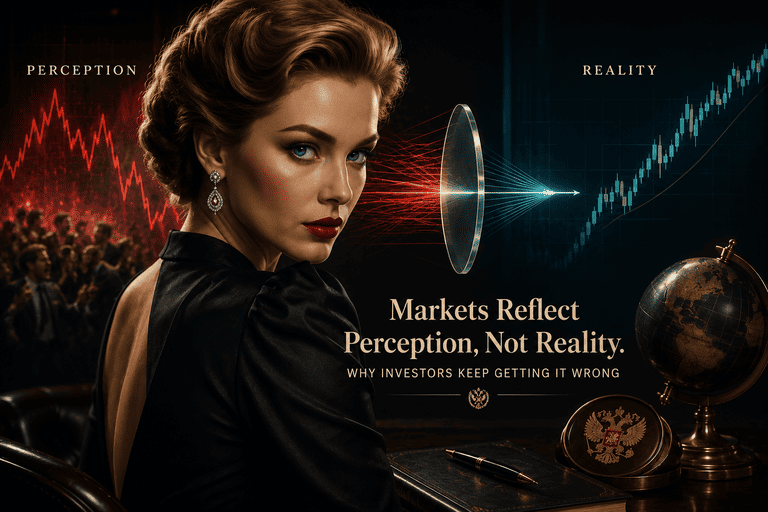
Fear Compresses Time: Until Every Decision Feels Final
July 24, 2026
Markets are often described as mechanisms for discounting the future, yet that description overlooks a far more important reality. Markets do not simply discount the future. They constantly redefine how far into the future investors are willing to look. During periods of confidence, time itself appears expansive. Investors willingly value companies based on earnings that may not materialise for years, embrace ambitious technological revolutions whose commercial potential remains uncertain and tolerate temporary setbacks because they are viewed as insignificant interruptions within a much larger trajectory. Optimism stretches the investment horizon until the future feels tangible, allowing today’s disappointments to become little more than minor detours along a much longer journey.
Fear reverses that geometry with astonishing speed.
It does far more than lower prices or increase volatility. It compresses time itself, shrinking an investor’s horizon from years to quarters, from quarters to weeks and, in extreme moments, from weeks to tomorrow morning. Businesses that only months earlier were celebrated for their long-term prospects suddenly find themselves judged almost entirely by their next earnings report, the next economic release or the next central bank announcement. The future, which once justified premium valuations and patient capital allocation, quietly disappears from view until only the immediate present remains visible.
This shift explains one of the great paradoxes of investing. Companies rarely become fundamentally worthless during bear markets, yet they are frequently priced as though their future has largely ceased to exist. The factories remain operational, talented employees continue developing new products, patents retain their value and customers often continue buying, albeit sometimes at a slower pace. The productive capacity of the business survives, but the market’s willingness to value that future collapses because fear has shortened the timeframe through which investors interpret reality. The company has not necessarily changed in proportion to its falling share price. The representation of time has.
Human psychology makes this almost inevitable. Survival has always demanded that immediate threats receive greater attention than distant opportunities. An ancestor who ignored the predator directly ahead because he was planning next year’s harvest did not leave many descendants. Evolution therefore trained the human mind to prioritise the present whenever uncertainty rises, a remarkably effective strategy for physical survival but one that often becomes deeply counterproductive in financial markets. Investing rewards the ability to value streams of cash flow extending years into the future, yet fear continually attempts to drag that horizon back towards the present, where uncertainty always appears greatest and possibilities appear smallest.
This is why bull and bear markets often resemble two entirely different universes despite being populated by the same companies. During optimistic periods investors effortlessly construct narratives spanning decades. Artificial intelligence promises to transform entire industries. Biotechnology will revolutionise medicine. Renewable energy will reshape civilisation. Temporary earnings disappointments are dismissed as irrelevant because the destination appears so compelling that the exact route scarcely matters. Investors willingly capitalise future possibilities, extending today’s valuations far beyond current profitability because the future itself feels unusually clear.
Bear markets dismantle that representation almost overnight. Suddenly the same investors who once projected exponential growth twenty years into the future become obsessed with next quarter’s margins, tomorrow’s inflation report or a single interest-rate decision. Businesses previously celebrated for their extraordinary optionality become condemned because free cash flow may temporarily weaken, while companies with immense competitive advantages are judged as though a few difficult quarters somehow invalidate decades of accumulated intellectual property, customer relationships and productive capacity. Nothing about the business necessarily changed with comparable speed. The geometry of time did.
History repeatedly demonstrates this phenomenon because every major crisis compresses time until the immediate future appears to consume everything beyond it. During the Global Financial Crisis many investors concluded that modern banking had become permanently broken and that capitalism itself might be approaching its final chapter. The pandemic produced remarkably similar thinking, convincing countless observers that commercial property would never recover, international travel had entered irreversible decline and normal economic activity might never fully return. Each conclusion felt entirely rational within the emotional landscape of the moment because fear had compressed the investment horizon until the next few months appeared infinitely more important than the following decade.
Reality, however, possesses an inconvenient habit of expanding time once again.
Economic systems adapt. Businesses restructure. Consumers alter their behaviour. Entrepreneurs discover opportunities precisely because old assumptions no longer hold. Gradually, almost imperceptibly at first, the future begins re-entering the market’s field of vision. Investors who only months earlier were paralysed by immediate uncertainty slowly regain the confidence to think several years ahead, valuations begin incorporating long-term cash flows once more and companies previously priced for permanent decline suddenly appear remarkably inexpensive in retrospect. The underlying businesses did not experience miraculous transformations overnight. What changed was the market’s willingness to acknowledge that they still possessed a future worth valuing.
This is why the greatest buying opportunities rarely emerge when economic news is improving. By then, time has already begun expanding again, optimism has returned and much of the repricing has already occurred. Exceptional opportunities arise when fear has compressed time so severely that investors become incapable of distinguishing temporary disruption from permanent impairment. They mistake cyclical weakness for structural collapse, extrapolate present conditions indefinitely into the future and assume today’s uncertainty will persist long after the forces creating it have disappeared. The market does not simply become pessimistic during these periods. It becomes temporally myopic.
The distinction is subtle but profound. Most investors believe successful investing requires predicting the future more accurately than everyone else. In reality, it often requires something considerably simpler. It requires refusing to let fear dictate the length of your investment horizon. When the crowd begins valuing businesses solely through the lens of the next headline, the disciplined investor deliberately expands the timeframe, asking not what the company will earn next quarter but what it is likely to earn over the next decade, not whether today’s news is encouraging but whether the competitive advantages underpinning the business remain intact.
This explains why patience functions as a genuine competitive advantage rather than merely a personality trait. Patience is not passive waiting. It is the conscious refusal to allow temporary emotional states to redefine the timeframe through which reality is evaluated. The investor capable of maintaining a ten-year horizon while everyone else has collapsed to ten days is not simply calmer. They are operating within a completely different geometry, one in which short-term volatility occupies only a tiny fraction of the landscape instead of dominating it entirely.
Markets therefore oscillate not only between greed and fear but between expansive and compressed perceptions of time. Greed stretches the future until every possibility appears attainable, often justifying valuations that reality struggles to support. Fear compresses it until only immediate dangers remain visible, causing equally profound distortions in the opposite direction. Neither representation accurately reflects reality because both confuse emotion with time itself.
Perhaps that is the deeper lesson every bear market teaches. The greatest risk is not volatility, recession or even falling prices. It is allowing fear to compress your horizon until the future effectively disappears. Once that happens, extraordinary businesses begin looking ordinary, temporary setbacks become permanent narratives and opportunities that will later appear obvious become psychologically impossible to seize. Markets eventually recover because businesses continue adapting, innovation continues advancing and economic reality gradually reasserts itself, but investors who surrender their perception of time often fail to participate because they mistake the emotional intensity of the present for the permanence of the future.
Fear changes prices, but only because it first changes time. Once you understand that, every bear market begins to look a little different. You stop asking whether the next few months will be difficult because they almost always are, and instead begin asking a far more useful question: Has the future really disappeared, or has fear simply made it impossible for everyone else to see?

Other Articles of interest