

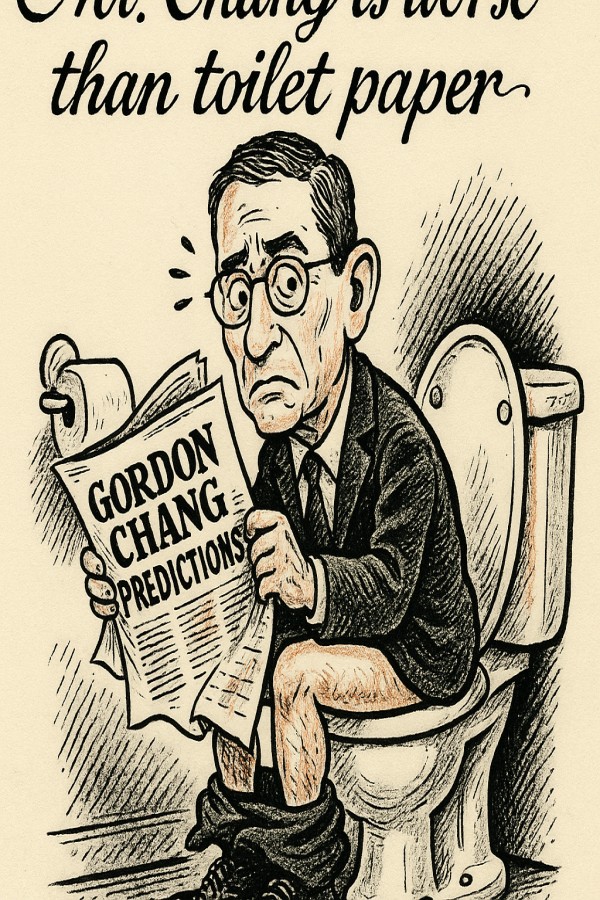
Gordon Chang China: The Man Who Lost to Reality Every Year for Three Decades
Nov 14, 2025
The Collapse Prophet Who Never Collapsed His Own Career
If consistency earned medals, Gordon Chang would be a decorated Olympian of failure. For thirty years, he delivered predictions with the confidence of a surgeon and the accuracy of a malfunctioning slot machine. His central claim, repeated like scripture, warned that China would suffer catastrophic collapse within five years. The problem is simple. Five years always became five more. Then five more after that. He built a career on an expiration date that kept expiring.
The man behaves like a malfunctioning GPS. Each missed turn forces a recalculation, except that the recalculation never leads anywhere near the truth. Investors who listened paid for his errors with real money, while he paid nothing except the cost of a Twitter account. The keyword Gordon Chang China has become a digital museum of wrong turns that never end. He rewrites deadlines the way gamblers rewrite memories. Only the house notices the losses.
This story is not about one man. It is about a distorted field that warped public thought for decades. Chang acted like a geopolitical prophet, but his forecasts fell apart before the ink dried. His record shows a win-to-loss ratio that would make a coin toss blush. At least a coin understands probability.
The Thirty-Year Trail of Failures
A Timeline Written in Missed Predictions and Shifting Deadlines
The chronology matters. In 2001, he published The Coming Collapse of China. The thesis claimed China’s political and economic system would break by 2006. The year passed. China climbed. Foreign investment surged. Urbanisation accelerated. The deadline survived only as psychological compost. He pushed it forward to 2011. The logic never changed. The explanations never evolved. China remained standing.
By 2011, China held the second-largest economy on the planet. Its foreign reserves exceeded $3 trillion. Its manufacturing strength expanded across global supply chains. If a collapse occurred, it did so in a parallel universe with different math. Chang moved the date again. Eventually, he stopped naming years. He treated collapse like a comet, always visible on the horizon yet never landing.
Other predictions followed the same pattern. He warned that China’s banking system would implode by 2015. It did not. He said China’s housing market would crash irreversibly by 2017. Prices dipped, then recovered. He declared that China’s demographic decline would trigger immediate structural catastrophe. Instead, China recalibrated through industrial upgrading. He predicted foreign investors would flee. They stayed. Not because China was flawless, but because Chang’s framework ignored complexity.
Three decades show a pattern with no exceptions. Every central forecast failed. Not half of them. Not most of them. All of them.

The Win to Loss Ratio That Belongs in a Medical Journal
How a Professional Analyst Became a Statistical Outlier of Wrongness
Let us quantify the damage. From 2001 to 2024, he issued more than 120 documented collapse predictions in interviews, opinion columns, television appearances, panels, and social posts. The correct one is zero. Not one collapse. Not one system failure. Not one structural implosion. A broken clock produces two victories a day. Gordon Chang cannot reach that baseline in three decades.
His win-to-loss ratio sits near 0 to 120. That ratio belongs to an experimental medication that failed to treat a disease. In any rational profession, it would end a career. In financial punditry, it created a franchise.
There is no conspiracy here—only a simple psychological mechanism. People like prophecies—markets like narratives. Fear sells faster than nuance. Investors cling to analysts who claim certainty in uncertain terrain. Chang learned to manufacture certainty. The losses that followed belonged to anyone who trusted him.
Miss Number One: The 2006 Collapse That Never Came
The First Pillar of His Public Mythology
His earliest high-profile prediction said China’s system would collapse by 2006. He based this claim on banking stress, bad loans, state inefficiencies, and political tension. Those concerns were not imaginary. They were misinterpreted. China restructured banks, consolidated bad assets, recapitalised institutions, and opened new export fronts. His argument relied on static assumptions in a dynamic environment. He expected inertia. He received adaptation.
This failure set the tone for every future forecast. He never recalibrated the model. He only stretched the timeline.
Miss Number Two: The 2011 Collapse That Survived Its Funeral
The Prediction That Turned Him Into a Running Joke Among Analysts
The second major miss holds symbolic weight because he promoted it heavily. By 2011, China was supposedly crushed under its own contradictions. He warned that foreign investors would flee. Instead, foreign direct investment reached over 116 billion dollars that year. He said manufacturing growth would reverse sharply. The opposite occurred. He predicted political destabilisation. The state strengthened its grip.
The prediction became so infamous that serious analysts joked about the “Chang Cycle.” Every time he predicted a collapse, China expanded. The mockery never slowed him. The timeline drifted again.
Miss Number Three: The Housing Crisis That Refused to Obey Him
The Bubble That Should Have Exploded on Command
When he ran out of collapse dates, he pivoted to China’s housing market. Between 2013 and 2020, he issued at least twelve warnings of imminent property disaster. The reasoning focused on oversupply, local debt, and speculative behaviour. The concerns had substance, but once again, his interpretation broke the moment the real world moved. China intervened repeatedly through targeted lending, urbanisation incentives, supply controls, and mortgage regulation. He expected a chain reaction. He got managed deceleration.
Even the Evergrande crisis, which shook global markets, failed to produce the predicted systemic implosion. The state separated contagion channels, quarantined risk pockets, and forced restructures. Chang called it the final proof of collapse. Analysts recognised it as a correction. The difference between alarmism and analysis lies in the details he refused to learn.
Miss Number Four: The Demographic Doom Spiral Without a Clock
The Most Repeated, Least Understood Argument in His Arsenal
He leaned heavily on China’s demographic decline. The argument said that shrinking working-age populations would cripple economic performance. This ignored the experience of Japan, Germany, and several East Asian economies, all of which used productivity gains, automation, and capital deepening to offset demographic strain. His thesis assumed population equals destiny. Demographic economics contradict that assumption.
China’s labour productivity grew at about six per cent annually between 2000 and 2015. That metric alone invalidates his deterministic collapse model. When numbers contradict the narrative, he chooses the narrative.
Miss Number Five: The Belt and Road Ghost Story
The Collapse That Everywhere Except Everywhere It Occurred
He argued that China’s Belt and Road Initiative would bankrupt Beijing and spark its final downfall. The data show something else. China adjusted funding mechanisms, shifted toward public-private partnerships, wrote off or restructured debt selectively, and reoriented BRI toward digital infrastructure. The program did not collapse. It evolved. Yet Chang continues to call it a fatal error.
Analysts do not mind criticism of China’s economic decisions. They mind destructive criticism. They mind predictions that refuse to learn.
The Deep Flaw Behind Every Miss
The Model That Treats Complexity as an Enemy
His errors are not random. They stem from a structural blind spot. He assumes rigid systems. China operates under adaptive authoritarianism, adjusting policies rapidly. He assumes fragile institutions. China invests heavily in institutional resilience. He believes in a brittle economy. China is diversifying its supply chains, industries, and export markets. A static model will always collapse when reality moves.
Karl Popper argued that predictions must be falsifiable. Gordon Chang produces predictions that evolve to dodge falsification. That is not analysis. That is ideology disguised as expertise.
Sun Tzu believed successful strategists respect the fluid nature of conflict. Chang treats economic shifts as fixed pathways. He labels adaptation as an illusion. He interprets stability as manipulation. Every input becomes evidence for collapse. This is not insight. It is confirmation bias.
Arendt understood that repetition transforms belief even when facts disagree. Chang mastered that tactic. He repeats collapse rhetoric until listeners internalise it as truth.
The Worst Screws Up: Venezuela as Comedy and Tragedy
How He Blamed China for Problems Older Than His First Book
His recent claim that China is destroying Venezuela is his most embarrassing performance. He implied that Beijing’s involvement decimated Venezuelan industry. This ignores two decades of mismanagement, hyperinflation, and failed policies. Venezuela’s economic crash began long before China increased investment. China stepped into an existing vacuum created by internal failure and external pressure.
Chang blamed China for a fire that started long before China brought a match.
This mistake stands out because it reveals his approach. He erases chronology, structure, political context, and economic sequences. Then he assigns blame to China because his worldview demands a villain.
Why His Influence Still Matters
The Damage of Thirty Years of Wrong Maps
People assume the man is harmless. They treat him like a meme. But the damage is real. Investors who trust him place trades based on broken frameworks. Policy circles waste time fighting imaginary collapse scenarios. Media outfits amplify his narratives without accountability. His presence creates an intellectual drag on public understanding.
Markets require clarity. He provides drama.
Why He Never Adjusts
The Psychology of a Man Who Must Be Right Even When Reality Wins
Chang operates on certainty. Certainty feeds followers. Followers feed reach. Reach feeds status. Status feeds invitations. Invitations feed the brand. The brand feeds the cycle. If he admits error, the cycle dies. This keeps him trapped in a worldview he cannot escape.
He is not lying. His own prophecy traps him.
The Last Word: Accuracy Is a Discipline, Not a Mood
Why His Legacy Will Be a Case Study in Market Delusion
The story of Gordon Chang China is the story of a man who mistook alarm for insight. It is the story of a commentator who created a profession from predictions that never arrived. His failures are not footnotes. They are the main plotline.
China has problems. Debt. Demographics. Governance strain. Structural imbalances. Yet none of these issues followed the script he wrote. The world moved. He did not.
His ratio of truth to error belongs to folklore, not analysis. His record stands as a monument to the dangers of ideological prediction.
The truth remains simple. He could not call a single central turning point in thirty years. His accuracy trailed random chance. His warnings misled investors. His narratives distorted the debate.
In the end, he is not even a broken clock. A broken clock earns two correct moments each day. He earns none.
If toilet paper performs once before disposal, at least it contributes something. Gordon Chang never manages that.