Trump: When Polarization Becomes the Trade
Mar 28, 2026
We’ve received many emails asking why we don’t say more about Taco Trump. The answer hasn’t changed. His biggest problem is that he talks too much, and the second is that he doesn’t know it. We said this the first time he was elected, when the tone was far less volatile and the market had not yet learned how to price his mouth.
Strip out the conspiracy layer and look at the mechanism. What have we said all along? The easiest way to rob a man is not force, it’s division. Keep him polarized long enough and he will either hand over the wallet himself or stand still there while it’s taken. That’s the part most miss. The crowd is so locked into the conflict that it stops seeing the transfer happening in real time.
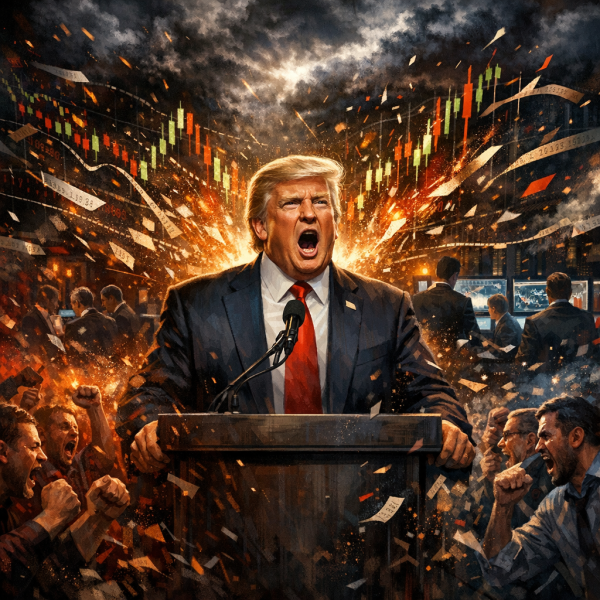
Call it crude if you like, but the pattern is simple and clean, a sequence of statements, reversals, and contradictions that move markets not gently but with force, the kind of environment that, to put it mildly, is a manipulator’s dream come true, and for those positioned ahead of it this is not noise, it is signal with timing and deadly precision. Mencken would have called it the public chasing its own tail while someone else counts the money.
We ran a simple exercise using some of our own plays. If you knew what was coming, you could go full cannonball mode, redeploying capital after each move instead of scaling. Even on a conservative run, the returns push into the 300% range since his election. Move that into futures and options, and the numbers stretch toward 3000%.
The irony sits in plain view. The more polarised the crowd becomes, the cleaner the opportunity for those outside it. What one side calls noise starts to resolve into structure for another, not through brilliance but through repetition. Once behaviour is compressed into a predictable pattern, the outcome is no longer a mystery, and all that’s left is timing.
Obviously we don’t know what he is going to do, so the scenario can’t be traded as fact, but logic has a habit of narrowing the field, and in a system openly driven by greed, where money does not just lead but dictates tempo, the rest of the cast does not play second fiddle but something closer to tenth, it follows that someone, somewhere, is positioned to benefit from the movement rather than react to it, because volatility is a trader’s best friend only in theory, in practice it becomes something closer to a partner when the timing is known in advance, and at that point the comparison to other forms of advantage starts to look less like exaggeration and more like an uncomfortable observation, low apparent risk paired with asymmetric gain has always attracted the same type of behaviour across markets and history.
So are we saying this is happening, that is not the claim, but the pattern is old and well documented, and it does not require invention, because when governments and corporations direct attention toward a single focal point and sustain it by steadily increasing levels of outrage, revulsion, and emotional fatigue, it tends to follow the structure described long ago by Charles Mackay and sharpened in tone by H. L. Mencken, where the mechanism is not persuasion but management of attention, the crowd is not guided by clarity but by agitation, and once that state is reached it becomes easier to redirect support toward causes that feel urgent rather than those that are examined, a pattern that Jonathan Swift would recognize as a kind of polite absurdity and Mark Twain would likely reduce to a simpler observation about repetition and belief, because each cycle promises correction and delivers continuity, each new group arrives as a counterforce and settles into the same incentives, and nothing materially changes except the narrative, while in the background the system continues to extract, steadily and without interruption, from both sides of the argument.
Conclusion
So the line is simple, focusing on the polarising factors does one thing well, it raises your blood pressure, narrows your field of view, and leaves you with nothing you can act on, and over time that is not just emotional cost but financial cost, because while attention is being pulled into outrage the underlying movement continues without you, so the only workable response is to step outside it, follow the money, track the pattern, and let the structure reveal itself, because what looks chaotic at the surface tends to resolve into something ordered once you stop reacting to it, and at that point it starts to resemble an illusionist’s trick performed in real time, not because it is mystical but because your attention was directed elsewhere while the mechanism did its work.
Now take it one step further, assume nothing but incentives, and the question shifts from personality to utility, because if repeated statements, reversals, and contradictions consistently move markets, then the value is not in the message but in the reaction it produces, and if that reaction is both predictable and frequent it becomes something that can be positioned around, which leads to an uncomfortable but straightforward thought, the environment itself becomes useful to those operating at scale, not because they control every move but because they understand the pattern well enough to extract from it, and the more reviled the figure becomes the easier it is to sustain misdirection, as attention stays locked on emotion while the actual transfer of value happens quietly in parallel.
In Plain Terms: Noise for Many, Signal for Few
Imagine knowing Trump’s words before they land, not for insight but for positioning, because they move markets, and that alone gives them value to the right players, the larger operators have likely done better from that volatility than under almost any other sitting president, and the revulsion surrounding it serves a second function, it fixes attention on outrage while the real movement happens quietly in full view.