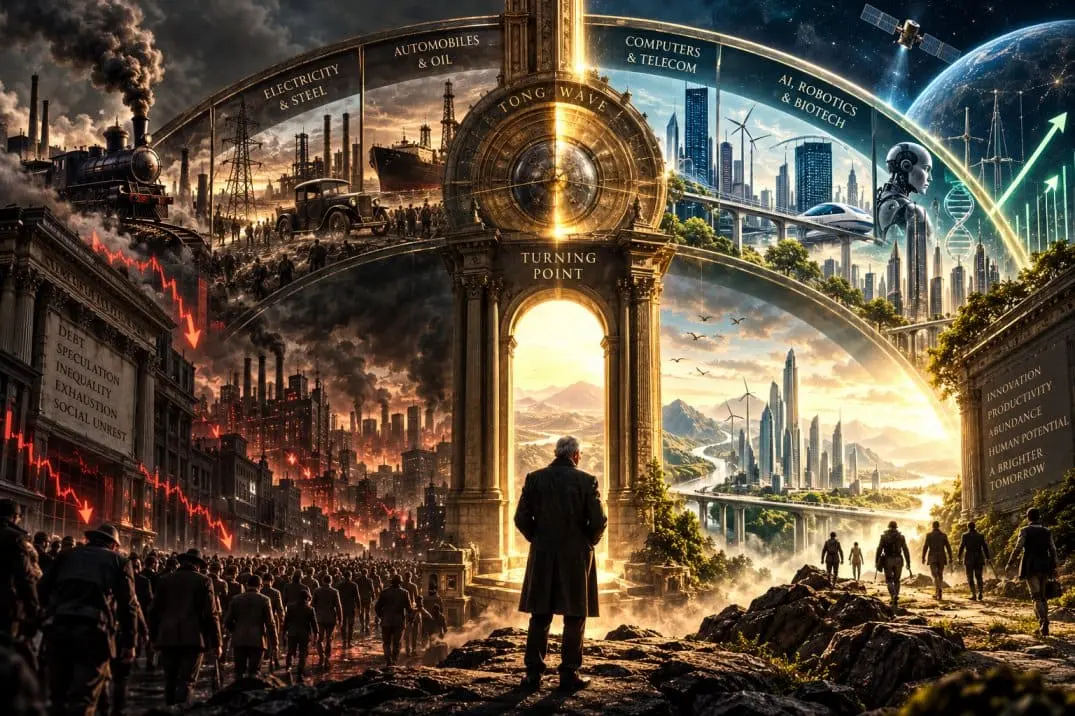
Kondratieff Cycle: The Economic Turning Point That Could Decide What Comes Next
Sept 11, 2026
The Long Wave Has No Signpost.
The Kondratieff Wave is usually presented as a 40-to-60-year economic rhythm moving through Spring, Summer, Autumn, and Winter, as though someone eventually puts a sign beside the road announcing which season has arrived. Real economies are considerably less cooperative, because debt does not disappear simply because a cycle says it should, technological revolutions can erupt inside periods of financial exhaustion, wars can accelerate industrial investment while simultaneously destroying purchasing power, and human beings can remain euphoric long after the underlying economic structure has begun deteriorating.
That is why the Kondratieff framework is more useful as a map of interacting forces than as a calendar. The original long-wave idea associated with Nikolai Kondratieff attempted to identify recurring patterns in prices, production, investment, and economic transformation over very long periods, but applying the framework mechanically creates the illusion that history moves through four neatly separated boxes. It does not, because the economic system is constantly carrying remnants of the previous cycle into the next one, creating overlaps in which old debt structures coexist with new technologies, declining institutions coexist with emerging ones, and exhausted narratives can temporarily produce spectacular asset bubbles.
So where are we now? The honest answer is more interesting than simply declaring that we are in Winter or Spring. We appear to be in a transitional environment in which the forces normally associated with late-cycle exhaustion are colliding with technologies and capital expenditures that look unmistakably like the beginning of another productive expansion. That contradiction is the story.
The Strange Season We Are Living Through
The conventional Kondratieff interpretation says Winter is associated with debt liquidation, deflationary pressure, financial stress, social instability, and the eventual restructuring that clears the way for another expansion. Yet the world has repeatedly demonstrated an ability to postpone liquidation through monetary intervention, fiscal spending, financial engineering, and institutional adaptation, which means the old cycle can remain alive long after the conditions that supposedly should have ended it have appeared.
Global public debt reached just under 94% of GDP in 2025 and the IMF projects it could reach 100% by 2029, while rising interest burdens, defense spending, strategic investment, and changes in sovereign debt markets are creating additional pressure on fiscal systems. The United States alone carried general government debt equivalent to 123.9% of GDP in 2025, with the IMF projecting the ratio could exceed 140% by 2031 under its baseline assumptions. That looks like Winter, but then something strange happens.
The global economy has not collapsed under the weight of those liabilities. The IMF currently projects global growth of approximately 3% in 2026 and 3.4% in 2027, while simultaneously warning that inflation has stopped declining smoothly and that geopolitical conflict, high debt, financial repricing, and disappointment over AI productivity could create significant downside risks. That looks less like a traditional Winter and more like an economic system refusing to choose a season, and that is precisely why the framework becomes interesting.
The New Spring Is Arriving Through a Winter Door
AI may represent one of the clearest examples of this contradiction. The technology itself is extraordinarily productive, but the infrastructure required to build it is capital intensive, energy intensive, and increasingly dependent on debt and financial markets. The IEA estimates that capital expenditure by five major technology companies exceeded $400 billion in 2025 and could rise another 75% in 2026, while global data-center electricity consumption is projected to roughly double from 485 TWh in 2025 to around 950 TWh by 2030.
That is classic expansionary behaviour. Capital is pouring into a new technological architecture, enormous amounts of infrastructure are being built, energy systems are being redesigned, and investors are attempting to identify the companies that will control the next productivity wave. At the same time, the financing structure underneath the boom is becoming increasingly important, with Reuters reporting that AI-related debt issuance had approached $500 billion by early August 2026 and that lenders were becoming more cautious as power constraints, project delays, and questions about returns increased.
So perhaps the more useful description is not Spring or Winter. It is Spring growing through the ruins of Winter. This matters because the greatest economic transitions rarely arrive after the old system has been completely dismantled. They usually emerge while the old system is still fighting for survival.
The Five Forces Shaping the Next Wave
Debt Saturation
Debt remains one of the strongest late-cycle forces because governments have increasingly relied on borrowing to postpone difficult adjustments, while households, corporations, financial institutions, and governments have become more sensitive to interest rates and refinancing conditions. The IMF’s warning that global public debt could reach 100% of GDP by 2029 is therefore more than a large number on a spreadsheet because high debt reduces the room policymakers have to respond when the next major shock arrives.
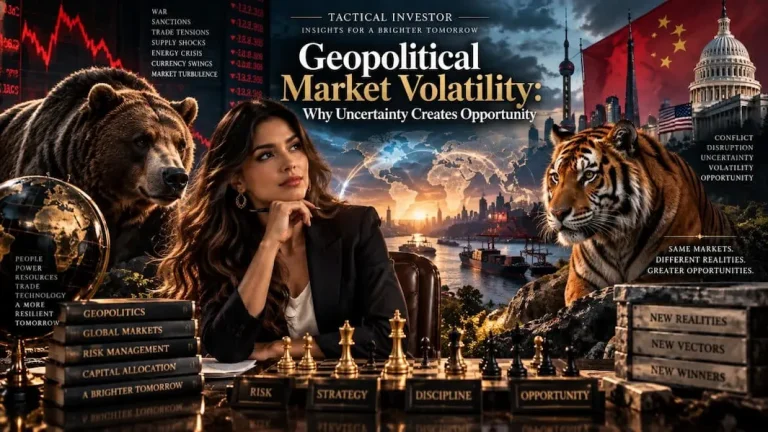
But debt does not automatically produce collapse. That is where mass psychology enters the equation, because debt becomes dangerous when confidence in the ability to service, refinance, or inflate away that debt begins deteriorating. Until that psychological transition occurs, an apparently unsustainable system can continue functioning for far longer than the pessimists expect.
Technological Acceleration
AI, robotics, biotechnology, energy storage, advanced computing, nuclear power, and automation represent the strongest argument against declaring that the global economy is simply entering a long Winter. The investment cycle surrounding AI is already spilling into electricity generation, transmission, cooling, semiconductor manufacturing, data centers, and infrastructure, with the IEA expecting data-center electricity demand to approach 950 TWh by 2030.
The psychological component is equally important because technological revolutions produce their own investment feedback loops. Investors see productivity potential, capital flows toward the perceived winners, rising valuations attract additional capital, and the rising valuations themselves become evidence that the revolution is real, which can eventually create a dangerous separation between genuine technological transformation and speculative excess.
Energy and Resource Constraints
The AI boom is also revealing an older economic truth that cannot be digitized away: every technological revolution eventually encounters physical constraints. Data centers need electricity, electricity requires generation and transmission, generation requires fuel or infrastructure, infrastructure requires capital, and capital must eventually earn a return.
The IEA expects global data-center electricity demand to more than double by 2030, while U.S. electricity demand is already projected to reach record levels in 2026 and 2027 as AI data centers and broader electrification increase consumption. This creates an unusual situation in which the supposedly weightless digital economy is generating enormous demand for very physical things such as copper, uranium, natural gas, transformers, grids, land, cooling systems, and power generation. The future may be digital. The infrastructure supporting it is not.
Geopolitical Fragmentation
The old global economic architecture is also changing as governments place greater emphasis on strategic autonomy, defense spending, domestic supply chains, critical minerals, energy security, and technological sovereignty. The IMF’s 2026 outlook explicitly identifies geopolitical fragmentation and higher defense spending as important forces shaping the economic environment, while noting that defense buildups can temporarily stimulate activity but also increase deficits and debt.
This is another reason the old Kondratieff labels become inadequate. A new investment cycle can be driven not merely by consumer demand but by governments spending enormous sums to secure energy, technology, defense, and supply chains. That is a different form of economic expansion, one that can coexist with fiscal deterioration and geopolitical stress.
Monetary Repositioning
Gold provides another clue. Central banks continued accumulating gold in 2026, with the World Gold Council reporting a net increase of 41 tonnes in official reserves in May, led by countries including Poland and China. This does not mean the dollar is about to disappear or that gold automatically rises forever, but it does indicate that some institutions are increasingly interested in diversifying reserves and reducing dependence on a single monetary architecture.
The signal is therefore more subtle than “buy gold because the dollar is dead.” The deeper signal is that confidence in the existing monetary structure is being supplemented by demand for assets outside it. That is psychologically significant.
Mass Psychology Is the Missing Clock
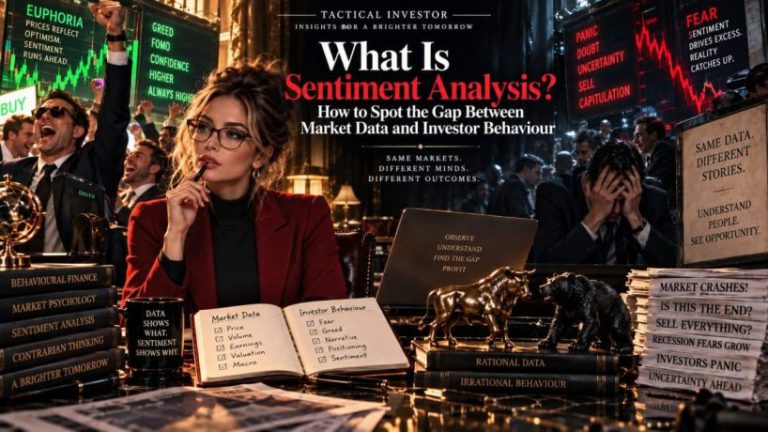
A long-wave cycle can tell you that the system is under pressure, but it cannot tell you when millions of people will suddenly decide that the pressure matters. That transition is governed by mass psychology, because markets do not respond mechanically to debt ratios, technological breakthroughs, demographic statistics, or geopolitical maps; they respond when human beings collectively interpret those facts and move capital accordingly.
This is why the same fundamental condition can produce completely different market outcomes at different points in time. High debt can coexist with a roaring bull market when confidence remains strong, while a comparatively modest deterioration can produce a violent liquidation when confidence is already fragile and participants are positioned in the same direction.
The crowd therefore becomes part of the cycle itself. When everyone believes that AI will transform everything, capital flows toward AI. When the narrative becomes saturated, expectations become extreme and valuations begin assuming perfection. When the technology continues improving but the market stops responding to good news with higher prices, the psychological force supporting the move may be weakening even though the underlying technology remains powerful. That is the distinction between a good technology and a good investment at a particular price.
The Vector Is Hidden Inside the Contradiction
The most useful way to read the current environment is therefore not to ask which season we are in, but to identify the forces competing for control. The debt force is pushing toward fiscal restraint, inflation, higher risk premiums, or eventual restructuring. The technological force is pushing toward productivity, capital expenditure, energy demand, automation, and potentially a new investment supercycle. Geopolitical forces are pushing toward fragmentation and strategic self-sufficiency, while monetary forces are simultaneously encouraging governments and investors to diversify away from concentrated exposures.
These forces do not move independently. They collide and when they collide, the market’s behaviour becomes particularly informative because price reveals which force is temporarily gaining control.
If AI investment continues expanding while valuations remain elevated and credit spreads stay contained, the expansionary force remains dominant. If AI spending continues but financing becomes increasingly expensive and project returns deteriorate, the expansion may be entering saturation. If commodity demand rises while economic growth weakens, the system may be moving toward a more complicated inflationary regime rather than the clean deflationary Winter many expect. This is vector psychology in practice, even when we do not use the word. Direction matters, but so do intensity, breadth, persistence, and exhaustion.
The Psychology of the Kondratieff Extremes
Every major cycle creates a period when the dominant narrative becomes so persuasive that questioning it feels almost irrational. In the early 1980s, inflation had become psychologically exhausting, interest rates were extraordinarily high, and confidence in traditional financial assets had suffered. In 2009, the psychological environment was almost the mirror image, with investors terrified of another collapse even as valuations and liquidity conditions were beginning to change.
The opportunity was not created simply because the economic cycle had turned. It was created because the crowd had become emotionally positioned for the past to continue. That is the recurring mechanism.
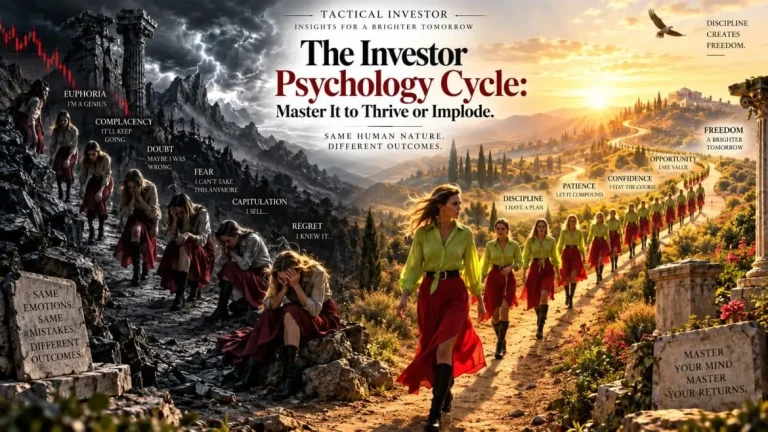
People extrapolate recent experience into the future, institutions build strategies around the prevailing regime, financial media reinforces the dominant narrative, and investors become increasingly comfortable with the idea that the current environment is permanent. Then something changes, and because the crowd is positioned around yesterday’s reality, the transition can become violent. That is why psychological exhaustion is often more useful than the calendar.
So Where Are We?
If forced to use the traditional Kondratieff language, the evidence suggests we are somewhere between late Winter and early Spring, but that answer is almost too neat to be useful. The more defensible interpretation is that the liquidation phase has never been fully completed because policymakers repeatedly intervened, while the technological and infrastructure investment associated with a new expansion has already begun operating at scale. In other words, the old cycle may not have died cleanly. It may be mutating.
That would explain the strange combination now visible across the global economy: historically high public debt alongside continued economic growth, aggressive AI investment alongside rising concerns about valuation and leverage, gold accumulation alongside continued dollar dominance, geopolitical fragmentation alongside resilient global trade, and inflation risks alongside technological forces capable of increasing productivity. The contradictions are not necessarily evidence that the framework has failed. They may be the evidence that the system is transitioning.
The Portfolio for an Uncertain Season
A transitional environment requires something different from a one-dimensional portfolio because the investor cannot know which force will dominate next. Hard assets can provide exposure to monetary and geopolitical stress, technology can capture productivity and capital-spending cycles, deep value can provide exposure to assets abandoned by the crowd, while cash and short-duration instruments preserve the optionality required to exploit sudden dislocations.
That does not mean buying everything. It means understanding why each position exists and what force would cause it to outperform. Gold, for example, can function as monetary insurance rather than merely an inflation trade, particularly when central banks continue accumulating reserves. Energy infrastructure and resource producers can benefit from the physical demands created by AI, while technology companies can benefit from productivity gains but remain vulnerable if expectations become disconnected from actual returns.
And then there is the most important asset of all during a transitional cycle: Liquidity. Cash is not necessarily a declaration that the market is going down. It is the ability to act when the market finally reveals which force has won.
Do Not Forecast the Season. Watch the Transition.
The greatest mistake with Kondratieff analysis is trying to force the present into a historical template and then assuming that the template will tell you what happens next. Long waves are useful because they remind us that economic systems have deep rhythms involving debt, innovation, demographics, resources, institutions, and psychology, but they become dangerous when those rhythms are treated as precise clocks capable of producing investment timing.
The better approach is to watch for convergence. When valuations become extreme, sentiment becomes euphoric, breadth deteriorates, financing becomes more fragile, and the dominant narrative requires increasingly perfect outcomes, the expansionary force may be approaching saturation. When prices collapse, sentiment reaches despair, quality assets are indiscriminately liquidated, and additional bad news produces diminishing downside, the destructive force may be exhausting itself.
That is where the opportunity appears. Not because a textbook says Winter has ended and not because a calendar says Spring has begun, but because the force moving capital has changed.
The Kondratieff Cycle Is Not a Circle
The Kondratieff Wave is better understood as a recurring pattern of transformation than as a clock that faithfully moves from one season to another. Economic systems accumulate debt, develop new technologies, exhaust old technologies, restructure institutions, experience demographic changes, encounter wars and resource constraints, and then generate new forms of investment and production that eventually alter the psychology of the entire system.
The cycle therefore behaves less like a circle and more like a constantly changing landscape. Sometimes the landscape looks familiar; Sometimes it becomes almost unrecognizable, and right now, the landscape is strange.
Debt is enormous, but the economy is still growing. AI is producing genuine technological acceleration, but speculation is already appearing around the technology. Gold is attracting official demand, yet the dollar remains dominant. Energy demand is rising because of a digital revolution that increasingly depends on physical infrastructure, while geopolitical fragmentation is forcing governments to spend more on resilience and defense. That is not a clean season. It is a transmutation zone.
The investor’s job is not to stand there demanding that the fog clear before acting. The investor’s job is to watch the pressure building underneath the fog, identify which forces are gaining strength, recognize where the crowd has become most confident, and prepare capital for the moment when the contradiction resolves itself. Because eventually it will. The question is not whether the next Kondratieff transition is coming. The question is which force will be holding the steering wheel when the old world finally loses control.