May 22, 2026
There’s a strange thing that happens every time the word “recession” hits the headlines. Otherwise rational people, the kind who carefully compare grocery prices and refuse to pay full price for a sweater, suddenly rush to sell perfectly good stocks at a 30% discount. It’s one of the great ironies of modern investing: humans hunt for bargains everywhere except in the stock market.
And yet, history keeps whispering the same lesson. Every recession fear buying opportunity has rewarded those who could keep their hands steady while everyone else hit the panic button. The trick isn’t predicting the future. It’s understanding the crowd you’re standing in.
The Psychology Behind Recession Panic
Fear is contagious. Not in a poetic sense, in a biological one. When markets drop, our brains light up the same regions that fire when we see a snake or hear footsteps behind us in a dark alley. The amygdala doesn’t know the difference between a tiger and a tumbling S&P 500. It just screams: run.
This is why recessions create some of the best buying opportunities in a generation. Not because the economy is secretly fine, it’s usually genuinely ugly, but because prices fall far below what the underlying businesses are actually worth. Fear overshoots. It always does. The crowd doesn’t sell because they’ve done the math; they sell because everyone else is selling, and standing alone feels dangerous.
Why the Herd Is Almost Always Late
Here’s a small joke the market plays on retail investors: by the time “recession” is on every news channel, the worst is often already priced in. Markets are forward-looking creatures. They sniff trouble months before economists confirm it, and they start recovering months before the headlines turn cheerful.
Consider the timeline of a typical downturn:
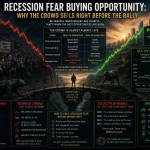
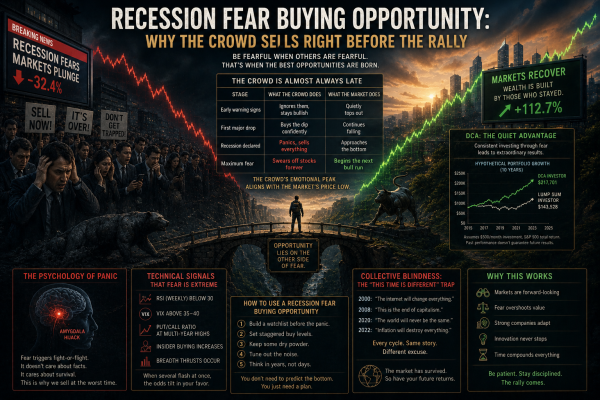
| Stage | What the Crowd Does | What the Market Does |
|---|---|---|
| Early warning signs | Ignores them, stays bullish | Quietly tops out |
| First major drop | Buys the dip confidently | Continues falling |
| Recession declared | Panics, sells everything | Approaches the bottom |
| Maximum fear | Swears off stocks forever | Begins the next bull run |
You’ll notice the pattern. The crowd’s emotional peak almost perfectly aligns with the market’s price low. That’s not a coincidence. That’s mass psychology in motion.
The Technical Side of Fear
Charts tell the same story numbers do, just more honestly. During recession scares, you’ll often see capitulation candles, those long, ugly red bars on high volume where everyone who was going to sell finally does. Volume spikes, RSI drops into oversold territory (often below 30), and sentiment indicators like the VIX shoot through the roof.
Smart investors watch for a few signals during these moments:
- Extreme oversold readings on weekly RSI
- VIX above 35 or 40, signaling outright panic
- Put/call ratios at multi-year highs
- Insider buying picking up while retail sells
- Breadth thrusts, where most stocks suddenly stop falling together
None of these are crystal balls. But when several flash at once, the odds tilt toward a recession fear buying opportunity worth taking seriously.
The DCA’d Investor’s Quiet Advantage
Let’s talk about the investor who DCA’d through the whole thing, dollar-cost averaged through every scary headline, every red Monday, every dinner party where someone confidently announced “the system is broken.” That person rarely makes the news. But they tend to retire earlier than the people who tried to time the bottom.
Dollar-cost averaging is boring on purpose. It strips emotion out of the equation by forcing you to buy on a schedule, regardless of how the market feels that morning. During recessions, those scheduled buys land on heavily discounted shares. The investor doesn’t need to be brave; they just need to be consistent. Which, frankly, is harder than it sounds.
Collective Blindness and the “This Time Is Different” Trap
Every recession comes wrapped in a story about why the rules have changed. In 2008 it was the death of banks. In 2020 it was the death of cities. In every cycle, there’s a fresh reason to believe stocks will never recover. This is collective blindness, the inability of a crowd to see past its current emotional state.
The truth is less dramatic. Economies cycle. Companies adapt. Innovation continues. The S&P 500 has lived through world wars, oil shocks, pandemics, banking collapses, and currency crises, and the long-term chart still slopes upward from the lower left to the upper right. Not in a straight line, but reliably enough that betting against it has been a losing strategy for over a century.
How to Actually Use a Recession Fear Buying Opportunity
Knowing the theory is easy. Acting on it is where most investors stumble. Here’s a practical framework that doesn’t require predicting the bottom:
- Build a watchlist before the panic. Decide which companies you’d love to own at a discount. When fear hits, you won’t be in the right headspace to research.
- Set staggered buy levels. Don’t dump your cash in at one price. Spread it across several entry points, 10% down, 20% down, 30% down.
- Keep some dry powder. Cash feels useless during bull markets and priceless during bear ones.
- Tune out the noise. Financial media earns clicks from fear. That’s their job. It doesn’t have to be yours.
- Think in years, not days. The recovery rarely happens on a tidy schedule, but it tends to happen.
The Contrarian Mindset Isn’t About Being Stubborn
People often confuse contrarian investing with simply doing the opposite of the crowd. That’s not quite right. The crowd is usually correct during the trend, it’s only wrong at the extremes. The skill is recognizing when emotion has overtaken logic, when prices have detached from value because too many people are too scared to think clearly.
Warren Buffett’s famous line about being “greedy when others are fearful” gets quoted to the point of cliché, but few actually practice it. The reason is simple: it feels terrible. Buying when everyone else is selling means going home, looking at your portfolio bleeding red, and resisting the urge to join the panic. It’s not glamorous. It’s just profitable.
Final Thoughts
A recession fear buying opportunity isn’t really about the recession at all. It’s about the fear, and what fear does to prices. Markets are auctions, and auctions held during emergencies tend to produce bargains for whoever can keep their wits.
The next time you hear the word “recession” repeated on every channel, remember that the real opportunity isn’t in predicting the economy. It’s in understanding the crowd. Because the crowd, bless its panicked heart, is reliably wrong at exactly the moments that matter most.