
Markets Move at a Speed Humans Cannot Operate In
Mar 6, 2026
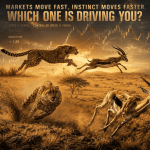
The most important change in modern markets is not leverage, complexity, or information. It is speed.
Markets now operate at multiple speeds simultaneously, and humans only function in one of them. That mismatch explains a large share of modern dislocations, sudden breaks, and policy confusion. It also explains why experienced participants often feel “late” even when they are early.
Speed is not acceleration. It is cadence. Early markets moved at human speed. Prices updated when trades occurred. Information traveled slowly. Decisions unfolded over hours, days, sometimes weeks. Feedback loops existed, but they were loose. Errors could be corrected before they compounded.
That environment no longer exists. Modern markets are layered. Some participants operate in milliseconds. Others operate daily. Others quarterly. Others politically. Each layer responds to different signals, but they interact through the same price mechanism.
Price becomes the collision point. Technically, this creates instability because fast systems respond to microconditions while slow systems respond to narratives. When these responses align, markets feel smooth. When they diverge, markets fracture.
Humans always sit in the slow layer.
Latency Is Not Caution
Psychologically, humans cannot process continuous feedback at market speed. The brain evolved for episodic information, not constant update. When price updates faster than cognition, people default to heuristics. They simplify. They anchor. They delay.
Delay is not caution. It is latency. Latency matters because fast systems do not wait. Algorithms respond to price, volatility, order flow, and liquidity changes immediately. They do not ask why. They do not contextualize. They execute.
Humans interpret. Machines react. When markets move slowly, interpretation works. When markets move quickly, reaction dominates. This is why sudden breaks feel confusing. By the time humans form an explanation, the move is over.
Technically, this shows up as gap risk. Price jumps through levels without trading. Stops trigger at worse prices than expected. Hedging fails because execution lags.
The human experience is shock. The market experience is routine.
Causality Gets Reversed
Speed mismatch also distorts perception of causality. Humans search for reasons after moves. Headlines get assigned. Narratives form. This creates the illusion that events caused price.
Often, price caused the event. Fast systems move first. Liquidity pulls back. Price gaps. Then humans react. Policy makers respond. Media explains. The sequence gets reversed in storytelling.
This reversal matters because it teaches the wrong lessons.
Psychologically, people believe they need better foresight. In reality, they need better preparation for speed transitions. Most losses do not come from being wrong about direction. They come from being wrong about tempo.
Tempo is harder to see.
When Speed Flips
Modern market stability often depends on fast systems dampening volatility. Market makers. Volatility sellers. Systematic rebalancers. These participants smooth movement as long as conditions stay inside expected ranges.
When conditions breach those ranges, speed flips. Fast systems withdraw or reverse. Liquidity disappears. Price accelerates. Humans are still processing the last calm moment when the environment has already changed.
This creates a sense of betrayal.
“It was fine five minutes ago.”
“Nothing new happened.”
“There was no warning.”
There was warning. It existed at a speed humans do not monitor.
Technically, warning signs appear as microstructure shifts. Order book thinning. Increased short-term volatility. Rising intraday correlations. These signals are real, but they operate below human attention thresholds.
Institutions rarely act on them because they are noisy and politically difficult to justify.
Career incentives favor slow confirmation.
Reflexivity at Machine Speed
Another consequence of speed mismatch is reflexivity. Fast systems amplify moves that humans interpret as information. A price drop triggers algorithms. The drop accelerates. Humans see acceleration and infer meaning. They sell. The loop tightens.
At no point does fundamental information need to change.
This is why explanations after crashes often feel hollow. The cause was structural, not informational. Speed created its own reality.
Policy makers struggle with this because policy operates at human and political speed. Decisions take time. Announcements take time. Implementation takes time. Markets move regardless.
This gap creates a dangerous illusion. Each intervention appears reactive, not preventive. Confidence erodes not because policy is wrong, but because it is late by design.
Markets sense this. Psychologically, participants internalize the idea that policy will always arrive after damage begins. This expectation changes behavior. People front-run interventions. They take more risk in calm periods. They sell faster in stress.
Speed accelerates again.
Crowd Acceleration and Air Pockets
Another distortion comes from communication speed. News travels instantly. Opinions propagate faster than understanding. Social amplification compresses reaction time further. Humans respond not just to price, but to each other’s responses to price.
This creates crowd acceleration.
Technically, this shows up as air pockets. Once selling begins, bids vanish because nobody wants to step in front of momentum they cannot outrun. Markets gap not because of fear, but because of asymmetry in reaction speed.
Buying requires deliberation. Selling can be immediate.
This asymmetry matters.
No True Insulation
Long-term investors often believe their horizon protects them. In principle, it does. In practice, speed still matters because portfolios are marked continuously. Risk limits get triggered. Collateral requirements adjust. Even long-term capital is forced to respond to short-term speed.
There is no true insulation. Psychologically, this creates cognitive dissonance. Investors believe they are long-term, but their structures force short-term action. This tension leads to poor decisions under stress.
They exit positions they still believe in because systems demand it.
Speed mismatch also explains why “nothing breaks until everything breaks.” Systems can absorb small shocks quickly. They cannot absorb regime changes slowly. When speed transitions occur, the move feels discontinuous.
Humans expect continuity. Markets deliver phase shifts.
What Experienced Operators Change
Experienced operators adapt by focusing less on prediction and more on readiness. They assume that when breaks occur, they will happen faster than comfortable. They design exposure accordingly.
This means less leverage, wider margins, fewer assumptions about execution quality.
These choices look conservative in calm periods. They look obvious in hindsight.
Another adaptation is recognizing when speed is increasing even if direction is unclear. Rising intraday volatility. Faster rotations. More violent responses to small news. These are tempo signals, not directional ones.
Ignoring them is costly.
Calm Plus Speed Is Unstable
The hardest part is psychological acceptance. Humans want reasons. They want narratives. They want to believe that understanding precedes movement. In modern markets, movement often precedes understanding.
This does not mean markets are random. It means causality operates at different speeds for different participants.
The slowest participant sets the story. The fastest participant sets the price. By the time the story makes sense, price has already moved to where it needs to be.
This is why experience matters more than intelligence. Experience teaches humility about speed. It teaches that comfort is not a signal. It teaches that when markets feel calm and fast at the same time, danger is near.
Calm plus speed is unstable.
The Structural Solution
The central mistake is believing that better analysis solves speed mismatch. It does not. Analysis takes time. Time is the scarce resource in fast transitions.
The solution is structural. Fewer dependencies. Less leverage. More optionality. Acceptance that some moves cannot be traded, only survived.
Markets are no longer environments humans control. They are environments humans inhabit alongside machines that do not hesitate.
Those machines do not panic. They do not doubt. They do not freeze.
Humans do. The future of market risk will not be defined by what people think. It will be defined by how quickly systems force them to act.
Speed is not the enemy. Ignoring it is.
And markets do not slow down to let anyone catch up.