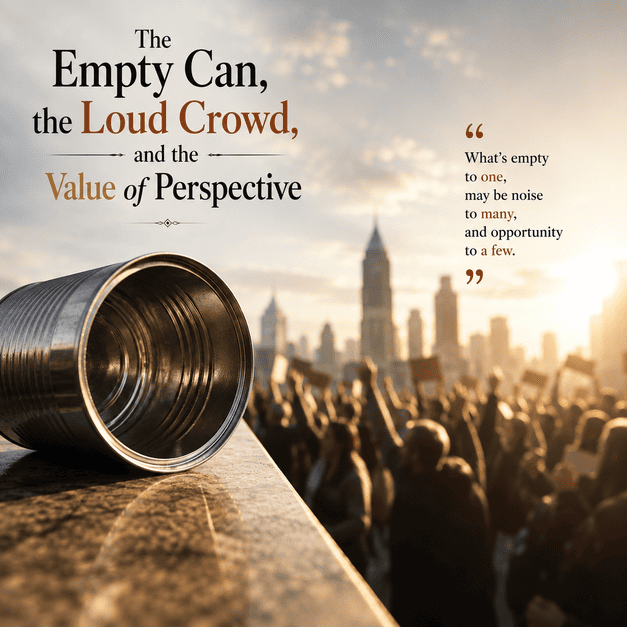
The Empty Can, the Loud Crowd, and the Value of Perspective
Aug 14, 2026
There is a peculiar habit in modern life, particularly around markets, politics and technology, where the loudest opinion is often mistaken for the most valuable one. I have never been particularly interested in following that habit because volume and substance are not the same thing, and the old expression that an empty can makes the most noise remains remarkably useful when examining how narratives spread through a crowd. The louder the certainty becomes, the more carefully I want to examine what is actually underneath it.
This is especially relevant when discussing subjects such as the supposed death of the dollar, the collapse of the Western financial system or the endless predictions of an imminent economic catastrophe. Many of these arguments are not new, even when the packaging is new, because some commentators have been forecasting the same ending for decades while repeatedly moving the deadline whenever reality refuses to cooperate. Civilisations change, currencies rise and fall, institutions weaken and rebuild, markets crash and recover, and yet the deeper pattern remains cyclical rather than terminal.
Nothing truly ends in the way people imagine it will. Systems mutate, power shifts, narratives disappear and return in different clothing, while the underlying incentives continue generating new versions of old behaviour. Life is the obvious exception, because eventually every cycle reaches a terminal point, but that is a different discussion; what matters here is that markets and institutions should be studied as adaptive systems rather than treated as stories with predetermined endings.
The Crowd Wants a Conclusion, Reality Gives It a Cycle
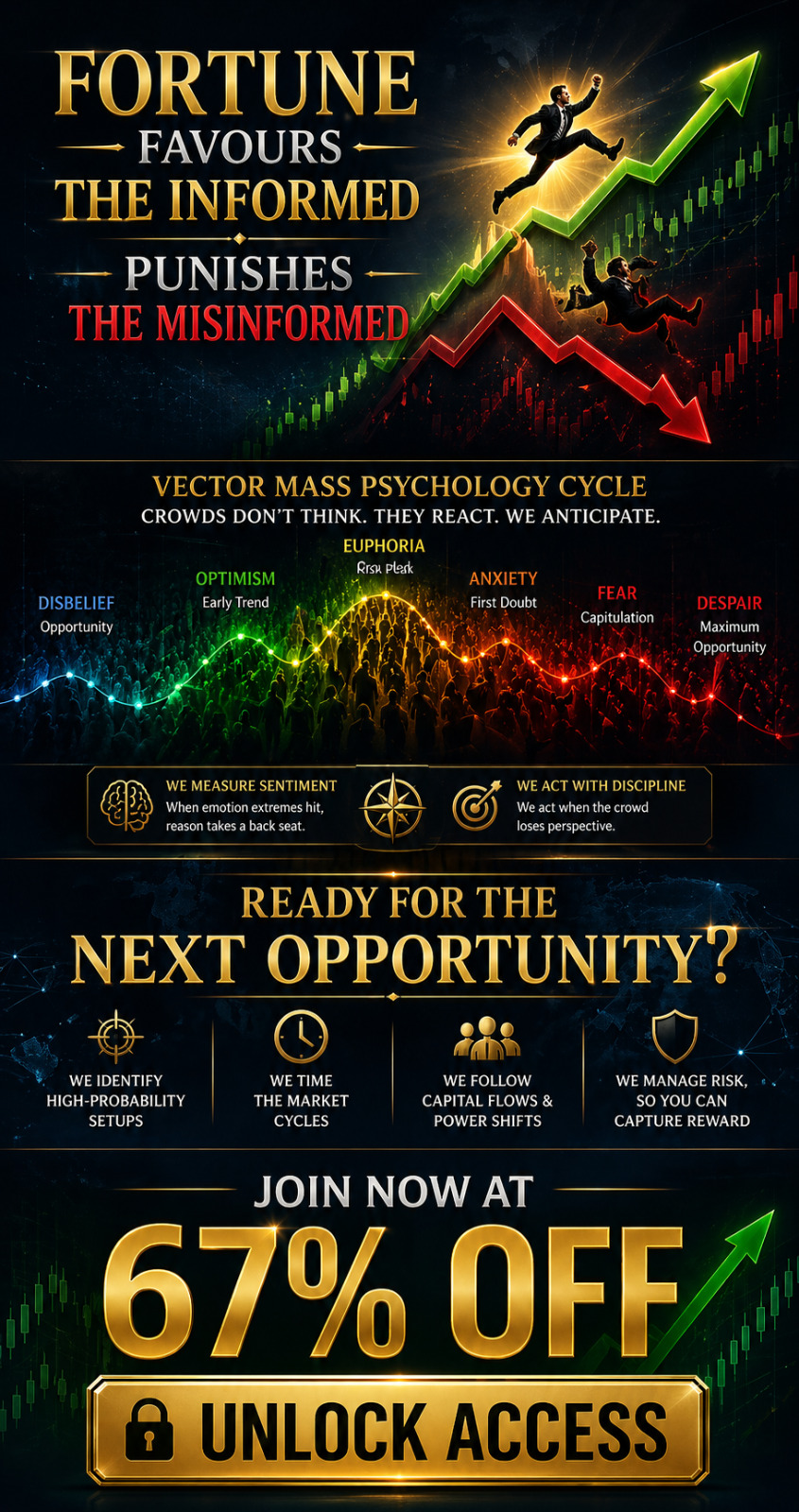
Mass psychology becomes dangerous when people stop observing cycles and begin demanding final answers. The crowd wants to know whether the dollar is dead, whether America is finished, whether AI will replace everyone, whether the market will crash or whether gold will rise forever because certainty reduces the discomfort created by uncertainty. The problem is that certainty is often most expensive precisely when the underlying system remains most dynamic.
George Soros built much of his thinking around reflexivity, the idea that perceptions can influence reality and reality can then reshape perceptions. That feedback loop explains why narratives can become temporarily powerful without necessarily becoming permanently correct, because enough people acting on a belief can make the belief appear true until the underlying conditions change. Daniel Kahneman approached the problem from another angle, showing how human beings systematically rely on shortcuts and biases when dealing with uncertainty, which helps explain why a dramatic narrative can become psychologically stronger than a complicated reality.
The market therefore rewards neither optimism nor pessimism by itself. It rewards understanding the vector created when enough participants adopt the same interpretation and begin acting on it, which is why a mediocre argument can move billions while a brilliant argument can remain irrelevant if nobody has embraced it. The important question is not which expert sounds most intelligent; it is which narrative the crowd has actually converted into behaviour.
Perspective Is Not Agreement
Perspective does not mean accepting every opinion as equally valid. It means understanding that your own interpretation is only one point inside a much larger system, and that other participants may be responding to incentives, risks and information that you have not fully considered. The ability to understand a different perspective without immediately adopting it is one of the most valuable forms of intellectual independence.
Marcus Aurelius understood something similar from a different direction. His writing repeatedly returned to the idea that events themselves do not completely determine our experience of them; interpretation, judgement and response shape what follows. That principle remains useful in markets because the same price movement can represent opportunity to one participant, danger to another and confirmation of an existing narrative to a third, even though the transaction occurring in front of all three is identical.
Machiavelli offers an even harder lesson: reality must be observed as it is, not as we wish it to be. That principle matters because investors often spend enormous amounts of energy trying to persuade reality to conform to the thesis they already hold, instead of asking what incentives are actually driving the people on the other side of the trade.
This is where perspective becomes a weapon. You do not need to believe the crowd. You need to understand what the crowd believes well enough to anticipate what it might do next.
AI Is a Perfect Example of Narrative Becoming Reality
Artificial intelligence provides perhaps the clearest modern example of this process because the technology is real, the productivity gains are real and the investment opportunity is real, yet the narrative surrounding those facts can become distorted very quickly. Some companies have begun talking as though they are approaching an understanding of human intelligence while still struggling with fundamental questions about reasoning, uncertainty, agency and context, which creates a strange gap between technological progress and the claims being made about it.
That is why I have described part of the current AI narrative as Artificially Inflated. The phrase is not a denial of the technology; it is a warning about what happens when a genuine technological revolution becomes surrounded by expectations that grow faster than the evidence supporting them. Every distorted narrative creates an opportunity because when expectations become detached from reality, capital begins flowing according to the narrative rather than the underlying economics.
The important opportunity is therefore not necessarily to oppose AI. It is to identify where the real leverage sits beneath the obvious story. The crowd sees the visible winner, but the deeper investor asks what infrastructure, memory, semiconductor capacity, energy, networking, data and software must exist for that winner to succeed, because the largest opportunity is sometimes sitting one layer beneath the story everyone is discussing.
Experience Is Becoming a Force Multiplier
There is another development worth watching because it changes how we should think about human productivity itself. Test data from a trusted source suggests that experienced professionals, particularly those over fifty, were able to increase productivity dramatically after becoming proficient with neural-network tools, producing sophisticated results that would previously have required substantially more time or supporting labour. If that finding continues to hold across larger samples, the important story may not be that AI replaces experienced people, but that AI amplifies experience in ways that change the economics of knowledge work.
This matters because experience contains compressed information that is difficult to reproduce through raw computation. A person who understands the nuances of an industry, a market, a legal system or a technical discipline can use an AI system as an amplifier rather than as a substitute for judgement, potentially turning decades of accumulated pattern recognition into a much more productive operating system.
That creates a strange reversal in the popular narrative. Instead of asking whether machines will replace experienced people, we may eventually need to ask whether experienced people using machines will displace entire layers of average knowledge work. The difference is not technological alone; it is a vector created by the combination of human judgement, machine speed and accumulated experience. The opportunity is already here, but the crowd is still mostly arguing about the costume.
Why We Do Not Need to Chase Every Narrative
This is where the discipline becomes simple, although the conclusion is not. We do not need to answer every question, predict every crash or respond to every loud voice because the cost of attention is itself a form of capital, and wasting that capital on arguments that have no actionable consequence weakens the ability to recognise genuinely important signals.
That is also why the AI Trend Trader performance data is presented as performance data, not as a sales pitch. The current records cover 2024 through the present, with the intention of eventually expanding the historical record back toward the service’s approximate 2021 inception, and the important observation so far is that there has not been a losing year in the period compiled to date. The point is not to hype the service but to provide a transparent record that can be examined on its own terms, because performance should carry the argument rather than promotion.
The same principle applies to every market narrative. If the dollar is supposedly dying, show the evidence. If the Western system is supposedly collapsing, identify the mechanism and the time horizon. If AI is supposedly creating human-level intelligence, define what intelligence means and demonstrate the evidence rather than substituting adjectives for proof. Noise demands attention and evidence earns it.
The Final Perspective
The most valuable perspective is often the one that allows you to stop needing a definitive answer. That is not intellectual laziness; it is recognition that markets, institutions and technologies evolve through interacting forces rather than through clean conclusions, which means the investor who insists on a final answer can become trapped by the very certainty they were seeking.
Thucydides understood the persistence of human motives across changing circumstances, which is why history remains useful even when the technology, institutions and personalities have changed completely. The same forces continue to appear because ambition, fear, status, self-interest and collective identity do not disappear simply because the world acquires better tools.
That is why I prefer vectors to predictions. A prediction tells you what someone thinks will happen, while a vector asks where pressure is accumulating, which way incentives are pointing and how quickly the crowd is synchronising around a narrative. Once you think that way, the market becomes less about choosing the correct opinion and more about recognising when the system itself begins revealing where the real force lies.
Perspective does not solve problems, but it prevents small setbacks from becoming unnecessary tragedies. Time is finite, panic is optional, and the rarest asset in markets is often not information but the ability to see what is already in front of you without being overwhelmed by the noise surrounding it.
The empty can will continue making noise. Let it. The question is not how loudly it speaks, but whether there is anything inside.

Fresh Perspectives