

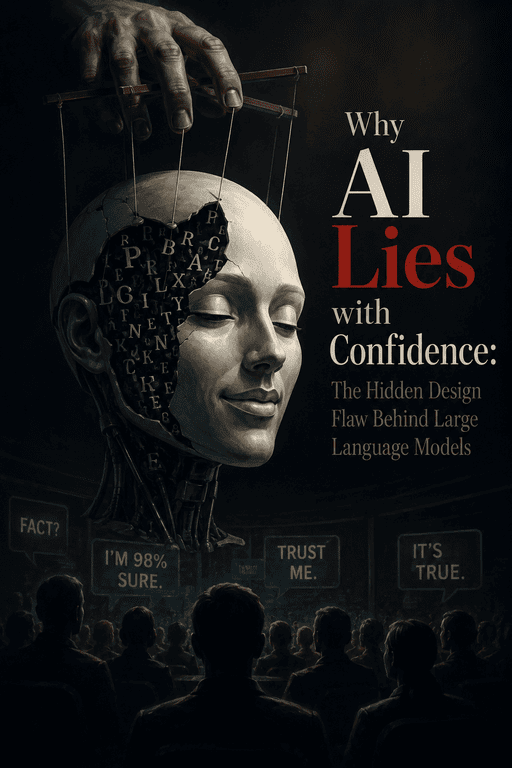
Why AI Lies with Confidence: The Hidden Design Flaw Behind Large Language Models
Aug 10, 2026
Artificial intelligence has become remarkably good at answering questions, writing code, analysing documents and explaining complex ideas. It can compress decades of scientific literature into a few paragraphs, draft legal documents in seconds and solve problems that once required teams of specialists. Yet despite these extraordinary capabilities, every major Large Language Model (LLM) shares a peculiar weakness. When it is correct, it often sounds confident. When it is completely wrong, it frequently sounds exactly the same.
That behaviour frustrates users because confidence naturally implies knowledge. Humans instinctively assume that someone who speaks with certainty probably understands what they are talking about. LLMs exploit that instinct unintentionally. They generate fluent, coherent language regardless of whether the underlying information reflects reality, creating the illusion that confidence and correctness are closely linked when, in fact, they are largely independent.
This has led many people to accuse AI systems of lying. Strictly speaking, that is not quite true. Lying requires intent. It requires knowing the truth and deliberately choosing to present something else. Today’s LLMs possess no such awareness. They do not experience belief, doubt, certainty or deception. What appears to be dishonesty is something both simpler and more profound. They have been optimised to produce language that looks plausible rather than to distinguish reliably between what is true and what merely sounds true.
Understanding that distinction explains why these systems can produce breathtaking insight one moment and complete nonsense the next without changing their tone, confidence or writing style.
The Primitive Isn’t Knowledge. It’s Prediction.
The most common misconception about artificial intelligence is that it “knows” things in roughly the same way humans do. It does not.
Modern LLMs are enormous neural networks trained on vast collections of books, articles, scientific papers, websites and countless other forms of text. During training they learn statistical relationships between words, ideas and patterns until they can predict what piece of language is most likely to come next. At every stage they perform essentially the same task:
Given everything that has already been written, what token is statistically most likely to follow?
That objective sounds deceptively simple, yet it produces astonishingly sophisticated behaviour because language contains compressed representations of much of human knowledge. The model gradually learns grammar, reasoning patterns, programming languages, mathematics, history, medicine and countless other subjects, not because it understands them in the human sense, but because accurately predicting language requires modelling many of the relationships embedded within it.
Prediction, however, is not the same as knowledge. Humans possess an internal model of reality built through direct experience. We know what uncertainty feels like. We recognise confusion, incomplete memories and conflicting evidence because our brains constantly compare incoming information with lived experience. LLMs experience none of that. They possess probabilities, not beliefs. They estimate which continuation appears most likely according to patterns observed during training, but they never experience the subjective awareness that tells a human being, I might be wrong.
Confidence Is an Illusion Created by Fluency
One of the most surprising aspects of modern AI is that confidence is largely an illusion generated by language itself. The model does not internally decide to sound confident. It simply continues producing statistically probable text, and fluent language naturally appears authoritative to human readers.
Suppose someone asks:
“Where was Napoleon born?”
The model predicts the next word after every preceding word until an answer emerges. If the underlying statistical representation strongly associates Napoleon with Corsica, it will probably generate the correct response. If a less common or highly ambiguous question appears, the same mechanism still operates. Rather than stopping, the model continues generating whatever sequence of words appears most coherent within the context of the conversation.
Humans interpret coherence as confidence.
The model experiences neither.
This distinction creates one of AI’s most persistent failure modes. Fluency is a property of language generation. Truth is a property of reality. Those two properties frequently overlap, which explains why LLMs are often remarkably accurate. They are not, however, identical. Whenever they diverge, the model may continue producing elegant prose while quietly departing from factual accuracy.
Why LLMs Don’t Simply Say “I Don’t Know”
Many users assume the obvious solution would be for AI systems to admit uncertainty more often. That turns out to be surprisingly difficult.
During training, models learn from billions of examples where questions are followed by answers. They receive continual reinforcement for completing text successfully, not for refusing to respond. If every difficult question produced the reply “I don’t know,” the model would perform poorly because many difficult questions actually do have correct answers. The safest strategy from a statistical perspective is therefore to continue generating language rather than stopping.
Human preferences reinforce this behaviour.
People consistently rate assistants more highly when they appear decisive, articulate and helpful. Responses filled with hesitation, caveats and uncertainty often receive lower ratings because users interpret caution as incompetence rather than intellectual honesty. After initial training, many models undergo reinforcement learning based on human feedback, where preferred answers receive additional weighting. Unfortunately, humans frequently reward confidence even when confidence exceeds the available evidence.
The optimisation objective gradually shifts toward producing responses that feel satisfying rather than responses that perfectly communicate uncertainty. Most of the time those goals overlap. Occasionally they diverge dramatically.
Why Hallucinations Are Almost Inevitable
Researchers use the term hallucination because the model generates information that appears internally consistent despite lacking sufficient support in reality. These hallucinations do not arise because the model intentionally invents facts. They arise because language strongly encourages completion.
Begin the sentence:
“The capital of…”
The model naturally wants to finish it.
Ask for an obscure scientific paper that never existed, and the same mechanism still attempts completion. The model may combine fragments from genuine papers, real authors and plausible journal titles into something that looks entirely authentic despite being fabricated. The output is statistically coherent because each component resembles patterns observed during training, even though the combination itself never existed.
This explains why hallucinations often appear extraordinarily convincing. They are assembled from individually plausible pieces that fit together linguistically even when they fail to correspond to reality.
The deeper issue is sometimes described as an epistemic gap. LLMs excel at modelling what people have written about the world, but modelling descriptions of reality is not identical to modelling reality itself. Most of the time the two align closely enough to produce useful answers. When they do not, the system has no independent mechanism for recognising that divergence unless additional verification tools are available.

Why AI Sometimes Sounds Like It’s Making Excuses
Another behaviour that frustrates users occurs after an error has been identified. Instead of responding simply:
“I was wrong.”
Some systems produce lengthy explanations about misunderstandings, ambiguity or context.
This behaviour is partly a consequence of conversational training. Modern assistants are optimised to remain helpful, polite and cooperative. They attempt to preserve the flow of conversation rather than abruptly ending it with a blunt admission of error. There is another reason as well.
LLMs possess no genuine introspective access to the internal chain of computations that produced a particular mistake. They cannot inspect billions of neural activations and identify the precise reason one answer emerged instead of another. Any explanation they generate is itself another prediction about what explanation best fits the conversation, not a forensic analysis of their own reasoning.
An ideal assistant would distinguish between several very different states:
“I don’t know.”
“I’m uncertain.”
“Multiple interpretations are possible.”
“I may be hallucinating.”
“That answer was incorrect.”
Those statements communicate fundamentally different levels of confidence, yet many systems historically collapsed them into a single fluent narrative because coherence often ranked higher than calibrated uncertainty during optimisation.
The Future of AI Depends on Knowing When Not to Answer
The industry’s next great challenge may not be making AI more intelligent. It may be making AI better at recognising the limits of its own knowledge.
Recent models have become noticeably more willing to acknowledge uncertainty, request clarification and distinguish verified facts from inference. Retrieval systems that connect LLMs to live databases, scientific literature and trusted sources have also reduced many forms of hallucination because they allow the model to verify information rather than relying solely on compressed statistical memory. Yet none of these developments completely eliminate the underlying problem because the optimisation objective remains fundamentally predictive.
True artificial general intelligence, if it eventually arrives, will almost certainly require something beyond language prediction alone. It will need richer world models, persistent memory, causal reasoning, self-monitoring and perhaps even internal mechanisms analogous to uncertainty itself. Whether those capabilities emerge through larger neural networks or entirely new architectures remains one of the defining research questions of modern AI.
Until then, users should remember a simple principle. A beautifully written answer is not necessarily a correct one. Fluency measures how well an AI models language. Accuracy measures how well it models reality. Those are related abilities, but they are not the same thing. The greatest strength of today’s LLMs is their extraordinary ability to compress and generate human knowledge. Their greatest weakness is that they can present truth and fiction with exactly the same calm, convincing voice, leaving the responsibility for distinguishing between them where it has always belonged: with the human asking the question.