
LEGN Stock: The Crash May Have Broken the Price, Not the Business.
August 13, 2026
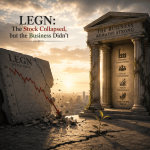
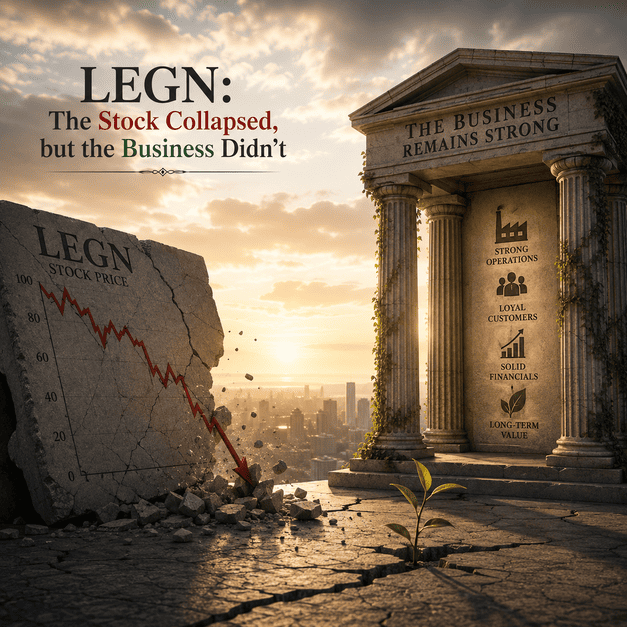
Legend Biotech has become an unusually interesting market psychology case because the stock and the business are currently telling two very different stories. The share price has been crushed by leadership uncertainty, competitive concerns and a brutal reset in expectations, yet the company’s central commercial engine, CARVYKTI, just produced another powerful quarter and Legend reported its first profitable quarter. The question is no longer whether the company can sell its therapy, but whether the market is willing to recognise what that commercial success is becoming.
That distinction matters because markets do not price today’s business in isolation. They price expectations about tomorrow, and when expectations become sufficiently negative, even good news can fail to produce a sustained rally because investors are still looking for reasons to remain sceptical. That is precisely where the asymmetry begins to become interesting: not because LEGN is automatically cheap, but because the narrative surrounding the stock may be deteriorating faster than the underlying economics.
The Price Tells One Story, CARVYKTI Tells Another
The Q2 numbers are difficult to dismiss. CARVYKTI generated approximately $657 million in net trade sales, up 50% year over year and 10% sequentially, with US sales increasing 32% and ex-US sales surging 128%. Legend also reported its first company-wide profitable quarter, including adjusted net income of approximately $63 million, while the company ended the quarter with roughly $965 million in cash and no long-term debt.
Those numbers do not prove that the stock is undervalued, because the market is looking beyond the current quarter. CARVYKTI remains the dominant economic engine, competition is developing, manufacturing remains complex and the company must prove that profitability can persist rather than appear as a single-quarter event. Nevertheless, the gap between the collapsing equity narrative and the accelerating commercial numbers deserves attention.
The market had already inflicted substantial damage before the earnings release. The stock had fallen dramatically from earlier highs into the high teens, meaning investors were not approaching Q2 with a blank sheet of paper. They were approaching it with a deeply negative prior, asking what could still go wrong after so much of the bad news had already been priced in.
The CEO Shock Changed the Vector
The biggest psychological event was not the earnings report. It was the sudden departure of CEO Ying Huang in late July, with Legend appointing CARVYKTI president Alan Bash as interim CEO while beginning a search for a permanent successor. The company said Huang would remain as an adviser through August to support the transition, but the market rarely treats an unexplained leadership change as neutral, particularly when a company is moving from development-stage biotech economics toward commercial profitability. (Legend Biotech)
The reaction showed how fragile sentiment had become. Shares fell sharply after the announcement, and analysts subsequently reduced targets while maintaining some bullish ratings, effectively saying that the underlying business remained attractive but the uncertainty deserved a lower valuation. Oppenheimer has now moved to Perform from Outperform and cut its target to $40, citing the CEO transition, competitive pressure and reduced M&A prospects.
That reveals the real battle. The bears are not necessarily arguing that CARVYKTI is failing today. They are arguing that uncertainty surrounding leadership, competition and the long-term commercial opportunity deserves to keep the valuation compressed. The bulls are looking at a company whose revenue is accelerating, profitability has arrived and whose balance sheet gives it room to fund the next stage.
The Market May Be Pricing Tomorrow’s Problems
This is where the story becomes more interesting than a simple oversold-stock argument. CARVYKTI is becoming a substantial commercial franchise, but investors know the multiple-myeloma market will not remain static, and competing therapies could eventually limit the size or duration of its opportunity.
The competitive issue is real, particularly because CAR-T therapies involve a complicated process involving cell collection, manufacturing, logistics, lymphodepletion and treatment monitoring. A therapy that can be delivered more simply can have a commercial advantage even when its biological profile is different, which means Legend cannot assume that today’s growth rate automatically becomes tomorrow’s growth rate.
Yet there is another side to the equation. CARVYKTI is expanding into earlier lines of treatment, while the international opportunity is becoming increasingly visible in the numbers. Ex-US sales growing 128% year over year is not what a stagnant commercial franchise looks like, and management continues to see the potential for peak annual CARVYKTI sales above $5 billion. (GuruFocus)
The market therefore has to solve two competing vectors at once. One points toward a larger commercial opportunity, while the other points toward eventual competitive pressure and uncertainty. The stock’s current valuation reflects the crowd leaning heavily toward the second vector.
Profit-Taking Is Not the Whole Explanation
It would be tempting to say the stock simply fell because investors took profits after earnings, but that explanation is too shallow. The shares initially responded positively to the Q2 report, which means the earnings themselves were not treated as bad news. The subsequent weakness is better understood as a failure to achieve the kind of sustained rerating that would force the market to abandon its existing bearish framework.
That distinction is important because confirmation is not the same as surprise. CARVYKTI’s growth story was already known, so the company needed to demonstrate not only strong sales but a durable change in the economics of the business. Q2 moved that process forward because profitability arrived. The next question is whether it continues.
The Margin Question Matters More Than Another Revenue Beat
Gross margin improved sharply in Q2, reaching roughly 58% compared with about 41% in Q1, but management has indicated that Q3 could move back toward the low-50% range as the treatment mix changes. That does not invalidate the profitability story, but it explains why investors may hesitate to extrapolate one quarter into a permanent earnings curve.
This is one of the most important distinctions in the LEGN thesis. Revenue growth demonstrates demand, while sustainable margin expansion demonstrates that the company can convert that demand into durable economic value. If Q3 shows continued CARVYKTI growth, gross margin above 50% and another period of adjusted profitability, the market will have a much harder time describing Q2 as an isolated event.
At that point, the narrative begins to change from “commercial biotech approaching profitability” to “profitable oncology platform with a growing cash engine.” Those are very different valuation categories.
The Balance Sheet Changes the Risk
Legend also has something many speculative biotechs lack: financial flexibility. The company finished Q2 with approximately $965 million of cash and no long-term debt, while its June equity offering raised approximately $212 million in proceeds at an offering price of $29.35 per ADS. (Legend Biotech)
The equity raise created dilution, so it should not be treated as an unqualified positive. But it also strengthened the balance sheet while Legend moved closer to self-funded commercial economics, reducing one of the classic risks associated with developing biotech companies: having to return to the market for capital before the underlying product becomes profitable.
There is an interesting reference point here. Investors were willing to buy newly issued shares at $29.35 in June, yet the stock subsequently traded substantially below that level after the company delivered its first profitable quarter. That does not prove the shares are cheap, because offerings occur for strategic reasons and dilution matters, but it creates a valuation discrepancy worth investigating rather than ignoring.
The Hidden Optionality Is Not CARVYKTI
The market’s immediate focus is correctly on CARVYKTI because that is where the money is being made. But the more enigmatic part of Legend’s story may eventually be what happens beyond the current franchise, particularly its work on in-vivo CAR-T.
The concept is radically different from conventional autologous CAR-T manufacturing. Instead of removing a patient’s cells, engineering them outside the body and returning them, in-vivo approaches attempt to generate or modify therapeutic cells inside the patient. Early data are nowhere near sufficient to establish commercial success, but the strategic implication could be substantial if the technology eventually works at scale.
That optionality should not be treated as current earnings. It should be treated as a potential change in the architecture of the business, because a company that can scale a commercial CAR-T franchise while simultaneously developing technologies that could reduce some of the manufacturing complexity of cell therapy has a different long-term possibility from a company dependent entirely on one established product.
The Contrarian Signal Is the Disconnect
This is where the LEGN setup fits the broader Tactical Investor framework. Oversold conditions do not mean a stock has reached its bottom, and a weak RSI cannot repair a broken business. But when technical exhaustion appears alongside improving commercial fundamentals, compressed sentiment and a large gap between perception and operating performance, the technical condition becomes much more interesting.
The crowd has already punished the stock for several identifiable risks: leadership uncertainty, competition, valuation compression and the possibility that CARVYKTI’s growth will eventually slow. That is precisely why the next move matters more than the previous move. If the company continues producing evidence that the commercial engine is strengthening while the stock remains priced as though the business is deteriorating, the divergence itself becomes the signal.
The key is not to predict that LEGN must double. The more useful question is whether the market has pushed expectations so low that the company only needs to remain good, rather than become extraordinary, to generate a substantial rerating.
What Would Change the Story?
The next major confirmation would come from the economics, not another analyst target. Continued CARVYKTI growth, sustained adjusted profitability and gross margins remaining above roughly 50% would begin establishing that Q2 was a transition point rather than an anomaly. A clearer CEO succession could then remove part of the psychological discount that has been placed on the stock.
The opposite outcome would be equally informative. If CARVYKTI growth slows sharply, margins deteriorate, competition begins taking meaningful share or leadership uncertainty persists, the current discount may be justified. A contrarian thesis is only useful when it can identify what would prove it wrong.
That is why I would not build the thesis around the old $50 or $56 price targets. Those numbers belong to a different market psychology. The more interesting question is whether LEGN can move from the high teens toward the high $20s and $30s simply by demonstrating that the business is becoming what the market has been refusing to price: a profitable commercial oncology company.
The Real LEGN Story Is the Gap
The most compelling feature of LEGN today is not that it is oversold, and it is not that analysts once placed much higher targets on it. It is the widening gap between a stock that has been treated as increasingly damaged and a business that has just delivered accelerating CARVYKTI sales, its first profitable quarter, a stronger balance sheet and continued international expansion.
That does not make Legend a guaranteed bargain. It creates a situation where expectations may be more important than absolute valuation, because a stock can rise dramatically without the business becoming dramatically better if the market’s perception improves faster than the underlying fundamentals change.
The enigma is simple: what happens when a market has already priced the problems, but the business keeps improving? That is where asymmetric opportunities can emerge, but only if the next few quarters confirm the change in vector.
For LEGN, the signal to watch is therefore not simply price. It is the intersection of CARVYKTI growth, sustainable margins, profitability, leadership stability and sentiment. If those variables begin moving in the same direction while the stock remains depressed, the market may eventually be forced to rewrite the story. And markets can rerate a company very quickly once the story changes.