
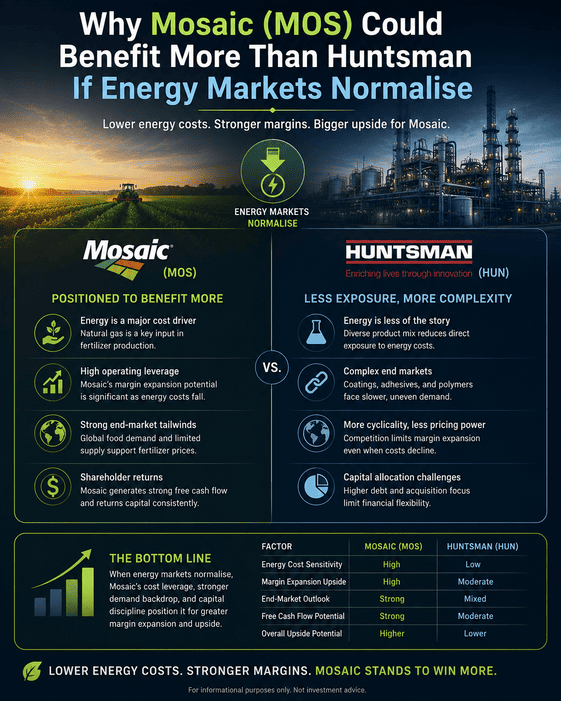
Why Mosaic (MOS) Could Benefit More Than Huntsman If Energy Markets Normalise
Aug 10, 2026
Geopolitical conflicts rarely affect every company in the same way. Investors often assume that lower oil prices automatically benefit every industrial business equally, yet the reality is considerably more nuanced because each company sits at a different point within the supply chain. Understanding where costs originate and how they flow through the income statement is often more important than predicting the next move in crude oil itself.
If tensions in the Middle East continue easing, the immediate reaction will likely be lower energy prices. Oil would probably decline, natural gas markets could gradually normalise as LNG flows improve, freight costs should ease and feedstock prices would begin falling across large parts of the chemical industry. Those developments would eventually improve manufacturing margins, although equity markets are unlikely to wait for the accounting statements to confirm the recovery. Investors discount future cash flows rather than current earnings, meaning the market usually begins pricing in better margins months before they actually appear in quarterly reports.
For companies such as Huntsman (HUN), the mechanism is relatively straightforward. Energy represents one of the company’s largest production costs, so lower oil, natural gas and transportation expenses should gradually improve profitability as contracts reset and lower input costs work their way through the manufacturing process. The sequence is remarkably consistent: geopolitical tensions ease, energy prices decline, production costs fall, operating margins improve and earnings recover. Share prices, however, generally begin moving somewhere between the first and second stages because markets focus on what is likely to happen rather than what has already happened.
Mosaic Is Driven by a Different Mechanism
The investment case for Mosaic (MOS) is considerably more complex because fertilizer companies operate under a different economic structure. Many investors instinctively focus on fertilizer prices, assuming higher selling prices automatically translate into higher profits. That assumption ignores the other half of the equation.
Mosaic’s profitability depends on margins rather than prices alone. During the recent geopolitical disruptions, sulphur prices surged, phosphate production became significantly more expensive and freight costs climbed alongside energy prices. Although fertilizer prices remained relatively strong, production costs often increased just as rapidly, preventing the company from fully benefiting from higher selling prices. Rising commodity prices therefore did not automatically produce expanding profits because costs were rising even faster.
Understanding that distinction changes the investment thesis entirely. The question is no longer whether fertilizer prices remain elevated. The question becomes whether production costs can normalise faster than fertilizer selling prices decline.
The Margin Spread Is What Matters
If geopolitical tensions continue easing, several important variables begin moving simultaneously. Sulphur prices could retreat, freight rates may decline, natural gas markets should gradually stabilise and energy costs would likely become less burdensome across the fertilizer industry. Those developments directly reduce Mosaic’s production costs.
At the same time, fertilizer prices could also soften as global markets become less disrupted. That creates the central question every investor should be asking: Do production costs fall faster than fertilizer prices? If the answer is yes, margins expand and earnings recover despite lower selling prices. If fertilizer prices collapse while costs remain stubbornly elevated, margins continue facing pressure.
This spread between costs and selling prices, rather than fertilizer prices themselves, is the real driver of Mosaic’s future earnings. Investors focusing only on commodity prices are often analysing the wrong variable.
China Could Become the Swing Factor
Another important variable remains China’s fertilizer export policy. If export restrictions continue limiting global supply while agricultural demand remains reasonably healthy, fertilizer prices may prove far more resilient than many pessimistic forecasts currently assume. Combine that with lower sulphur prices, improving freight markets and easing energy costs, and the earnings outlook begins improving even without another commodity boom.
Markets often become overly pessimistic when several temporary headwinds appear simultaneously. As those headwinds gradually fade, earnings frequently recover much faster than consensus expectations because investors continue anchoring their forecasts to yesterday’s conditions rather than tomorrow’s environment.
Vector Perspective
Viewed through the Vector Framework, HUN and MOS represent two distinctly different opportunities despite both potentially benefiting from lower geopolitical tensions. HUN is primarily a cyclical recovery opportunity, where the investment thesis depends on lower energy, feedstock and transportation costs steadily improving operating margins as manufacturing expenses normalise. The market is likely to anticipate that recovery well before stronger earnings appear in the financial statements because future expectations always move ahead of reported results.
MOS, by contrast, is an asymmetry opportunity. The sharp decline in the share price has already embedded considerable uncertainty into expectations, yet the company’s future depends far less on fertilizer prices than on the spread between production costs and selling prices. If sulphur, freight and energy costs retreat more rapidly than fertilizer prices weaken, margins could expand materially from today’s depressed levels, allowing earnings to recover far faster than the market currently anticipates.
The critical variable is therefore not simply whether the war ends. It is how quickly energy, sulphur and freight costs normalise relative to fertilizer selling prices because that spread ultimately determines whether Mosaic’s margins strengthen or weaken. Investors who focus solely on commodity prices risk missing the far more important vector driving the business: the direction of margins rather than the direction of fertilizer prices.

Thought-Provoking Reads