The Subtraction Mindset: Why Charlie Munger Chose Less and Compounded More
Aug 24, 2026
The easiest way to misunderstand wealth is to measure it by what can be accumulated, because the modern economy has become remarkably efficient at turning every increase in income, status or net worth into an argument for acquiring something larger, newer or more expensive. Success is supposed to become visible. The house expands, the car improves, the lifestyle rises, and the individual gradually discovers that the assets acquired to demonstrate freedom have also created a larger structure that must now be financed, maintained and defended.
Charlie Munger understood the other side of that equation. Addition is not automatically progress, and subtraction is often the more powerful form of leverage because wealth, attention and judgement can all be weakened by the unnecessary structures built around them.
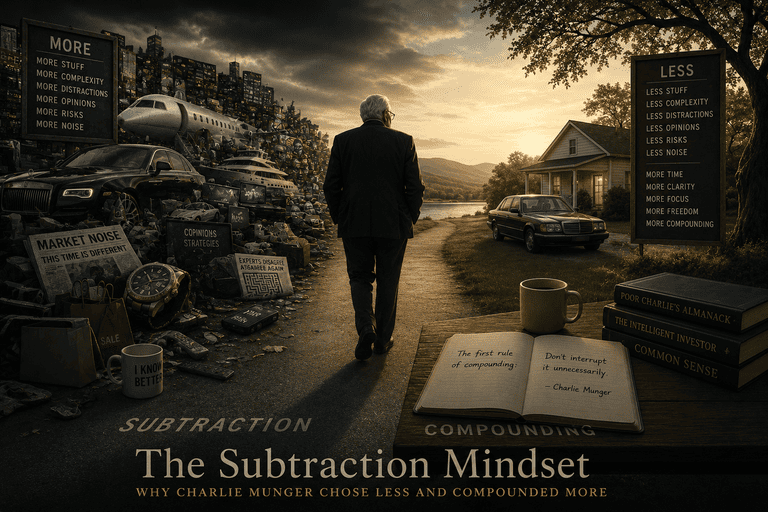
Munger lived for decades in a relatively modest Los Angeles home despite having the means to live almost anywhere, and he openly questioned whether increasingly extravagant homes actually made wealthy people happier. The significance of that choice lies less in the house itself than in the psychological mechanism behind it. Once wealth becomes a vehicle for social comparison, consumption begins to follow a vector that has no natural endpoint, because there will always be a larger house, a more expensive car or another individual whose visible possessions establish a new standard.
The important question, therefore, is not why Charlie Munger lived in a particular house. It is why so many people who possess increasing amounts of wealth nevertheless feel compelled to keep enlarging the structure around their lives, even when each additional layer consumes more capital, attention and independence. That is where the subtraction mindset begins.
The Instinct to Add
Human beings are naturally inclined to solve problems through addition. A struggling company creates another committee, a confused investor adds another indicator, an anxious individual fills the calendar with commitments, and a government confronting one problem frequently produces several new institutions to investigate it. Adding feels like action, while removing something can appear dangerously close to doing nothing, even when the existing structure is precisely what is creating the problem.
This tendency is particularly dangerous because complexity often acquires its own momentum. Once a system becomes crowded with rules, information, commitments and moving parts, intelligence is increasingly diverted towards navigating the structure rather than addressing the original objective. The individual becomes busy managing complexity and eventually mistakes that activity for progress.
Munger’s latticework of mental models can be understood through the opposite lens. Its purpose was not to encourage people to collect an endless catalogue of theories and carry them around as intellectual decoration, but to identify a relatively small number of powerful forces that repeatedly influence incentives, behaviour, judgement and error. The objective was compression. Reality is complicated, but useful thinking requires identifying which variables actually matter.
The same principle applies to the environment surrounding the mind. Attention is finite, which means every unnecessary demand competes with something more valuable, whether that something is analysis, creativity, rest, relationships or the ability to recognise an opportunity before the crowd has noticed it. From that perspective, distraction is not simply an inconvenience. It is an allocation decision.
The relevant question is not whether something occupies your attention, but whether the return justifies the capital being spent.
Munger’s House and the Machinery of Social Imitation
Turning Munger’s home into a monument to minimalist genius would miss the point and probably invent more philosophy than the facts can support. The documented reality is simpler: he remained in a relatively modest home despite extraordinary wealth and expressed scepticism about the assumption that increasingly expensive houses necessarily produce greater happiness.
That scepticism strikes directly at one of the most powerful forces in mass psychology: imitation.
The crowd rarely decides what is enough in isolation. Standards are constantly adjusted by observation. One neighbour expands his house, another upgrades his car, someone else moves into a more exclusive area, and the visible movement of the group gradually shifts what previously appeared sufficient into the category of inadequate. Wealth stops being measured by utility and begins to function as a position within an invisible hierarchy.
The difficulty is that hierarchies have no finish line. Anyone who allows comparison to determine satisfaction has effectively outsourced part of their emotional balance sheet to the behaviour of other people, including people whose priorities, finances and private circumstances they neither understand nor control.
That is not merely a psychological weakness. It is poor capital allocation. The same independence that allows an investor to resist a euphoric market can also protect an individual from converting every increase in wealth into a permanently larger lifestyle. Both require the ability to separate personal judgement from the emotional vector of the crowd, particularly when imitation is being rewarded and the pressure to participate appears rational because everyone else seems to be doing well.
Less Noise, More Optionality
The economic case for subtraction is stronger than the aesthetic version usually associated with minimalism. This is not about empty rooms, white walls or pretending that discomfort is morally superior to comfort. The real advantage is optionality.
A person who reduces unnecessary expenses requires less income to maintain independence and is therefore less vulnerable to a sudden loss of earnings. A business that removes wasteful operations has a greater chance of surviving when conditions deteriorate. An investor who preserves liquidity rather than committing every available dollar during an extended advance retains the ability to act when panic creates opportunities that were invisible while the crowd was celebrating.
The common mechanism is the preservation of unused capacity. Capital that has not been wasted remains available. Attention that has not been fragmented can still be directed towards a meaningful problem. Time that has not been consumed by low-value obligations can be reallocated when circumstances change. Subtraction does not create opportunity by magic; it creates the space from which opportunity can be recognised and exploited.
This matters because markets themselves move through alternating phases of addition and forced removal. During a bull market, rising prices reinforce confidence, confidence encourages greater exposure, and greater exposure appears intelligent because the immediate feedback is positive. Investors add risk because recent decisions have been rewarded, often forgetting that a favourable environment can conceal poor judgement for a surprisingly long time.
Eventually the vector reverses. Assets fall, leverage becomes visible, liquidity disappears and positions that looked sensible when prices were rising suddenly reveal how little margin for error existed beneath the surface. What was voluntarily added during optimism is then removed under pressure.
The distinction between a disciplined investor and a reactive participant often lies in who controls the subtraction. The crowd waits until reality imposes it. The disciplined investor reduces excess before excess becomes a problem.
The Crowd Adds Until the Structure Cannot Carry Its Own Weight
Mass psychology rarely operates through moderation because imitation accelerates behaviour. An asset may initially be purchased because its valuation appears attractive, but as prices rise, the original reasoning becomes less important than the visible success of those who acted earlier. Others buy because the first group made money, and eventually the price itself becomes the argument.
The same vector operates outside financial markets. People acquire possessions because others possess them, add commitments because busyness has become a proxy for importance, and allow expenses to rise because the surrounding group has normalised a more expensive definition of life. Each individual decision may appear reasonable when viewed separately, yet the accumulated structure can eventually become too heavy to support.
In markets, the process is called deleveraging. In corporate life, it becomes restructuring. At the personal level, it may arrive as financial stress, exhaustion or the slow recognition that the lifestyle built to demonstrate success now requires continuous effort merely to sustain itself.
The underlying pattern is remarkably consistent: expansion continues while the feedback remains favourable, questioning declines as confidence rises, and subtraction is postponed until circumstances make it unavoidable.
That is why the ability to remove can be more valuable than the ability to acquire. Adding another stock to a portfolio, another indicator to a chart or another obligation to a calendar requires little more than willingness. Deciding what should be removed requires judgement because it forces the individual to confront sunk costs, ego, habit and the uncomfortable possibility that something once considered valuable no longer deserves the resources being devoted to it.
Subtraction as Rational Aggression
Subtraction should not be confused with passivity. Deliberately removing what weakens your position can be an aggressive act of capital allocation, particularly when the crowd is still moving in the opposite direction.
Selling a deteriorating asset before the deterioration becomes obvious, reducing debt while conditions remain favourable, eliminating expenses that serve status rather than utility, refusing to consume information that produces anxiety without improving judgement, or limiting a portfolio to the number of companies that can actually be understood are all variations of the same principle. The objective is not to own less for the pleasure of owning less, but to concentrate capital, energy and attention where they have the highest probability of producing a meaningful return.
This fits naturally with Vector Mass Psychology because crowds are constantly pulled towards expansion when confidence dominates and contraction when fear takes control. The difficulty is that most participants move with the vector because the movement itself changes their perception of reality. Rising prices appear to validate optimism, falling prices appear to validate pessimism, and the emotional feedback loop becomes increasingly difficult to separate from the underlying facts.
The disciplined observer attempts to break that loop. Instead of asking whether the crowd is expanding or contracting, the more important question is whether the movement is creating value or merely producing motion.
That distinction applies to life as much as it applies to markets.
More choices do not automatically create more freedom when many of those choices exist only to consume attention. More possessions do not necessarily create greater security when they require additional income to maintain. More information does not automatically improve decision-making when the signal has been buried beneath a growing volume of noise. Deliberate constraints can therefore increase agency by removing options that were never sufficiently valuable to deserve consideration in the first place.
Build a Structure That Leaves Something for the Opportunity
The lesson is not that everyone should imitate Charlie Munger’s lifestyle or assume that living in a modest house is itself evidence of wisdom. Copying the visible behaviour of successful people while ignoring the principles that guided their decisions is one of the more reliable ways to turn a useful idea into a costume.
The structural lesson is more valuable: build an environment that protects the resources you are least able to replace.
That may require reducing expenses designed primarily to impress people who are not contributing to your financial independence, cutting commitments that consume energy without producing meaning, filtering information that creates emotional movement without improving decisions, or simplifying an investment process until the remaining structure can actually be understood and tested.
The crowd will continue to provide reasons for expansion. Rising markets encourage greater exposure, prosperity makes additional debt appear harmless, success invites lifestyle inflation, and silence becomes uncomfortable enough that people fill it with noise merely to avoid confronting their own thoughts. None of these forces disappear, which is precisely why the ability to subtract can become a durable competitive advantage.
The individual who removes the unnecessary is not withdrawing from life or rejecting ambition. They are preserving capital, attention and optionality for the moments when something genuinely worth adding appears.
Charlie Munger’s house was simply an illustration of that broader principle. Wealth can be displayed, consumed or compounded, and the direction chosen often depends on whether each new acquisition is evaluated through personal utility or through the shifting expectations of the crowd.
The subtraction mindset begins with a question that becomes increasingly valuable as life, markets and institutions grow more complicated: what would improve if this were removed?
Sometimes nothing should be removed. Sometimes addition is precisely what the situation requires. But unnecessary complexity is expensive, status is often a poor substitute for judgement, and the ability to preserve clarity can be more valuable than the ability to accumulate endlessly.
The strongest positions, whether financial or psychological, are not always built by adding another layer. They are often created by recognising which layer is quietly weakening the structure and having the judgement to remove it before reality does.

Ideas That Challenge Consensus