Popular Delusions and the Madness of Crowds: Every Generation Repeats the Same Mistakes
Aug 17, 2026
The Madness Never Ends
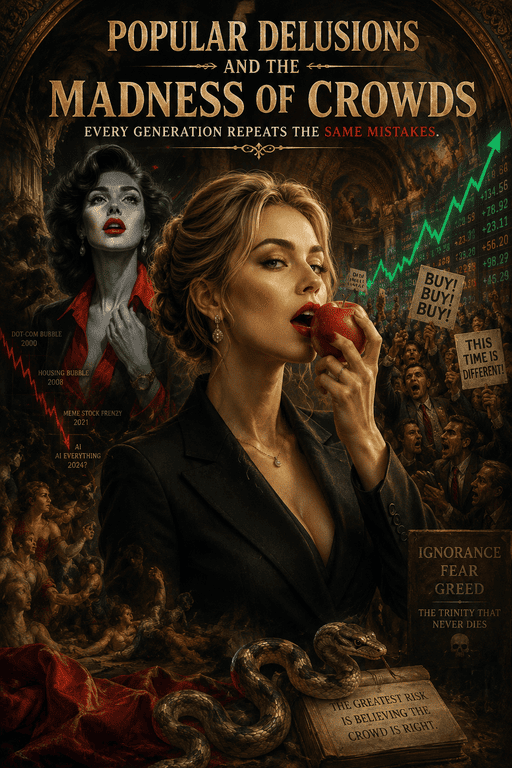
History’s greatest financial bubbles are rarely born from economics alone. They emerge when emotion overwhelms judgement, when stories become more valuable than facts, and when crowds mistake shared conviction for objective truth. Charles Mackay understood this nearly two centuries ago when he chronicled the great manias that periodically swept through societies, destroying fortunes and exposing the remarkable ease with which intelligent people surrender independent thought once absorbed into a crowd. His enduring contribution was not merely documenting Tulip Mania or the South Sea Bubble but revealing a timeless truth that transcends every market, every technology, and every generation: people think in herds, and they usually regain their reason one at a time.
Modern finance has changed almost beyond recognition since Mackay wrote Extraordinary Popular Delusions and the Madness of Crowds. Markets trade in milliseconds, information circles the globe instantly, and algorithms execute transactions faster than human thought. Yet beneath this technological sophistication lies the same emotional architecture that fuelled speculative frenzies centuries ago. Fear still spreads faster than analysis, greed still disguises itself as optimism, and collective conviction continues to masquerade as evidence. Human nature remains the market’s only permanent constant.
This distinction matters because most investors spend their lives studying businesses, economies, interest rates, and financial statements while devoting comparatively little attention to the force that frequently dominates all of them: collective psychology. Markets are not simply mechanisms for allocating capital; they are arenas in which millions of emotional decisions collide every day, producing prices that often deviate dramatically from underlying value. Understanding balance sheets may explain what a company is worth, but understanding crowd behaviour explains why markets routinely price that company far above or below its intrinsic value.
The greatest fortunes are seldom built by predicting the future with perfect accuracy. They are built by recognising when the crowd has become emotionally detached from reality. That detachment appears in every generation under different names, different technologies, and different narratives, yet its psychological foundations remain remarkably consistent. Mackay recognised this long before behavioural finance existed as a formal discipline, and his observations remain as relevant today as they were in Victorian Britain because markets continue to reward those who understand people at least as well as they understand numbers.
Fear: The Invisible Architect of Market Behaviour
Fear occupies a peculiar position within financial markets because it serves both as a survival mechanism and as one of the greatest destroyers of wealth. Evolution designed fear to keep human beings alive by encouraging rapid responses to immediate threats. In nature, hesitation often proved fatal. Financial markets, however, operate according to almost the opposite principle. The instinct that once preserved life frequently sabotages investment performance because perceived danger and genuine opportunity often arrive together.
When markets decline sharply, investors rarely experience falling prices as simple numerical changes. They experience them as threats to security, identity, and future wellbeing. Losses carry far greater psychological weight than equivalent gains, causing individuals to abandon carefully constructed investment plans precisely when discipline becomes most valuable. Behavioural economists describe this tendency as loss aversion, but its practical consequences extend well beyond academic terminology. Fear narrows attention, shortens time horizons, and encourages immediate action even when inaction would produce superior results.
Fear rarely operates alone. Confirmation bias quickly joins the process, encouraging investors to seek information supporting their growing anxiety while unconsciously dismissing evidence suggesting markets may have overreacted. Every negative headline appears to confirm disaster, every optimistic analysis seems naïve, and every additional decline reinforces the conviction that selling immediately represents prudence rather than panic. What begins as reasonable caution gradually transforms into emotional certainty.
Social proof accelerates this progression because human beings instinctively interpret widespread behaviour as evidence of correctness. Watching neighbours, colleagues, professional commentators, and institutional investors all rushing towards the exits creates the comforting illusion that joining them must be the safest course of action. The individual no longer evaluates markets independently but borrows confidence from the crowd, overlooking the uncomfortable reality that collective agreement often reaches its highest intensity precisely when collective judgement is at its weakest.
Modern communication technologies amplify these ancient instincts with unprecedented speed. Information now travels globally within seconds, while social media compresses emotional contagion into real time. Financial news channels provide continuous coverage, algorithms amplify emotionally engaging content, and trading systems increasingly react to shifts in sentiment alongside traditional market data. Fear therefore propagates through multiple reinforcing channels simultaneously, creating feedback loops capable of pushing prices far beyond what changing fundamentals alone would justify.
Yet this recurring process contains an important paradox. The same psychological forces that produce irrational selling also create extraordinary opportunity. Every episode of indiscriminate panic eventually generates situations where fundamentally sound businesses trade at prices reflecting emotional liquidation rather than rational valuation. Understanding fear, therefore, is not merely an exercise in avoiding mistakes. It is the foundation upon which disciplined contrarian investing is built.
The Crowd’s Greatest Illusion
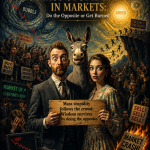
Perhaps the most dangerous misconception in investing is the belief that large numbers of people cannot be simultaneously wrong. Democracies derive legitimacy from majorities, but markets do not. Financial reality remains completely indifferent to popular opinion. A million investors can enthusiastically overpay for an asset, just as a million frightened investors can dramatically undervalue it. Consensus creates comfort, not accuracy.
Crowds possess remarkable strengths under ordinary circumstances. They aggregate information, establish liquidity, and contribute to efficient price discovery. Problems emerge only when emotion begins overwhelming independent judgement. As uncertainty increases, individuals progressively outsource thinking to the behaviour of those around them. Instead of asking whether prices accurately reflect underlying value, they ask whether everyone else appears to be buying or selling. Independent analysis quietly gives way to emotional imitation.
This transformation rarely feels irrational from the inside. On the contrary, following the crowd often feels extraordinarily sensible because it reduces psychological discomfort. Standing alone during periods of market euphoria or panic demands emotional resilience few investors naturally possess. Remaining invested while others liquidate portfolios feels reckless, just as refusing to participate during speculative manias feels unnecessarily pessimistic. Social belonging exerts enormous influence over financial decision-making precisely because humans evolved in environments where separation from the group often carried severe consequences.
Markets reverse that evolutionary logic. The greatest opportunities frequently emerge precisely when independent judgement becomes most psychologically uncomfortable. Investors who consistently outperform over long periods are rarely those possessing superior forecasting abilities. More often, they possess unusual emotional independence, allowing them to distinguish between changing prices and changing value while the majority struggles to separate the two.
This explains why speculative bubbles always appear rational before they collapse. Every mania constructs its own intellectual framework explaining why traditional valuation no longer applies. During Tulip Mania, rare bulbs supposedly represented a revolutionary asset class. During the South Sea Bubble, extraordinary commercial promises justified extraordinary prices. Technology bubbles argued that earnings had become obsolete. Housing bubbles insisted property prices could never decline nationally. Cryptocurrency enthusiasts, meme-stock traders, and countless future speculators all develop similarly persuasive narratives supporting emotionally satisfying conclusions.
The specific story matters remarkably little. What remains constant is the psychological process through which crowds gradually elevate belief above evidence. Once enough people accept the narrative, disagreement becomes increasingly difficult because opposing the crowd requires questioning not merely prices but collective identity itself.
History demonstrates remarkable consistency on this point. Every speculative era sincerely believes it has escaped the limitations governing previous generations. Every generation eventually discovers that human psychology remains considerably less innovative than financial markets.
History Doesn’t Repeat. Human Nature Does.
The enduring relevance of Mackay’s work becomes apparent when examining successive market crises separated by centuries yet united by identical emotional patterns. The Dutch Tulip Mania remains memorable not because tulip bulbs possessed extraordinary intrinsic value but because speculation transformed ordinary objects into symbols of unlimited prosperity. Prices rose because people expected them to continue rising, attracting ever more participants whose confidence rested primarily upon previous price appreciation rather than objective worth. Eventually, confidence reversed, and fear spread with precisely the same speed optimism once had, leaving behind financial devastation that appeared incomprehensible only because the underlying psychology had been ignored.
The crash of 1929 followed remarkably similar emotional dynamics despite occurring within a vastly different economic environment. Years of expanding prosperity encouraged investors to believe rising markets reflected a permanent new reality. Confidence evolved into certainty, leverage amplified speculation, and caution gradually disappeared because continued success appeared inevitable. When confidence finally cracked, the psychological reversal proved every bit as dramatic as the optimism preceding it. Investors who previously feared missing opportunity suddenly feared owning risk itself, creating liquidation so indiscriminate that sound businesses collapsed alongside genuinely overvalued enterprises.
The Global Financial Crisis repeated the pattern under modern conditions. Sophisticated financial engineering, complex derivatives, and interconnected banking systems created the appearance of innovation, yet the emotional foundation remained familiar. Excessive confidence encouraged increasingly reckless behaviour until deteriorating fundamentals could no longer support prevailing optimism. Once fear replaced complacency, interconnected markets transmitted panic with extraordinary speed, demonstrating that technological sophistication had accelerated emotional contagion without reducing its power.
Even the pandemic-driven sell-off of 2020 illustrated the same psychological architecture. Genuine uncertainty regarding public health rapidly expanded into indiscriminate selling across numerous asset classes, frequently disconnecting price from long-term value. Companies possessing durable competitive advantages temporarily traded alongside businesses facing existential threats because fear seldom discriminates with precision during moments of collective panic.
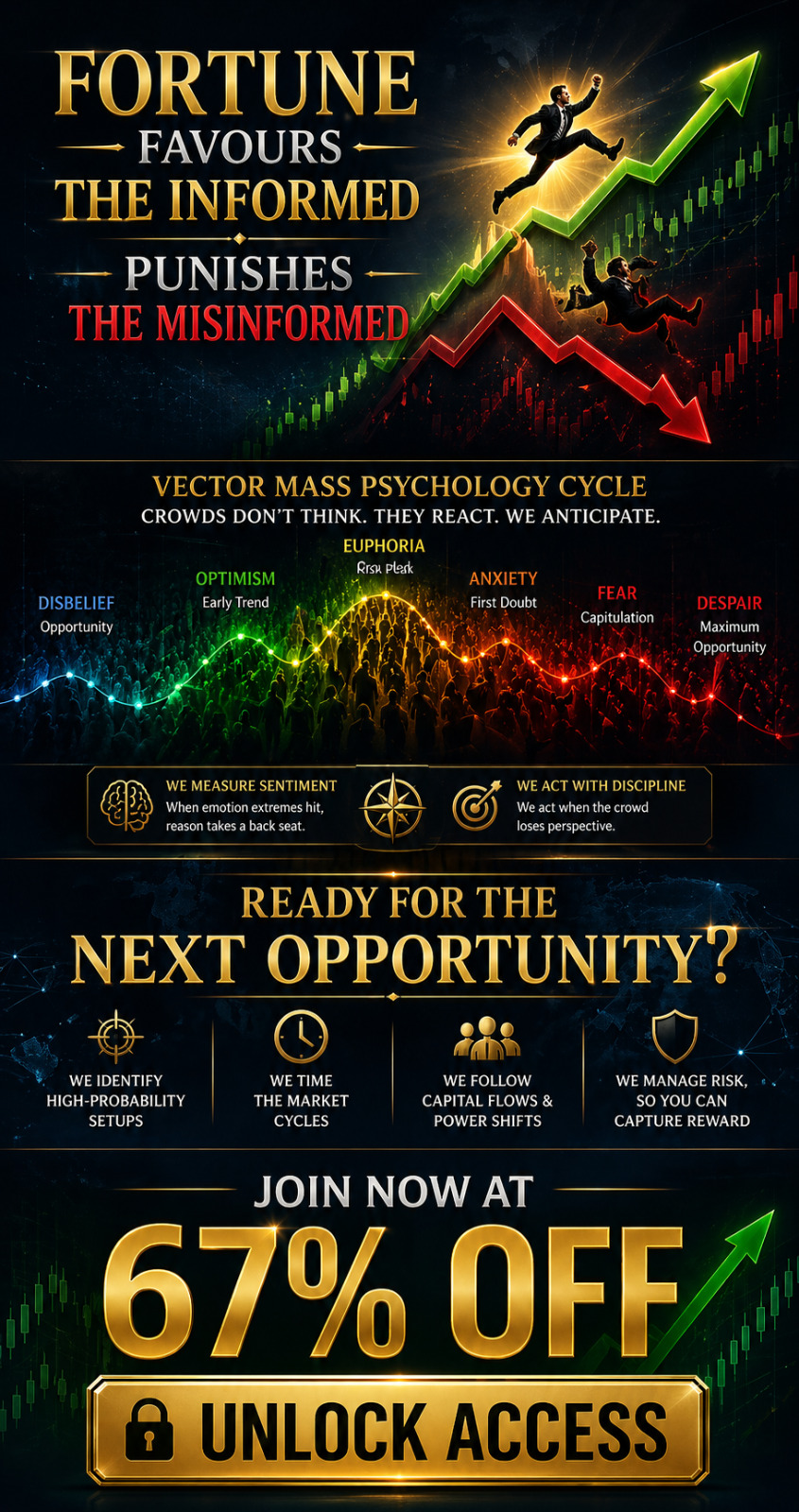
Every crisis appears unique while unfolding because contemporary details dominate public attention. With historical perspective, however, similarities become unmistakable. Optimism gradually evolves into euphoria, euphoria breeds complacency, complacency encourages excess, excess eventually encounters reality, and fear reverses the entire process with astonishing speed.
Markets continually invent new reasons to behave irrationally and Human beings continue responding irrationally for the same old reasons.
The Contrarian’s Advantage: Turning Fear into Opportunity
If crowd psychology explains why markets periodically disconnect from reality, contrarian investing explains how disciplined investors profit from that dislocation. The essence of contrarianism is frequently misunderstood because it is portrayed as doing the opposite of whatever the crowd is doing. Genuine contrarian investing is far more demanding. It is not reflexive opposition but disciplined independence. The objective is not to disagree with consensus for its own sake but to recognise when consensus has become so emotionally extreme that it has overwhelmed rational price discovery.
The distinction is crucial. Markets spend much of their existence moving in the correct direction. Following the crowd during healthy trends is not irrational; indeed, fighting every rally or every decline simply because it is popular is another form of emotional investing disguised as sophistication. True contrarianism begins only when emotion pushes prices materially away from intrinsic value, creating opportunities that would not exist in a more balanced psychological environment.
This is why the greatest investors in history consistently appear patient rather than perpetually rebellious. Warren Buffett’s famous advice to be “fearful when others are greedy and greedy when others are fearful” is not a slogan encouraging automatic opposition. It is a recognition that markets oscillate between emotional extremes, and that those extremes repeatedly distort valuation. Charlie Munger often argued that successful investing resembles waiting for the right pitch rather than swinging at every ball. Jesse Livermore, despite the dramatic highs and lows of his career, understood that fortunes were made not through constant activity but by recognising the rare moments when collective psychology reached unsustainable extremes.
What unites these investors is not superior forecasting but emotional independence. They understood that the crowd’s emotional state frequently becomes a more valuable indicator than the latest economic forecast. When optimism reaches levels where risk is ignored, caution becomes increasingly attractive. When fear becomes so pervasive that investors indiscriminately liquidate quality businesses alongside failing ones, opportunity begins emerging from the wreckage.
This emotional independence cannot be improvised during a crisis. It must be cultivated long before markets become turbulent. Once panic dominates headlines, social media, and financial television, the pressure to conform becomes immense. The investor who has not already developed a disciplined framework almost invariably abandons rational analysis in favour of emotional comfort. Preparation therefore becomes a competitive advantage. By establishing valuation criteria, capital allocation rules, and risk parameters before markets become volatile, disciplined investors reduce the likelihood that fear will dictate decisions precisely when clear thinking becomes most valuable.
The paradox is striking. During periods of market calm, emotional discipline appears unnecessary because everyone feels intelligent while prices rise. During periods of panic, emotional discipline becomes extraordinarily difficult because every instinct argues for immediate action. Yet those uncomfortable moments are precisely when the greatest opportunities usually appear. Exceptional returns rarely come from buying assets everyone already loves. They emerge from purchasing quality businesses when temporary fear has convinced the majority that permanent decline has become inevitable.
Monetising Fear Instead of Fearing It
Most investors experience volatility as something to endure. Contrarians increasingly learn to view it as something to harvest.
Fear has an economic value because uncertainty always commands a premium. During periods of market stress, investors become willing to pay significantly more for protection than they do during periods of optimism. This psychological asymmetry creates opportunities extending well beyond purchasing undervalued shares. It allows disciplined investors to monetise fear itself.
One of the clearest examples appears in the options market. As volatility rises, demand for downside protection increases sharply, causing put option premiums to expand. Investors overwhelmed by uncertainty willingly pay higher prices for insurance against further declines. Rather than participating in this rush for protection, experienced investors sometimes take the opposite side of the transaction by selling puts on businesses they would be comfortable owning anyway. If prices stabilise or recover, the inflated premium becomes income. If prices continue falling and shares are assigned, they acquire fundamentally sound companies at valuations they already considered attractive, further reducing their effective purchase price through the premium received.
The strategy is elegant because it transforms fear into income while maintaining a disciplined investment process. Rather than hoping markets become volatile, the investor recognises that volatility itself creates opportunity. Emotional excess, instead of becoming something to avoid, becomes the source of improved probabilities.
A further refinement involves directing those premiums towards long-term opportunities. Income generated during periods of heightened fear can be redeployed into LEAPS, allowing investors to establish long-duration exposure to high-quality companies without committing the full capital required for outright ownership. In effect, short-term panic finances long-term optimism. Fear pays for future opportunity.
None of this should be mistaken for a shortcut to wealth. Options magnify both opportunity and risk, demanding rigorous position sizing, deep understanding of the underlying business, and unwavering discipline. Used carelessly, they become instruments of speculation. Used intelligently, they become tools for converting temporary emotional distortions into structured long-term advantage.
The principle matters more than the mechanics. Markets repeatedly overprice fear because human beings consistently overestimate immediate danger while underestimating long-term resilience. Investors capable of recognising that imbalance possess an enduring advantage regardless of the specific instruments they employ.
Risk Management: The Discipline Behind Every Contrarian
Contrarian investing is often romanticised as fearless conviction, yet the reality is considerably less dramatic. The greatest contrarians do not ignore risk. They manage it obsessively. Their confidence arises not from believing they cannot be wrong but from accepting that uncertainty is permanent and preparing accordingly.
One of the most common mistakes inexperienced investors make is confusing conviction with concentration. Discovering what appears to be an exceptional opportunity does not justify risking disproportionate amounts of capital on a single outcome. Markets possess an extraordinary ability to remain irrational longer than anticipated, and even the strongest investment thesis can be temporarily overwhelmed by broader economic or psychological forces. Intelligent position sizing therefore becomes one of the most important forms of emotional discipline because it prevents temporary misjudgements from becoming permanent financial damage.
Accumulating positions gradually often proves more effective than attempting to identify exact market bottoms. Emotional extremes unfold over time, not at a single moment. By deploying capital incrementally, investors acknowledge the limits of prediction while maintaining the flexibility to exploit further weakness should it occur. Patience becomes a form of risk management because it avoids exhausting capital before opportunities fully develop.
This philosophy extends beyond buying shares. Every decision should be evaluated not simply in terms of potential reward but in terms of asymmetry. The most attractive investments are rarely those promising the largest returns. They are those where downside risk remains limited relative to the magnitude of potential upside. Contrarian investing is therefore not about seeking maximum gains but about identifying situations where emotional overreaction has created unusually favourable probability distributions.
Emotional discipline remains the thread connecting every aspect of this process. Markets constantly tempt investors to abandon carefully constructed plans in response to short-term price movement. Successful investors resist this temptation by distinguishing between volatility and deterioration. Falling prices alone reveal very little. What matters is whether the original investment thesis remains intact. If business fundamentals continue improving while prices decline because of temporary panic, lower prices represent increasing opportunity rather than increasing danger.
This mindset requires humility as much as confidence. No investor consistently predicts turning points with precision. The objective is not perfection but process. Decisions grounded in sound analysis, prudent risk management, and emotional independence will inevitably outperform decisions driven by fear, greed, or the comforting illusion that following the crowd provides safety.