
The Gambler’s Mindset: Confronting the Secret Desire to Lose Syndrome
Oct 6, 2025
Introduction: The Investor’s Paradox – Embracing the Thrill of Defeat
Why are we so magnetically drawn to stories of failure and chaos, even when victory lies within our grasp? Beneath the surface of the investor’s psyche lies a paradoxical affliction—the secret desire to lose syndrome. It’s the silent saboteur that turns calculated risk into reckless surrender, all while cloaked in rationality. This mindset, lurking in the shadow of logic, thrives on drama and chaos, steering many towards disaster when triumph was theirs to seize.
Consider market crashes. To one investor, they are treasure troves ripe for plundering. To another, they’re the stuff of nightmares, a cascade of losses too terrifying to endure. Yet, it is not the market that defines these outcomes; it is the lens through which we view them. Fear or opportunity? Panic or poise? The battlefield is not external—it is within.
The truth is bold and unflinching: most investors are far more willing to consume the venom of negativity than to drink from the cup of optimism. Why? Because disaster commands attention. It roars louder, cuts deeper, and, perversely, feels safer than hope. But safety is an illusion. To win, you must unshackle yourself from the fear that binds you. You must challenge the allure of failure and rewrite your script.
The Investor’s Dilemma: A Tale of Four Glasses
Picture four glasses of water. A stranger whispers, “One of these once held a dead fly.” Suddenly, every glass is poisoned. Logic folds under fear. Even if you’re dying of thirst, most people wouldn’t drink. Now flip the script. Another voice says, “One of these is from the purest Swiss spring.” Do people rush in? Rarely. Hope hesitates where fear dominates.
That’s the investor’s dilemma in miniature. Markets are psychological minefields where whispers of doom spread faster than facts. Investors lunge to sell at the faintest hint of danger, even when the threat is exaggerated. But whispers of opportunity are met with scepticism or silence. Evolution wired us for caution; markets punish us for it. In a financial battle, fear seduces, but action wins. The few who rise above panic convert collective terror into a form of leverage.
Market Crash Myths: Mastering the Gambler’s Mindset
A market crash is not a monster hiding under your bed. It’s a storm at sea, daring you to learn its rhythm. Yet most investors panic at the first warning of a crash, dumping quality assets like sailors tossing cargo overboard. Fear doesn’t sharpen their senses; it hijacks them. The gambler’s mindset takes over—not the bold kind that bets with edge, but the fatalist kind that treats losing as spectacle.
The market doesn’t care about your fairness doctrine. Life owes you nothing. The market owes you less. Crashes expose that truth with surgical precision. In chaos lies opportunity, but only for those who focus. Forget controlling the uncontrollable. Stop blaming manipulation and crowds. Your task is singular: read the trend and follow it with discipline. Trends are the heartbeat of the market. The noise is just static.
Victory isn’t handed to the cautious; it’s seized by the defiant. The storm will come. Panic will roar. Most will fold. Your edge is the decision to stand firm, harness volatility, and act when others freeze. When the dust clears, the victors are never the loudest—they’re the ones who moved when everyone else stared at the glasses and did nothing.
Life was, is, and will never be fair. Life is what you make of it. So don’t fret about things you cannot control; look for ways to take advantage of these situations. Sol Palha
Investing and the Desire for Defeat: Unmasking the Hidden Urge
Most investors lose not because the game is unwinnable, but because a part of them is wired to sabotage themselves. From childhood, culture, religion, and tradition condition us to obey inherited scripts. We’re told what’s right, what’s acceptable, and above all, not to question the structure that feeds us these rules. Much of this information is untested, biased, or outright irrational. Yet it shapes how people approach uncertainty: with blind faith, not analysis.
This programming doesn’t vanish when money enters the equation. It mutates. Investors unconsciously replicate these patterns, seeking certainty where none exists and following rituals they barely understand. Markets punish this inherited obedience. The result is a quiet but powerful “desire to lose”—a psychological pull toward behaviours that feel familiar but end in financial pain. Breaking it requires questioning every reflex, especially the comforting ones.
The Gambler’s Mindset in Action
The gambler’s loop begins with the sting of loss and ends with ruin. Casinos exploit this with precision. “Chasing losses” is their bread and butter. A player loses, then keeps betting to erase the pain. Dopamine fires not on the win but on the anticipation of it, keeping the gambler glued to the machine. The “near-miss” effect weaponises this further. Two jackpot symbols line up, the third just misses, and the brain reacts as if it almost won. This isn’t entertainment. It’s neurological engineering.
Markets echo the same patterns with different costumes. Investors double down on losing positions to “average down,” convincing themselves recovery is inevitable. Sometimes it works. More often, it compounds the damage. Overtrading is another classic symptom. Investors trade constantly, chasing short-term fluctuations like gamblers pressing “spin” again. Costs rise, judgment decays, and discipline evaporates.
Consider the dot-com bubble. As tech stocks soared, many piled in late, convinced the future was guaranteed. When the crash came, they didn’t cut their losses. They bought more of the collapsing names, hypnotised by the memory of near-misses and quick riches. Most never recovered. The NASDAQ took fifteen years to reclaim its peak. That wasn’t bad luck. It was the gambler’s loop wearing a Wall Street suit.
The Near-Miss Effect in Investing
Investors who narrowly avoid disaster often mistake survival for skill. Selling just before a crash creates a rush—a sense of mastery—that fuels future recklessness. They begin timing everything, convinced they have an edge. The 2008 crisis was full of such stories: traders who sidestepped early drops, then loaded up aggressively, only to be crushed by the next leg down. What felt like genius was just variance.
This near-miss effect explains why many traders reach a peak just before blowing up. Luck reinforces overconfidence. Overconfidence drives risk-taking. Risk-taking without discipline ends in ruin. The mechanism is psychological, not financial.
Breaking the Loop
Every losing pattern above shares a common root: surrendering to instinct over analysis. The desire to lose is not literal—it’s the gravitational pull of comfort, habit, and ego. Breaking it means deliberately confronting inherited beliefs, interrupting reflexes, and treating markets as probabilistic rather than personal.
Serious investors build protocols that override impulse. They set exits before entries. They size positions rationally, not emotionally. They accept uncertainty rather than chasing the high of being “right.” The herd plays for dopamine—the disciplined play for survival. History keeps score.
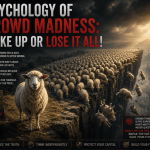
The Gambler Mindset: Succumbing to the Herd Mentality of Loss
We are trained early to obey scripts that promise safety, then punish deviation with shame. Eat this, study that, marry by this age, serve the group, deny the self. The result is a population fluent in compliance and illiterate in judgment, perfect for herds that need bodies more than brains. Markets love that arrangement because crowds that fear embarrassment are easily stampeded when prices fluctuate.
We glorify vows we cannot keep, then act shocked when they collapse under ordinary strain. “I promise forever” sounds noble, yet most people cannot keep a weekly gym plan without cheating by Tuesday. The mismatch breeds anxiety, then paralysis, then a desperate search for someone else to blame when the fantasy buckles. In markets, that same hunger for certainty breeds ruin, since outcomes are based on probabilities, not poetry.
Break the Script, Not Reality
Thinking outside the box does not mean floating above facts; it means interrogating the box that shaped your reflexes. Hold ideas lightly, test them hard, revise publicly, and resist the urge to defend a belief simply because it is yours. The mind that learns faster than it signals virtue becomes dangerous, because it stops trading identity for outcomes. That mind can sit with discomfort long enough to reach clarity.
Strong relationships and strong portfolios share the same spine, internal stability before external attachment. If you expect another person, or the market, to regulate your mood, you will overreact whenever they wobble. Build your own floor through skill, habits, and honest accounting of risk, then bring that completeness to partners and positions. Dependence invites drama, and drama sells headlines, but it never compounds.
Crowds chase relief, not returns, which is why they buy highs for comfort and sell lows for pain relief. After a loss, gamblers double down to erase shame, then call it courage when it is only craving. The loop is simple: sting, impulse, action, regret, repeat, with fees deducted at every turn. Markets reward the operator who breaks the loop because patience allows the price to return to reason.
From Herd to Vanguard: A Rebuild Protocol
- Replace certainty talk with probability language, then write rules you will actually follow under stress.
- Journal trades and triggers, track the thought that preceded each error, and design a countermove you can execute.
- Run small controlled experiments, size tiny, gather evidence, scale only when the edge survives contact with reality.
- Seek disconfirming data first, because comfort is a drug, and drugs like to be renewed.
- Define exit criteria at the outset, so that your frightened present does not compromise the future.
- Audit influences, mute the loud and wrong, and keep a short list of sources you can defend.
Pick Your Table: Casino or Workshop
You can live as a gambler, soothing fear with bets and calling the rush a plan, or you can live as a builder, trading dopamine for data and applause for progress. The world will continue to sell scripts that turn free minds into predictable streams of cash and attention. Decline the role. Choose clarity over noise, process over performance theatre, and results over reputation. The herd offers company in failure, the vanguard offers solitude that profits.

Articles That Push the Boundaries of Knowledge




Inductive Versus Deductive Reasoning