
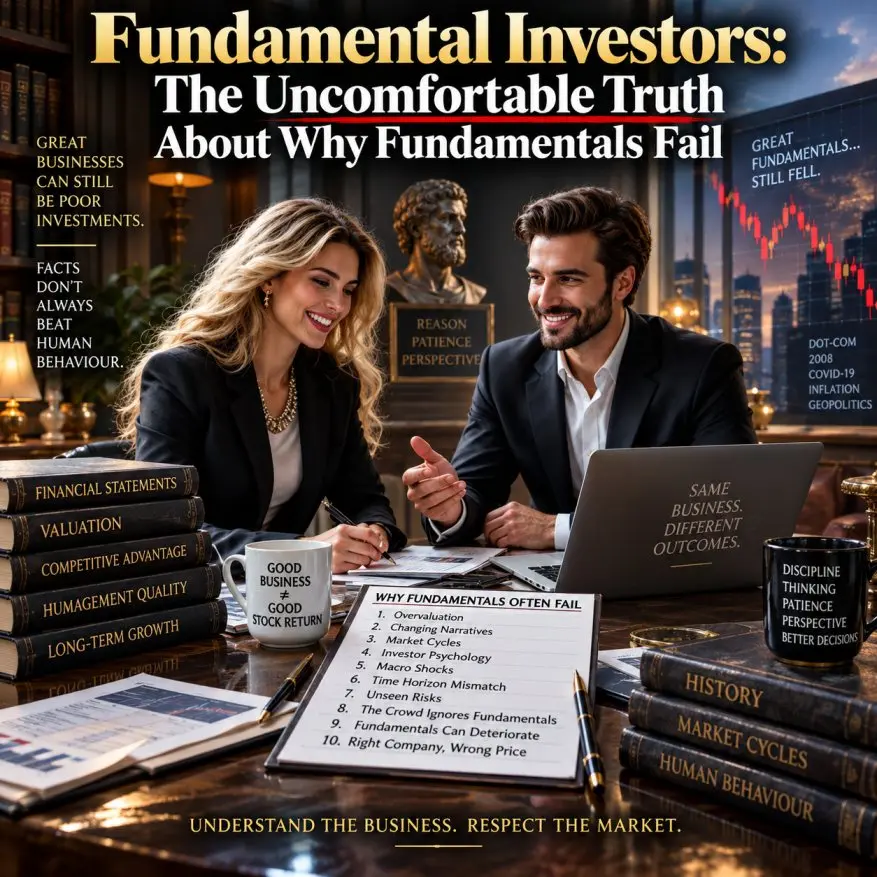
Fundamental Investors: The Uncomfortable Truth About Why Fundamentals Fail
Sept 10, 2026
When Being Right Still Loses You Money
Fundamental analysis tells investors what a business may be worth, but markets do not price businesses according to fundamentals alone. Liquidity, positioning, expectations, fear, greed, and herd behaviour can overwhelm valuation for months or even years, allowing a fundamentally correct thesis to lose money simply because the market’s vector is moving in the opposite direction.
This is the uncomfortable distinction between being right and being profitable. Earnings and cash flow change gradually, while capital can move instantly when sentiment fractures, liquidity tightens, or a dominant narrative changes. A stock can therefore remain cheap while falling another 30%, not because the valuation analysis is necessarily wrong, but because valuation does not stop forced selling.
Why Fundamentals Lose Their Edge
Fundamental analysis is deductive, which means thousands of investors can examine the same filings, ratios, earnings, and projections and reach similar conclusions. Once the market broadly accepts that a stock is undervalued, much of the informational advantage disappears because the belief has already been incorporated into price.
The greater weakness is timing. Earnings arrive quarterly, valuation models change slowly, but price reacts immediately to liquidity and psychology, so a cheap stock can remain cheap while the market continues moving lower. Fundamentals identify terrain, but they do not tell you when the psychological battle over price will begin, intensify, or end.
Mass Psychology Changes the Equation
Markets are social systems because investors constantly observe one another and react to Collective behaviour. Loss aversion causes investors to experience losses more intensely than equivalent gains, while herd behaviour transforms that individual discomfort into collective selling when enough participants begin trying to escape simultaneously.
That is how a market decline becomes a psychological feedback loop. Falling prices create fear, fear creates selling, selling produces lower prices, and those lower prices convince more investors that their fear was justified. The market can therefore move considerably further than fundamentals alone would suggest because the crowd is responding not only to information, but to the behaviour of everyone around it.
Vector Psychology: What Force Is Actually Moving Price?
This is where vector psychology becomes essential. The relevant question is not simply whether price is rising or falling, but what force is producing the movement, whether that force is strengthening or weakening, and whether price is becoming increasingly disconnected from value.
A decline caused by collapsing earnings, excessive debt, or permanent impairment is fundamentally different from one caused by forced liquidation, deleveraging, panic, or indiscriminate selling. Both produce falling prices, but only the second can create the kind of emotional dislocation that turns fear into opportunity.
Technicals Reveal Behaviour
Technical analysis provides the behavioural evidence that fundamentals cannot provide in real time. Price, volume, momentum, breadth, and volatility reveal whether capital is confirming the fundamental thesis or rejecting it, while indicators such as RSI, MACD, and moving averages help identify whether the prevailing vector is strengthening, weakening, or becoming stretched.
Technicals are not magical forecasting tools. Their value comes from showing what participants are actually doing, particularly when price and fundamentals disagree, and that information can prevent the classic fundamental-investing mistake of buying an asset simply because it looks cheap while the market is still aggressively repricing it.
The Price and Value Disconnect
The greatest opportunity often appears when emotional intensity becomes disproportionate to fundamental deterioration. A falling stock is not automatically cheap, because a deteriorating business can deserve a lower valuation, but when fear pushes a fundamentally sound asset far below a reasonable assessment of its value, the market has created a dislocation rather than merely repriced risk.
This is where the tactical investor becomes interested. The objective is not to buy every collapse, but to identify situations where the crowd’s emotional reaction has become excessive and where the potential reward from restoring the price/value relationship justifies the remaining risk.
Capitulation Changes the Psychology
Capitulation occurs when investors who previously tolerated losses finally reach their psychological limit. They stop asking whether the asset is worth owning and start asking how quickly they can eliminate the pain of owning it, which can produce indiscriminate selling across entire sectors and create extreme price movements.
Capitulation does not guarantee the exact bottom. It signals that the emotional force behind selling may be approaching exhaustion, particularly when extreme volume, oversold conditions, improving breadth, or failed attempts to establish new lows suggest that sellers are losing control. The hunter watches this process rather than trying to predict the precise low.
The Hunter and the Hunted
The hunter versus hunted framework is not about intelligence or secret market control. The hunted investor is trapped inside the herd’s emotional timeframe, reacting to headlines, losses, and the actions of other participants, while the hunter steps outside that psychological loop and studies the herd’s direction, conviction, and exhaustion.
The hunter does not automatically oppose the crowd. That would simply create another form of herd behaviour, and sometimes the crowd is correct, particularly when fundamentals are genuinely deteriorating.
The hunter instead waits for asymmetry. When the crowd is selling because value has collapsed, there may be no opportunity, but when the crowd is selling because fear has overwhelmed valuation, the hunter can exploit the resulting price/value disconnect.
Patience Is a Position
Patience is not passive when it preserves capital and optionality. Cash allows an investor to wait while the herd exhausts itself, while psychological discipline prevents the investor from chasing euphoric prices or dumping quality assets during temporary panic.
For investors who genuinely want to own a stock at a lower price, cash-secured puts can extend this principle by potentially providing income while waiting for the desired entry. The strategy fits the broader philosophy of getting paid to enter, getting paid while holding, and getting paid to sell, provided the underlying business is genuinely worth owning.
Why Integration Wins
Fundamentals define value. Technicals reveal price structure and timing, while mass psychology explains why price can temporarily detach from value, and vector psychology connects these elements by identifying the direction and intensity of the forces acting on the market.
This integrated approach prevents two opposite mistakes. Buying because something is cheap while the bearish vector remains intact can produce unnecessary losses, while selling because the crowd is panicking can mean surrendering a valuable asset at precisely the moment emotional pressure is creating an opportunity.
Templeton understood the importance of combining valuation with extreme pessimism, while Graham emphasized the margin of safety and Munger rejected monocausal thinking. Their methods differed, but the common principle was adaptability rather than analytical purity.
Conclusion: Precision Over Purity
Fundamental analysis is not obsolete. It is incomplete when separated from timing, market structure, and human behaviour, because value only becomes financially useful when the market eventually recognizes it. Fundamentals explain value. Technicals explain structure. Mass psychology explains distortion. Vector psychology explains the force connecting them. The investor who understands this does not need to predict every market turn.
The objective is to recognize when the crowd’s behaviour has become extreme, determine whether the underlying value has actually changed, and act when fear or greed has created a sufficiently large disconnect between price and reality. That is the real advantage. You are not trying to be smarter than the market; you are trying to understand the people moving it, recognize when the herd’s vector changes, and remain prepared when emotional behaviour creates the opportunity.

Interesting Reads for the Inquisitive