

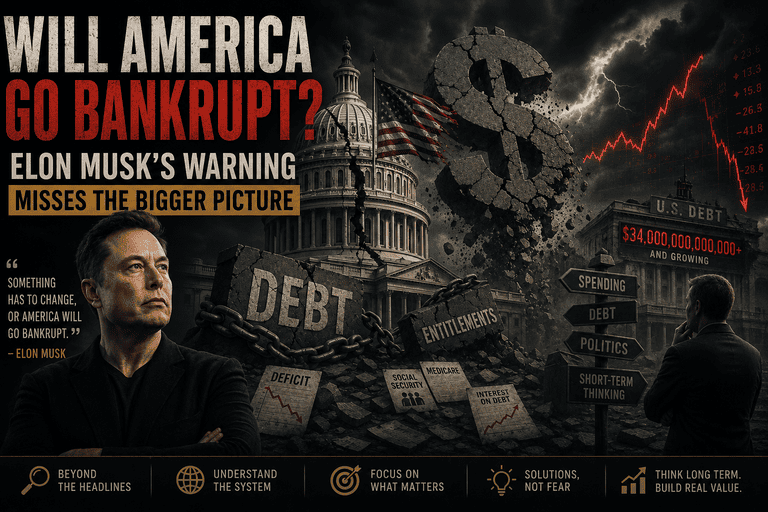
Will America Go Bankrupt? Elon Musk’s Warning Confuses Sovereign Debt with Corporate Failure
Elon Musk has once again delivered a headline perfectly engineered for the modern media cycle, warning that America is “1,000% going to go bankrupt” and “fail as a country” unless its fiscal trajectory changes. It is a dramatic claim, one that guarantees attention because it compresses an extraordinarily complex subject into a single emotionally charged conclusion. The problem is not that America’s debt trajectory deserves no scrutiny. It absolutely does. The problem is that the headline confuses two entirely different concepts: sovereign finance and corporate bankruptcy, treating them as though they operate under the same rules when they plainly do not.
Observable Reality: Governments Are Not Corporations
A corporation that continually spends more than it earns eventually runs out of options. Creditors refuse to lend, suppliers demand payment, cash flow dries up and bankruptcy follows because the company lacks the legal authority to create the currency required to meet its obligations. Governments that borrow primarily in their own currency occupy a fundamentally different position because they possess powers unavailable to any private enterprise. They can refinance existing debt, issue new debt, expand the money supply through their central bank and, in many cases, allow inflation to reduce the real value of outstanding obligations over time.
That does not mean debt is irrelevant or that governments can borrow without consequence. It simply means the consequences are usually different. Rather than ending in a formal bankruptcy proceeding, excessive sovereign borrowing tends to manifest through slower economic growth, currency depreciation, persistent inflation, declining purchasing power, rising interest costs and, ultimately, a gradual transfer of the burden onto ordinary citizens through higher taxes or a lower standard of living. The bills are still paid. Society simply pays them differently.
The Narrative: Bankruptcy Makes a Better Headline Than Monetary Economics
The language of bankruptcy resonates because everyone understands what happens when a business fails. It is immediate, visible and familiar. Applying that language to governments creates a compelling narrative, encouraging readers to believe that nations face the same binary outcome as corporations, namely solvency or collapse.
Yet history offers little support for that comparison. Numerous governments have carried debt burdens that would render most corporations insolvent many times over, while continuing to function because markets retained sufficient confidence in their ability to service interest payments and because those governments retained monetary flexibility unavailable to private borrowers.
Japan provides perhaps the clearest modern example. Government debt has exceeded 200% of GDP for years, a level that would almost certainly destroy an ordinary corporation, yet Japan has neither declared bankruptcy nor experienced the type of sovereign collapse that debt ratios alone might suggest. Critics invariably describe Japan as a “special case,” pointing to domestic ownership of debt, demographic characteristics or the policies of the Bank of Japan. Those observations are valid, but they also reveal an important pattern. Every period of unusually high sovereign debt is eventually explained as exceptional, reinforcing the familiar claim that “this time is different.” But sometimes it is but often it isn’t.
Applying the Tactical Investor Framework Changes the Question
While the bankruptcy analogy is technically flawed, dismissing the underlying fiscal concerns would be equally mistaken. The better approach is to examine governments using the same principles investors apply when evaluating businesses, while recognising that governments possess monetary powers corporations do not.
A financially healthy business generally funds most of its long-term growth through operating profits, using debt selectively to finance productive investment that generates future returns. Borrowing can accelerate expansion, but it should complement positive cash flow rather than permanently replace it. When a company continually issues new debt simply to refinance existing obligations while remaining structurally dependent on external financing, experienced investors rarely describe it as financially strong, even if it continues meeting every interest payment on schedule.
Viewed through that lens, many governments resemble businesses whose underlying financial position has gradually weakened. They consistently spend more than they collect, refinance maturing obligations with newly issued debt and rely upon economic growth, financial repression or monetary expansion to maintain stability. The fact that these mechanisms continue functioning does not prove the model is healthy. It merely demonstrates that sovereign borrowers possess tools unavailable to private enterprises.
What Actually Matters Is Not Bankruptcy but Dependence
The real issue is therefore not whether the United States will “go bankrupt” in the corporate sense. It almost certainly will not, provided it continues borrowing in dollars while maintaining access to deep and liquid capital markets. The more meaningful question is whether the current fiscal model has become structurally dependent upon ever-increasing debt issuance, continuous refinancing and monetary accommodation simply to preserve the status quo.
The United States enjoys advantages few nations have ever possessed. The dollar remains the world’s dominant reserve currency, US Treasury securities continue serving as the cornerstone of the international financial system and global demand for dollar-denominated assets provides extraordinary borrowing capacity that other countries can only envy. Those advantages buy time, lower borrowing costs and provide exceptional financial flexibility.
They do not repeal arithmetic. Interest expenses eventually consume a larger share of government revenues. Larger deficits require additional borrowing. Additional borrowing increases the future interest burden, creating a feedback loop that becomes increasingly difficult to reverse without either stronger economic growth, meaningful fiscal restraint or some combination of inflation and financial repression.
The Structural Reality
The headline asks whether America is going bankrupt and that is the wrong question. The more important question is whether a financial system built upon persistent deficits, expanding debt and continual refinancing can remain stable indefinitely without eventually requiring significant adjustment. History suggests that confidence, not mathematics, determines how long such systems persist, because investors continue lending as long as they believe future obligations will remain manageable.
Eventually, however, confidence and arithmetic converge. The adjustment may arrive through inflation rather than default, through financial repression rather than bankruptcy, or through decades of slower growth rather than sudden collapse. Those outcomes differ enormously from corporate bankruptcy, yet they still impose very real costs on society, costs that are rarely borne equally. Governments generally continue functioning. Bondholders often continue receiving payments. The greatest burden falls upon ordinary households through diminished purchasing power, higher living costs and slower improvements in living standards.
The debate, therefore, should never have been about whether America will “go bankrupt.” It should be about whether perpetual borrowing has gradually become a substitute for sustainable fiscal discipline, because while sovereign nations rarely fail like corporations, they can still become financially impaired in ways that leave citizens paying the price long before the government ever misses a payment.