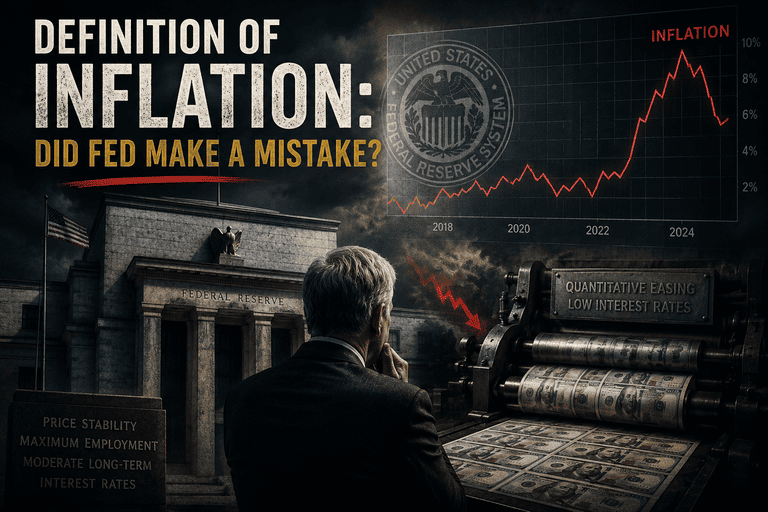
The Definition of Inflation: What If the Fed Got It Wrong?
“Bankers know that history is inflationary and that money is the last thing a wise man will hoard.” William C. Durant
July 28, 2026
What Inflation Really Means
Inflation is one of the most abused terms in economics because most discussions confuse its symptoms with its cause. Rising prices are merely the visible expression of deeper monetary forces, whether driven by an expanding money supply, constrained production, or shifting demand. Price increases alone tell us little. The real question is why prices are rising.
Moderate inflation is neither inherently good nor bad. In a productive economy it often reflects healthy demand and expanding activity. Persistent inflation, however, gradually erodes purchasing power, distorts investment decisions, and weakens economic growth. Context, not ideology, determines whether inflation is constructive or destructive.
The Fed’s Definition Misses the Cause
For decades the Federal Reserve has treated inflation primarily as rising consumer prices, while many monetary economists argue that prices are only the downstream consequence of a more fundamental process: monetary expansion.
Viewed through this lens, inflation is not the increase in prices but the increase in money itself. Prices simply adjust to reflect changes in purchasing power, making them an effect rather than the disease. Focusing exclusively on consumer prices risks treating symptoms while leaving the underlying monetary imbalance untouched. As Ludwig von Mises observed, inflation begins with the expansion of money and credit; rising prices merely reveal what has already occurred beneath the surface.
Why the Fed Raised Rates
When the Federal Reserve began raising interest rates, the stated objective was straightforward: prevent inflation from becoming entrenched.
The difficulty was that inflationary pressures remained surprisingly weak despite years of extraordinary monetary accommodation. Former Fed Chair Janet Yellen repeatedly argued that below-target inflation reflected temporary forces and would eventually move back toward the Fed’s 2% objective, but persistent global trends suggested otherwise. Weak productivity growth, ageing demographics, technological disruption, global competition, and excessive debt all continued suppressing pricing power despite unprecedented monetary stimulus. The question therefore was never whether the Fed could raise rates. It was whether the economy could withstand them.
Debt Changes Everything
Modern economies are far more leveraged than those of previous decades, making them increasingly sensitive to even modest increases in borrowing costs. As Bill Gross warned, higher short-term rates disproportionately affect corporations, households, and governments carrying substantial debt burdens. Rising interest expenses reduce investment, weaken consumption, compress corporate margins, and ultimately increase default risk. Leverage amplifies both expansion and contraction, leaving highly indebted economies far less capable of absorbing sustained monetary tightening. Interest rates no longer operate in isolation. They operate on mountains of accumulated debt.
The Global Picture Told a Different Story
If inflation had truly become the dominant global threat, central banks would have responded with synchronized tightening. Instead, many moved in the opposite direction.
Japan continued expanding monetary stimulus while repeatedly postponing its inflation target. South Africa surprised markets by cutting rates. Inflation weakened across Canada, Germany, Brazil, and much of the developed world, while institutions such as Credit Suisse continued describing global inflation as broadly benign. The data suggested that inflation was not accelerating globally but gradually losing momentum, making aggressive tightening increasingly difficult to justify.
Deflationary Forces Were Winning
Several structural forces continued placing downward pressure on prices regardless of central bank policy. Retail competition intensified as Amazon accelerated the decline of traditional brick-and-mortar retailers, contributing to thousands of store closures across the United States. Grocery competition became even more aggressive as Aldi, Lidl, and Amazon’s acquisition of Whole Foods ignited a sustained price war that permanently increased consumer pricing power.
Technology amplified these trends. Artificial intelligence, automation, e-commerce, and global supply chains continuously reduced transaction costs, improved productivity, and increased price transparency, making it progressively harder for businesses to maintain pricing power. Technology was doing what central banks struggled to prevent; It was making goods cheaper.
The Velocity Problem
Perhaps the strongest argument against persistent inflation was not consumer prices but the velocity of money. Despite unprecedented monetary expansion, M2 velocity continued declining, indicating that newly created money circulated through the economy more slowly rather than generating sustained demand. Monetary expansion alone cannot create lasting inflation if money remains trapped within financial assets instead of flowing through productive economic activity.
Liquidity without velocity creates asset inflation far more readily than consumer inflation. That distinction explains why stocks, real estate, and financial assets appreciated dramatically while broad consumer inflation remained persistently subdued for years.
Conclusion: Inflation Is More Than Prices
Inflation cannot be understood by watching prices alone because prices merely reveal the interaction between money, credit, productivity, debt, technology, and human behaviour. Central banks focus on consumer prices because they are easily measured, but markets respond to the deeper forces shaping those prices long before official statistics recognise the shift.
The Federal Reserve’s decision to raise rates was therefore never simply a battle against inflation. It was an attempt to normalize monetary policy within an economy that remained structurally dependent on cheap money, extraordinary liquidity, and historically low borrowing costs. The challenge was not whether rates should rise but whether a highly leveraged financial system could tolerate them without exposing weaknesses created during years of easy credit. Markets eventually answer questions that policy cannot and the only uncertainty is how expensive the lesson becomes.

Articles You’ll Love: Our Top Picks for Curious Minds