Investor Psychology: Master Your Mind Before the Market Masters You
“The investor’s greatest enemy is rarely the market itself. It is the mind trying to make sense of uncertainty while surrounded by thousands of people doing exactly the same thing.”
Sept 16, 2026
The Market Is a Human Behaviour Machine
Markets are often presented as machines that process information efficiently, with prices supposedly reflecting earnings, interest rates, economic growth, corporate guidance, and every other piece of information available to investors. Yet markets repeatedly produce bubbles, panics, momentum cascades, violent reversals, and periods in which perfectly reasonable analysts can construct persuasive explanations for moves that they failed to anticipate, because the market does not simply process information, it processes information through human beings whose emotions, expectations, biases, incentives, and social behaviour constantly alter the meaning of that information.
This is why mass psychology matters. An individual investor can be cautious while the crowd is euphoric, or optimistic while everyone else is terrified, but once enough participants respond to the same narrative in the same direction, individual decisions become a collective force capable of moving prices far beyond what any spreadsheet alone would suggest.
The deeper problem is that investors are not standing outside this system and observing it objectively. They are inside it, exposed to the same headlines, price movements, social media narratives, forecasts, fear, greed, FOMO, and confirmation bias as everyone else, which means the first psychological battle is not against the market but against the part of your own mind that desperately wants certainty.
Bias Is the Beginning of the Problem, Not the End
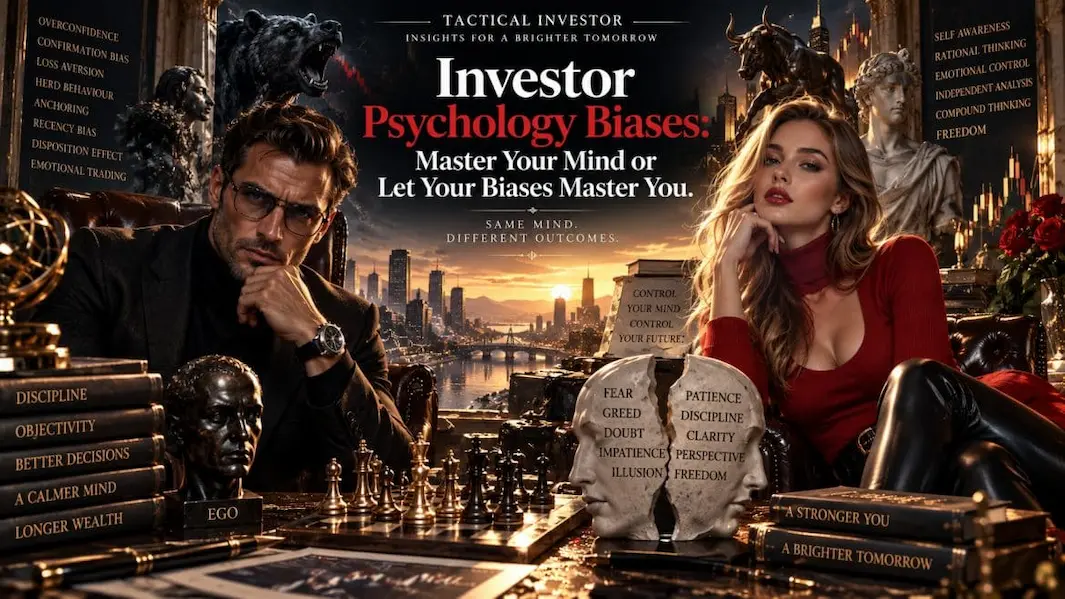
Behavioural finance has identified numerous biases that influence investment decisions, including loss aversion, anchoring, confirmation bias, recency bias, availability bias, overconfidence, and herd behaviour. These biases matter because they distort the way investors interpret information, particularly when markets become emotionally extreme and the pressure to conform becomes stronger than the willingness to question the prevailing narrative.
Loss aversion can cause investors to hold declining positions because accepting the loss feels psychologically worse than continuing to hope for recovery. Anchoring can cause an investor to treat an old price target, previous market high, or historical valuation as though it remains objectively meaningful even after the underlying conditions have changed, while confirmation bias allows people to selectively collect information that supports a position they have already emotionally adopted.
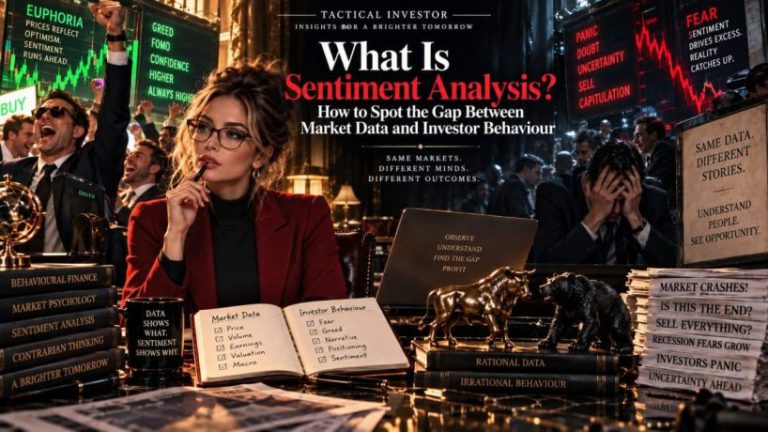
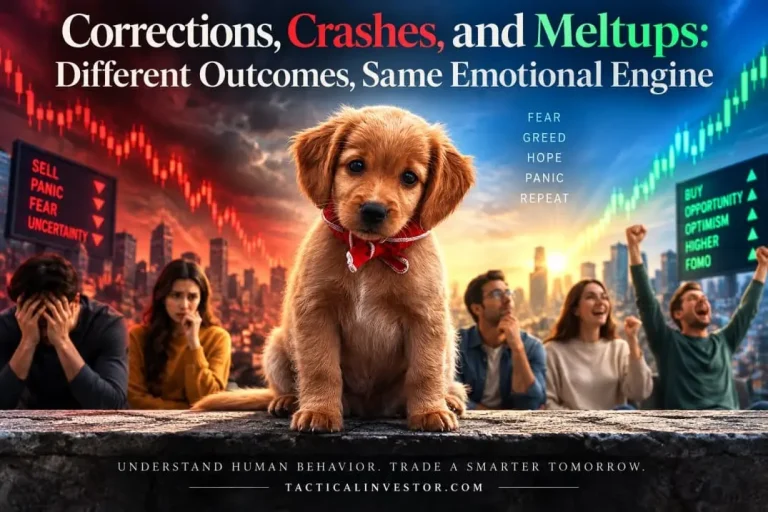
But the most dangerous development occurs when individual biases synchronize across the crowd. Fear becomes mass fear, optimism becomes mass optimism, and eventually the market begins responding to the emotional reaction itself, creating a feedback loop in which rising prices generate confidence, confidence generates buying, buying generates further price increases, and those price increases become the justification for even greater confidence. That is where individual psychology becomes mass psychology.
The Crowd Does Not Need to Be Rational to Move the Market
A market can remain fundamentally defensible while becoming psychologically excessive, just as it can become fundamentally attractive while the crowd remains terrified. The distinction matters because valuation alone cannot tell you when the crowd will change its mind, while sentiment alone cannot tell you whether an asset has become genuinely undervalued.
The investor therefore needs to watch the interaction between sentiment and price. When optimism is increasing while breadth expands and the trend remains healthy, rising prices may simply reflect genuine demand, but when confidence becomes extreme while participation narrows, momentum weakens, valuations stretch, and investors begin treating further gains as inevitable, the psychological structure is becoming more fragile.
The reverse can happen during a collapse. Fear can initially be justified, but if selling becomes indiscriminate, sentiment reaches extreme pessimism, quality assets are liquidated alongside weak ones, and increasingly negative news produces progressively smaller declines, the market may be approaching a transition even though the headlines remain horrific.
The point is not that fear equals bottom or euphoria equals top. The point is that the reaction of the crowd contains information about the force behind the price movement.
Vector Psychology: Read the Force, Not Just the Emotion
This is where vector psychology becomes useful because simply labelling a market “bullish,” “bearish,” “fearful,” or “euphoric” tells you very little about what is actually happening. A market vector can be examined through four dimensions: direction, intensity, breadth, and persistence.
Direction tells you where capital is moving, intensity tells you whether that movement is accelerating or weakening, breadth tells you whether participation is broadening or narrowing, and persistence tells you whether the force survives reversals or is beginning to lose control. When these components align, the underlying market force becomes considerably easier to interpret, while divergence between them can reveal a transition that the headline narrative has not yet recognised.
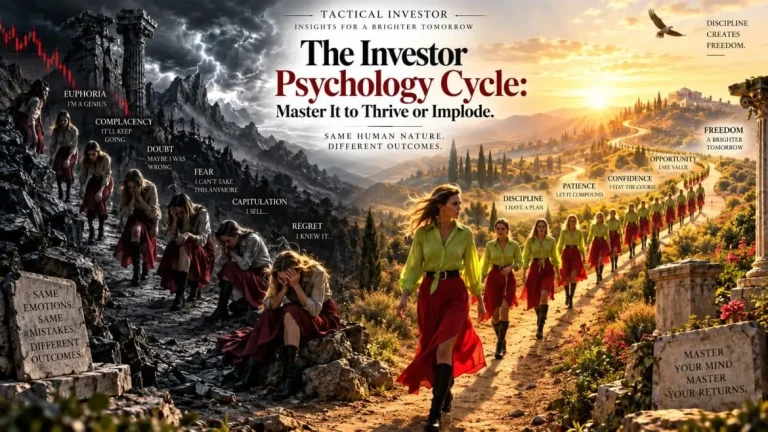
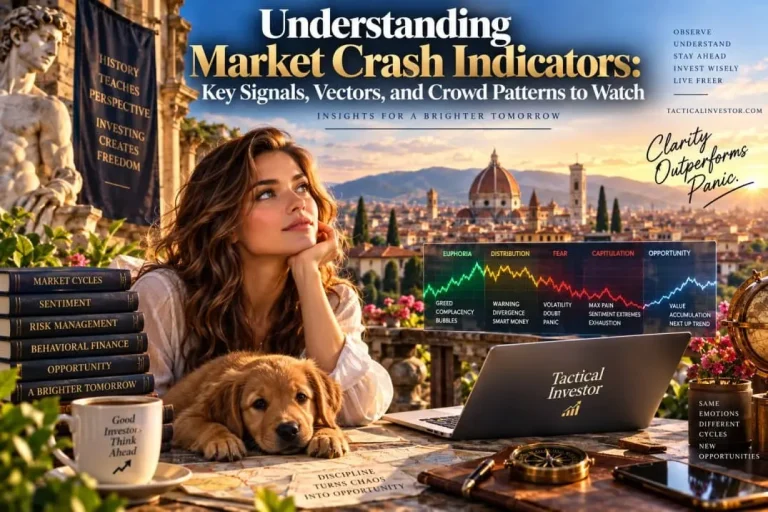
This creates a more useful sequence than simply memorising emotional labels. Optimism can expand into acceleration, acceleration can become saturation, saturation can produce reversal, reversal can develop into panic, panic can exhaust into capitulation, and capitulation can eventually give way to absorption and recovery.
The investor does not need to predict precisely when one stage ends. The advantage comes from recognising when the force driving the previous stage is losing power.
Why Experts Get Market Forecasts Wrong
This is also why market forecasting is far more difficult than it appears. An expert can correctly identify a structural problem and still produce a terrible investment forecast because direction, timing, magnitude, sequencing, and actionability are separate questions.
A strategist might correctly argue that valuations are excessive but fail to recognise that speculative psychology can keep pushing prices higher for years. Another may correctly anticipate a recession but be so early that investors who followed the forecast miss years of gains, while someone else might correctly identify an approaching crash but dramatically exaggerate its magnitude and therefore destroy the practical usefulness of an otherwise intelligent warning.
This is the forecasting trap. Being directionally right is not the same as being financially useful.
The market does not pay investors for eventually being proven correct by history. It pays them for making decisions while uncertainty still exists, which means a serious forecast should be judged not merely by whether the event eventually occurred but by timing, magnitude, sequencing, and whether an investor could realistically position capital around the forecast.
That standard applies equally to bullish and bearish experts. The problem is not forecasting itself, because forecasts can be useful, but treating confident narratives as though confidence is evidence.
The Trend Is the Market’s Behavioural Record
Technical analysis becomes considerably more useful when understood through this psychological framework. A chart is not merely a collection of lines and indicators, because price is the accumulated record of millions of decisions, and those decisions contain information about confidence, fear, positioning, liquidity, expectations, and changing perceptions.
A rising trend accompanied by expanding breadth and persistent demand tells a different story from a rising index supported by fewer stocks while momentum deteriorates. Likewise, a sharp decline followed by stabilisation, improving breadth, declining selling pressure, and increasingly resilient price action tells a different story from a market that continues making lower lows despite supposedly positive developments.
Indicators such as RSI, MACD, moving averages, stochastic oscillators, volume, and breadth are therefore most useful when they help identify changes in behaviour rather than when they are treated as mechanical buy and sell buttons. Technical analysis records what the crowd is actually doing, while psychology helps explain why the crowd may be doing it. The combination is considerably more powerful than either approach alone.
Sentiment Is Useful Only When Price Confirms It
Sentiment is another area where investors frequently become trapped by simplistic rules. Extreme bullishness does not automatically mean the market must fall, and extreme bearishness does not automatically mean the market must rise, because sentiment can remain extreme while the underlying trend continues to strengthen or weaken.
The useful question is whether sentiment is confirming or contradicting price behaviour. When optimism is extreme and the market continues accelerating with broad participation, the trend remains powerful even though risk may be increasing, whereas extreme optimism combined with deteriorating breadth and weakening momentum provides a different signal because the emotional fuel is no longer producing the same response.
Fear works the same way. A market falling violently while fear continues accelerating is still under pressure, but when fear remains extreme and bad news increasingly fails to push prices lower, the relationship between emotion and price may be changing. The market is always telling you something. The difficult part is learning to listen without forcing it to say what you want to hear.
Contrarian Does Not Mean Automatically Opposite
Contrarian investing is frequently misunderstood as doing the opposite of whatever everyone else is doing. That is not contrarian thinking; it is simply another form of herd behaviour with the direction reversed.
A genuine contrarian investor asks whether the crowd’s belief is already reflected in price and whether the underlying evidence supports that belief. When euphoria produces extraordinary expectations, the contrarian becomes cautious because future returns increasingly depend on expectations becoming even more extreme, while during panic the contrarian becomes interested when fear has pushed quality assets below reasonable value and the selling force begins losing effectiveness.
This is where patience becomes a weapon. You do not need to catch the precise bottom, because markets often decline through multiple waves of selling, and you do not need to sell the exact top because attempting to extract every last dollar from an euphoric market can turn discipline into greed. The objective is to exploit asymmetry rather than prove that you can predict the future.
The Psychology of the Crash
Market crashes expose human behaviour more clearly than almost any other environment because the normal hierarchy of priorities changes rapidly. Investors who previously cared about valuation and long-term returns suddenly care about survival, liquidity, and avoiding further losses, while institutions facing leverage, redemptions, margin calls, or risk limits can become forced sellers regardless of what they believe an asset is worth.
This is why crashes can create extraordinary opportunities without every falling stock becoming a bargain. The psychological pressure can become indiscriminate, pushing good businesses lower alongside weak ones, and that is precisely where valuation, liquidity, technical behaviour, and emotional extremes need to be considered together.
Cash-secured puts can become particularly interesting in such environments when used on companies you genuinely want to own anyway. Elevated fear can increase option premiums, allowing an investor to get paid to wait for a lower entry price, potentially creating a substantial effective discount while preserving the possibility of simply keeping the premium if the shares never reach the strike. The strategy is not “buy the crash.” It is get paid to wait while the crowd decides what it is worth.
The Greatest Bias Is the Need for Certainty
Perhaps the most damaging psychological bias is not any individual behavioural error but the desire to convert uncertainty into certainty. Investors want to know whether the market will crash, whether gold will rise, whether interest rates will fall, whether a stock will double, or whether an expert’s forecast will prove correct, yet markets do not operate according to the emotional need for definitive answers.
This is why experts can become psychologically dangerous even when they are intelligent and sincere. A compelling forecast can provide the crowd with something it desperately wants, which is a coherent story about an unknowable future, and once that story becomes emotionally satisfying, evidence that contradicts it can be dismissed rather than examined.
The investor’s job is therefore not to find the person who sounds most certain. It is to identify the forces that are actually operating, determine what the market is pricing, examine where expectations appear excessive, and remain flexible enough to change position when the evidence changes.
Master Your Mind Before You Attempt to Master the Market
Investor psychology is ultimately a study of human behaviour under uncertainty, and that makes it far more important than simply memorising a list of cognitive biases. You need to understand how an individual bias becomes collective behaviour, how collective behaviour becomes sentiment, how sentiment reinforces trends, how trends eventually become emotionally excessive, and how those emotional extremes can reverse with astonishing speed.
The market does not need you to be emotionless. It requires you to recognise when your emotions are becoming part of the same process you are attempting to analyse.
Study the crowd. Study the trend. Study sentiment. Study valuation. Study the reaction to news rather than merely the news itself, and pay particular attention when price behaviour begins contradicting the dominant narrative.
That is where the real information often appears. The investor who masters psychology does not escape uncertainty, because nobody can. They simply become less dependent on certainty, more capable of recognising changing forces, and better positioned to act when the crowd’s emotional extremes create an opportunity that was invisible while everyone was thinking alike.