

Stock Market Complacency: Break the Mould and Soar Higher
Dec 06, 2024
The Lure of Complacency in Rising Markets
Rising markets turn even sober minds into dreamers. Gains stack, screens glow green, and a quiet voice whispers that gravity retired. That voice lies. Complacency grows like mould in warm air, soft at first, then everywhere. It dulls the edge, stalls discipline, and convinces investors that risk vanished. When the turn comes, it does not tap the shoulder. It bites.
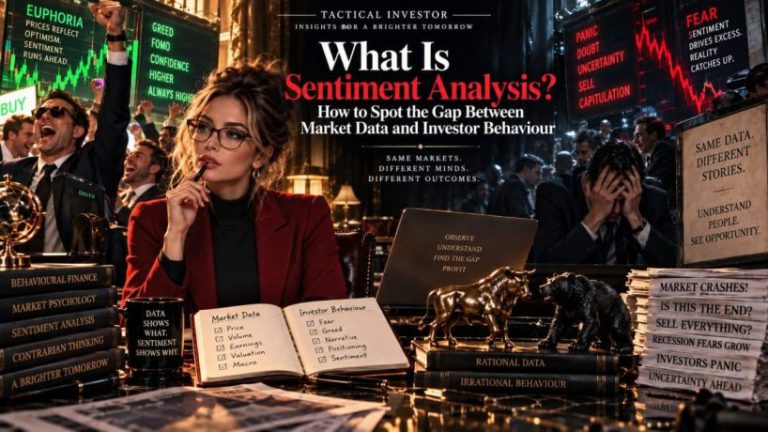
Crowds amplify the danger. Mass psychology coils around momentum, pulling people toward the same exits they once stampeded through. FOMO crowns itself king, and reason takes a long smoke break. History left scars that prove the cycle: the housing bubble, the tech mania, every fever that claimed immunity from correction. The herd believed safety lived in numbers. The collapse proved otherwise.
Robert Shiller mapped these moods with clinical clarity. He showed that sentiment moves markets with the same force as money. The investor who forgets this becomes prey.
The Role of Cognitive Biases in Investment Decisions
Cognitive biases are mental shortcuts our brains use to process information quickly, but they can lead us astray in investing. Confirmation bias, for instance, causes individuals to favour information that confirms their preexisting beliefs, disregarding contradictory data. This bias can reinforce complacency, as investors focus on positive signals and ignore warning signs.
Anchoring is another bias where investors fixate on specific information, such as a stock’s historic high price, and make decisions based on that reference point rather than current realities. Overconfidence bias leads investors to overestimate their knowledge or ability to predict market movements, fostering a false sense of security.
Daniel Kahneman, a renowned psychologist and economist, has illuminated these biases in his work on behavioural economics: his book Thinking, Fast and Slow delves into how these mental processes impact decision-making. By becoming aware of cognitive biases, investors can mitigate their effects by seeking diverse perspectives, questioning assumptions, and relying on data-driven analysis.

Technical Analysis as a Tool for Objective Insights
While psychology plays a significant role in market movements, technical analysis offers a method to interpret market data objectively. Investors can gain insights into market sentiment and potential future movements by examining statistical trends gathered from trading activity, such as price movement and volume.
Chart patterns, moving averages, and momentum indicators help identify trends and potential reversal points. For example, a divergence between a stock’s price and an indicator like the Relative Strength Index (RSI) can signal a possible shift in momentum. Technical analysis doesn’t predict the future with certainty but provides probabilities that aid in making informed decisions.
Seasoned traders like John Bollinger, the creator of Bollinger Bands, advocate for technical analysis as part of a comprehensive investment strategy. By integrating technical tools with fundamental analysis and understanding market psychology, investors can develop a more nuanced view of the markets, avoiding the pitfalls of complacency.
Learning from the Titans of Investing
Great investors do not surf the crowd’s mood, they move against it with cold clarity. Buffett built his empire by refusing to chase noise, treating panic as opportunity and euphoria as risk. His principle is simple: sentiment misprices assets, discipline reclaims their truth. Mass psychology creates the wave, but independent thought decides who rides it and who gets dragged under.
Graham trained him to anchor every decision in intrinsic value. Strip away hype, measure what the business is worth, and act only when price sinks below that line. This cuts through the delirium that inflates assets during manias and protects capital when markets lose their grip on reality. It is an antidote to the crowd’s emotional seesaw.
Dalio widened the frame by studying cycles the way a navigator studies tides. Prepare for rain during sunshine, expect turbulence during calm, and diversify across timeframes and conditions. His discipline shows that markets do not reward clairvoyance; they reward resilience. Learning from these minds resets the investor’s posture from reactive to sovereign.
Seizing Opportunities: Advancing Beyond Complacency
Complacency whispers that survival is enough. Opportunity demands the opposite. When markets break, crowd fear reaches a pitch that forces even strong hands to fold. This is where strategic investors step in. They treat a panic as a clearance rack of first-rate companies, not a funeral for capital. Price collapses while value sleeps untouched.
Blue chips trade at discounts during crashes because emotion moves faster than fundamentals. Buying them at these moments stacks future returns in your favour. It is a decision that looks reckless to the crowd and obvious in hindsight. The vector here is simple: volatility reshapes risk for those willing to step toward it.
Selling put options adds another lever. You agree to buy a stock you already want at a price you already like, and you get paid for standing ready. When volatility spikes, premiums balloon and the income becomes meaningful. If the stock never touches the strike, you keep the cash. If it does, you acquire the asset at an effective discount. It is a disciplined way to turn fear into yield.
Investors who want further advantage can redeploy dividends into more shares, bank tax benefits through loss harvesting, or expand into adjacent assets that move on different psychological currents. Each tactic reinforces the same principle: movement beats stagnation. Once complacency is stripped away, strategy fills the space.
The Power of Independent Thinking
Independent thought cuts through the herd’s fog. It demands investigation over imitation, evidence over echo, judgment over impulse. Markets reward this posture because most participants surrender their reasoning the moment a crowd forms. Sentiment becomes gravity. Independent thinkers resist that pull.
The mind sharpens when exposed to varied sources, especially those that challenge its assumptions. Disagreement widens perspective and builds intellectual range. A personal decision journal adds another layer of discipline, revealing patterns in reasoning and blind spots that crowd noise often hides.
Munger perfected this craft by borrowing tools from psychology, history, and economics. He understood that markets are human theatres long before they are mathematical systems. Investors who bring multiple lenses to a single problem escape linear traps and see structure where others see chaos. This is the architecture of durable advantage.
Navigating Cognitive Biases: Practical Steps
Addressing cognitive biases requires deliberate effort. Implementing checklists can help ensure that decisions are evaluated systematically. For instance, before investing, an investor might verify that they have considered alternative viewpoints, assessed potential risks, and examined whether emotions influence the choice.
Another valuable practice is engaging with advisors or peers who can provide objective feedback. They can offer insights or highlight blind spots that an investor may overlook due to inherent biases. Being open to constructive criticism strengthens the decision-making process.
Mindfulness and reflection can also play a role. By being aware of one’s emotional state, investors can recognise when fear or overconfidence may affect their judgments. Techniques such as meditation or simply pausing before making significant decisions can improve clarity and reduce impulsivity.
Applying Technical Analysis in a Balanced Strategy
Technical analysis earns its place when it sharpens timing and exposes crowd behaviour in real time. Price and volume carry the psychological imprint of buyers and sellers, revealing where conviction strengthens and where doubt fractures. When paired with fundamentals, the picture gains depth. Value sets the anchor, and technicals reveal when the crowd has pushed the price too far from it.
A practical framework starts with trend strength, momentum confirmation, and volatility structure. Identify the dominant trend through moving average alignment, confirm momentum with RSI or MACD divergence, then read volatility through ATR expansion or contraction. When all three vectors agree, the probability shifts in your favour. Add fundamentals, and the signal carries weight rather than hope.
Risk management becomes mechanical. Map key support and resistance based on volume shelves and prior reaction zones, then position size according to volatility. This strips emotion from the process. Entries follow structure instead of impulse. Exits follow rules instead of fear. The discipline turns noise into signal.
Embracing Change and Adapting Strategies
Markets change shape faster than investors expect. Technology rewires behaviour, geopolitics bends supply chains, and consumer patterns flip without warning. Those who cling to fixed models drift into irrelevance while the market evolves around them. Adaptation is not flair. It is survival.
Digital assets proved this shift. Early dismissal came from reflex, not analysis, and the cost was a massive opportunity. Others approached them with scrutiny, mapped their mechanics, and entered with defined risk. Curiosity paired with discipline allowed them to benefit without surrendering judgment.
Adaptation does not demand chasing every novelty. It requires attention, willingness to test assumptions, and the clarity to update models when evidence shifts. Continuous learning keeps investors ahead of stagnation, and flexibility protects them when the world moves in directions they did not expect.

Conclusion: Ditch the Herd, Achieve Success
Stock market complacency is a subtle adversary. It lulls investors into comfort, masks risks, and encourages conformity over critical thought. However, investors can break free from the herd mentality by understanding mass psychology, recognising cognitive biases, and employing tools like technical analysis.
Success lies in vigilance, continuous learning, and the courage to think independently. By adopting strategies embraced by some of the most respected experts in the field, investors position themselves not just to avoid pitfalls but to capitalise on opportunities that others may overlook.
In the journey of investing, complacency is the path of least resistance, but it’s the road less travelled that leads to actual achievement. By proactively managing risks, staying informed, and remaining adaptable, you can ditch the herd and chart a course toward lasting success in the ever-changing landscape of the stock market.
Inspired Reflections: Shining Light on New Ideas