
Introduction: The Limits of Permanent Pessimism
Aug 6, 2026
Every bull market eventually produces a new prophet of doom. The headlines change, the economic justification evolves and the statistics become more sophisticated, but the message rarely changes: this time the crash will be unlike anything investors have experienced before. Mark Spitznagel has become one of the latest voices making that case, arguing that the market is building toward the worst collapse since 1929. Before him, Jim Rogers spent years issuing similarly apocalyptic warnings, and while both men will eventually be correct that another major bear market will occur, that is a statement of inevitability rather than evidence of superior market timing.
Predicting that markets will eventually crash is not a difficult skill. It is no different from predicting that winter will eventually follow summer or that economic expansions will eventually give way to recessions. The challenge is identifying when those events occur, because investors who remain positioned for catastrophe year after year often sacrifice some of the greatest wealth-building opportunities in history while waiting for a collapse that refuses to arrive. Timing matters, and history has shown that perpetual pessimism can be just as destructive to long-term returns as perpetual optimism.
The Difference Between Prediction and Performance
A broken clock is famously correct twice a day. Permanent Market crash forecasters often perform even worse because they repeatedly announce financial Armageddon, quietly discard the predictions that failed and then point triumphantly to the one occasion when markets finally decline as proof they had been right all along. Unfortunately, investors have short memories, and the media has an even shorter one, allowing years of incorrect forecasts to disappear beneath a single successful headline. That is not forecasting; it is survivorship bias applied to market commentary.
The problem with this style of investing is that it conditions people to fear the very mechanism that has historically created the greatest opportunities. Corrections, bear markets and even severe stock market crashes are not abnormal interruptions to investing; they are permanent features of every financial cycle. Markets periodically become overextended, optimism reaches unsustainable levels and prices eventually reset, only for the next cycle of growth to begin again. Investors who spend their lives trying to avoid every decline often discover they have also avoided many of the strongest advances.
Opportunity Wears an Unfamiliar Face
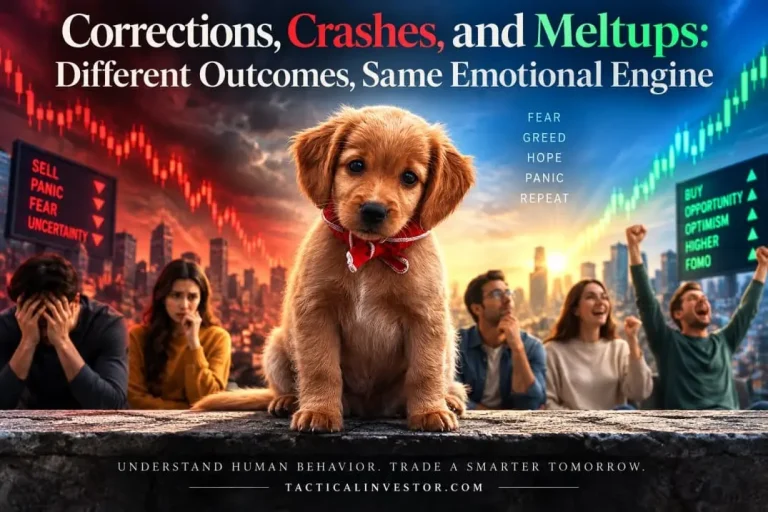
More importantly, the word crash means very different things depending on the type of investor you are. For the individual who chased momentum, ignored valuation, bought near the peak because everyone else appeared to be getting rich and allowed fear of missing out to replace independent thinking, a crash can be financially devastating. For the disciplined investor who understands sentiment, respects market cycles, manages risk and patiently waits for periods of excessive pessimism, the same event is something entirely different. It is not the end of opportunity but the beginning of it.
This is the distinction that sensational headlines almost never explain. Markets do not suddenly become dangerous because prices fall; they become dangerous long before that, when investors abandon discipline during the euphoric phase and convince themselves that risk has permanently disappeared. By the time the eventual correction arrives, the real damage has already been done because emotional decisions were made months earlier at inflated prices. The crash merely exposes mistakes that optimism had successfully concealed.
When Opportunity Changes Hands
That is why every major decline should be viewed as a transfer of opportunity rather than a universal disaster. Wealth is repeatedly transferred from those forced to sell because they are overleveraged, overextended or emotionally exhausted to those who prepared for volatility before it arrived. History consistently demonstrates that some of the best long-term investments are made during periods when fear dominates the headlines, because panic temporarily drives prices below intrinsic value and creates opportunities unavailable during periods of widespread optimism.
None of this suggests investors should ignore risk. Elevated valuations deserve attention, excessive leverage deserves caution and speculative excess should never be dismissed simply because prices continue rising. Preparation is essential, but preparation is fundamentally different from permanent pessimism. Intelligent investors reduce unnecessary risk, maintain liquidity, monitor sentiment and remain flexible without convincing themselves that every rally is merely the prelude to economic collapse.
The Discipline of the Cycle
The most successful investors understand that markets move in cycles rather than straight lines. Bull markets create excess, bear markets remove excess and each prepares the foundation for the next phase of the cycle. The objective is therefore not to predict every major top or bottom but to navigate those cycles without allowing either euphoria or fear to dictate investment decisions. Long-term wealth is built by remaining emotionally detached while others swing between greed and panic.
Mark Spitznagel and Jim Rogers will almost certainly be correct one day because another significant market decline is inevitable. That eventual success, however, does not erase years of premature warnings or transform repeated incorrect forecasts into reliable investment strategy. Investors should remember that prediction is not reality, and reality has consistently rewarded those who remained disciplined, adaptable and patient instead of those who spent years waiting for the next financial apocalypse. A crash is catastrophic only for those who bought certainty at the top; for everyone else, it is simply another opportunity disguised as fear.

What We’re Reading