

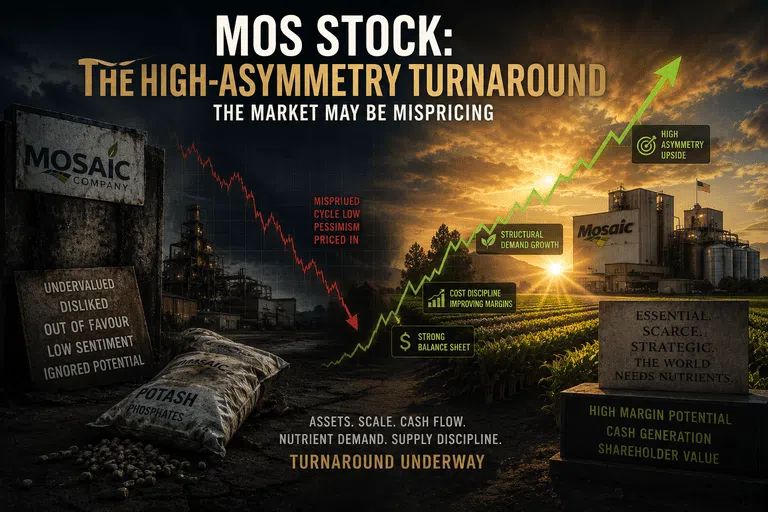
MOS Stock: The High-Asymmetry Turnaround the Market May Be Mispricing
Aug 24, 2026
The Mosaic Company has the kind of structure that deserves a serious Titanium stress test, not because the latest quarter was particularly strong, but because the market is currently looking at a convergence of negative forces that may not all be permanent. The central question is whether Mosaic is suffering through a cyclical compression that can eventually reverse, or whether the sulphur shock is merely exposing deeper structural weaknesses that will continue suppressing earnings even after input costs normalise.
My initial conclusion is that MOS remains a credible Titanium candidate, although it should not be treated as a simple oversold bargain or a stock that automatically doubles once sulphur prices decline. The more accurate description is a high-asymmetry cyclical turnaround in which several negative vectors are currently converging at the same time, while several independent recovery mechanisms could eventually reverse those pressures.
Sulphur is clearly the largest immediate problem, but it is not the only one. Brazil remains weak, phosphate production curtailments are creating secondary cost pressures, potash volumes have been affected by operational factors, and the company is still restructuring parts of the portfolio that have failed to generate acceptable returns. The real opportunity lies in determining whether these problems are permanent impairments or temporary pressures that are making the underlying earnings power of the company look substantially worse than it could be under more normal conditions.
Sulphur Is the Main Pressure, but the Problem Is More Complex
The increase in sulphur costs has been particularly damaging because sulphur is a critical input for Mosaic’s phosphate operations, and when the economics become unfavourable the company cannot simply continue producing at full capacity and hope the margins eventually improve. Production curtailments become rational from a capital-allocation perspective, but they also create a second-order problem because lower output reduces the company’s ability to spread fixed costs across a larger number of tonnes.
The sequence is important because it explains why the damage can become self-reinforcing. Higher sulphur costs pressure margins, production is curtailed to avoid uneconomic output, lower production reduces sales volumes, fixed costs are absorbed across fewer tonnes, idle costs rise, and the reported earnings deterioration becomes larger than the original input-cost shock alone would suggest.
This creates the first major source of potential operating leverage in a recovery. If sulphur availability improves and prices become more sustainable relative to phosphate selling prices, Mosaic does not merely benefit from cheaper inputs, because it can also restore production, increase volumes and improve fixed-cost absorption at the same time.
That distinction matters because the upside case does not depend entirely on sulphur collapsing to historically low levels. Mosaic’s own guidance suggests that phosphate economics can remain attractive even with sulphur prices far above historical norms, provided the relationship between input costs and phosphate selling prices remains sufficiently favourable.
The critical variable is therefore not simply whether sulphur becomes cheap. It is whether sulphur becomes available at a sustainable cost relative to the price Mosaic receives for its phosphate products.
Brazil Remains the Most Important Structural Question
If sulphur is the largest immediate earnings problem, Brazil is probably the second major issue that requires careful examination. Mosaic Fertilizantes reported a significant deterioration in operating performance, with lower production and sales volumes, higher purchased-product and raw-material costs, production curtailments, higher idle costs and tighter customer credit conditions all contributing to the pressure.
This means a collapse in sulphur prices would not instantly transform Mosaic into a clean earnings story. The Brazilian business has its own operational and structural problems, and the turnaround thesis therefore requires more than an improvement in one commodity input.
The encouraging part is that management does not appear to be treating every asset as strategically sacred. Weaker operations are being reviewed, production has been curtailed where economics are unattractive, and non-core assets are being examined as part of a broader attempt to improve capital allocation and stop weaker parts of the portfolio from consuming resources that could be deployed more effectively elsewhere.
That is precisely what should happen during a difficult cyclical period. A company cannot control the global sulphur market, but it can control whether it continues allocating capital to assets that no longer generate acceptable returns.
If Brazil stabilises, the market may eventually begin to view the business differently. It does not necessarily need to become a major growth engine immediately, because simply moving from value destruction towards stability would remove one of the major negative vectors currently weighing on Mosaic’s overall earnings profile.
Lower Production Is Making the Current Earnings Picture Look Worse
One of the more interesting aspects of the MOS structure is that the response to the sulphur shock has itself amplified the reported weakness. Curtailing uneconomic production protects the company from manufacturing tonnes at unattractive margins, but it also creates idle costs and weaker fixed-cost absorption, making the earnings decline appear more severe.
This is painful in the short term, but it is also where the operating leverage becomes interesting. A recovery in input economics could simultaneously allow Mosaic to purchase sulphur at more favourable relative prices, restart curtailed production and spread its existing fixed costs across a larger volume base.
The potential recovery is therefore not linear. The company does not simply save a certain number of dollars on sulphur and report an equivalent improvement in earnings, because multiple parts of the income statement can begin improving together once production normalises.
That is the essence of the Titanium case. The market is currently valuing the company against an earnings environment in which several negative variables are interacting with one another, while a more normal operating environment could remove several of those pressures simultaneously.
Potash Appears More Temporary Than Structural
The Potash segment has also experienced pressure from lower sales volumes, partly reflecting turnaround activities and changes to the asset base, including the Carlsbad transaction. Volumes declined during the period, although realised MOP prices improved and margins per tonne showed greater resilience.
The important distinction is that the potash weakness does not currently appear to represent the same type of structural deterioration seen in parts of the Brazilian operation. Mosaic’s Esterhazy operations are expected to return to a more favourable cost profile following turnaround activity, and production and cost normalisation remain central to management’s operational priorities.
If that process develops as expected, potash could become another recovery lever rather than another permanent problem. Higher volumes combined with improved costs and supportive pricing would materially strengthen the overall earnings picture, particularly if phosphate margins are recovering at the same time.
The broader structure therefore contains a useful degree of diversification. Mosaic is not dependent upon a single business suddenly becoming healthy, because improvement can potentially emerge from phosphate margins, restored production, potash costs and volumes, and a less destructive Brazilian operation.
Liquidity Gives Mosaic Time
Turnaround stories become dangerous when the company does not have sufficient financial flexibility to survive the period required for the thesis to play out. Mosaic’s balance sheet and liquidity position are therefore important because the company has strengthened its funding profile while retaining substantial access to additional liquidity.
The company has refinanced part of its short-term funding structure and continues to have access to an undrawn revolving credit facility, while capital expenditure is also being reduced as management attempts to improve free-cash-flow generation.
That does not mean leverage should be ignored, nor does it eliminate the risks associated with a prolonged period of weak fertiliser economics. What it does mean is that Mosaic appears to have sufficient financial breathing room to manage through an extended difficult environment without immediately being forced into destructive asset sales or desperate capital decisions.
Time is one of the most underrated assets in a cyclical turnaround. A company with a viable balance sheet can wait for the cycle to improve while restructuring internally, whereas a financially constrained company can be forced to realise losses or dilute shareholders before the recovery arrives. Mosaic’s ability to survive the difficult part of the cycle is therefore an essential component of the upside thesis.
The Company Emerging From the Downturn Could Be Leaner
The most interesting part of the MOS story is that management is not merely waiting for external conditions to improve. The company is reducing costs, targeting substantial annual savings, cutting capital expenditure, reviewing weaker operations, selling or reassessing non-core assets and attempting to improve the cost structure of key production facilities.
These measures could matter significantly if the cycle eventually turns because cost reductions achieved during the downturn may remain in place even after phosphate and potash economics improve. The resulting company could therefore have a different earnings structure from the one that entered the current period of pressure.
This is where the turnaround begins to look more interesting than a conventional oversold trade. The upside is not based exclusively on the assumption that an external commodity shock reverses, because internal restructuring could provide an additional layer of earnings improvement.
The ideal scenario would therefore involve an external recovery occurring at the same time as the benefits of internal restructuring begin appearing in the numbers. That combination could produce substantially greater operating leverage than either factor alone.
The Actual MOS Recovery Sequence
The current market narrative is relatively straightforward. High sulphur costs, weaker Brazilian performance, production curtailments, lower volumes, idle costs and depressed earnings have combined to create an unattractive picture, and investors are understandably reluctant to assign a strong multiple to a company experiencing several simultaneous pressures.
The potential recovery structure is considerably more complex.
Sulphur economics improve relative to phosphate prices, curtailed production begins returning, sales volumes recover, fixed-cost absorption improves, idle costs decline, phosphate margins strengthen, Esterhazy moves towards a more favourable cost structure, Brazil stops destroying value and permanent cost reductions begin flowing through to earnings.
Not every element has to improve at once for the stock to recover, but the possibility of several vectors turning in the same direction is what creates the asymmetry. A normalisation in only one variable might produce a modest improvement, whereas a broader cyclical recovery could produce a much larger change in earnings expectations.
Could MOS Double?
A double is plausible, but it should not be treated as inevitable simply because the stock appears depressed. MOS would probably require several elements of the recovery structure to develop together, including more sustainable sulphur economics, restored phosphate production, improved fixed-cost absorption, better potash costs and volumes, stabilisation in Brazil and fertiliser prices that remain sufficiently supportive.
The downside scenario must also be taken seriously. If sulphur remains elevated while phosphate prices weaken, margins could remain under pressure for longer than the market currently expects, while a failure of Brazil to stabilise would remove one of the potential recovery levers.
That is why MOS should not be viewed as a clean compounder. It is a cyclical capital-allocation opportunity where the investment case depends heavily on the relationship between current expectations and the company’s normalised earnings power.
The market is currently focused on the visible damage, and rightly so, because the latest results demonstrate that the pressures are real. The more important Titanium question is whether those results represent the company’s future earning capacity or simply an unusually compressed point within the cycle.
Titanium Verdict: 8.5/10
I would maintain MOS as a strong Titanium watchlist candidate and place the current structure around 8.5/10, not because the latest quarter was attractive but because the asymmetry has become clearer as the various pressures have been identified.
The negative factors are visible and measurable, the company appears to have sufficient liquidity to survive an extended difficult period, management is actively restructuring the portfolio rather than defending every existing asset, and several independent recovery mechanisms could improve earnings if the external environment becomes less hostile.
The most important point is that MOS does not require a miracle. It requires the current negative vectors to stop reinforcing one another, while the operational improvements already underway begin contributing to a more efficient cost structure.
Twelve to twenty-four months from now, the market could potentially be looking at a company with more sustainable input economics, restored production, improved fixed-cost absorption, lower capital expenditure, permanent cost savings, stronger potash economics and a cleaner portfolio.
If several of those changes occur together, the current earnings picture may eventually look like the point of maximum compression rather than a permanent deterioration in Mosaic’s underlying business.
MOS is therefore not simply an oversold fertiliser stock. It is a high-asymmetry cyclical turnaround whose potential depends on whether the market is currently pricing a temporary convergence of problems as though it represents a permanent state.
That distinction is where the opportunity lies.

Ideas That Challenge Consensus