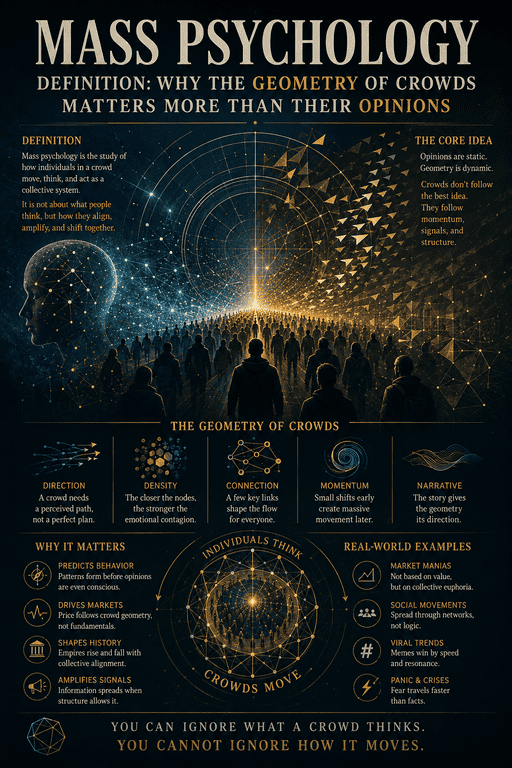
Mass Psychology Definition: Why the Geometry of Crowds Matters More Than Their Opinions
August 7, 2026
Mass Psychology Is Not About What the Crowd Thinks. It Is About How the Crowd Moves.
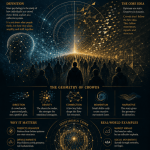
Most definitions of mass psychology begin with the individual. They describe how people influence one another inside groups, how emotions spread through societies, or how collective behaviour shapes politics, culture, and financial markets. Those definitions aren’t wrong, but they miss the most important point. They focus on meaning when they should focus on geometry.
Mass psychology is not primarily the study of beliefs. It is the study of alignment.
A market bubble doesn’t emerge because millions of investors independently discover the same brilliant idea. A panic doesn’t begin because every investor suddenly becomes irrational at exactly the same moment. Both occur because countless individual decisions gradually align until the crowd begins moving as though it were a single organism. Opinions become synchronised. Expectations converge. Independent judgement slowly gives way to collective momentum.
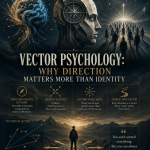
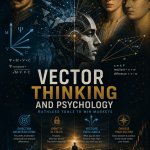
This is why our approach has evolved beyond traditional Mass Psychology into Vector Mass Psychology (VMP). Classical psychology asks what the crowd believes. Vector psychology asks where those beliefs are moving, how quickly they are accelerating, how coherent they have become, and whether the underlying system can absorb that growing alignment without breaking. Once you begin viewing markets through geometry rather than opinion, entirely different patterns become visible.
Agitation Always Comes Before Understanding
One of the oldest misconceptions about crowd behaviour is that people analyse events before responding to them. Reality usually unfolds in the opposite direction. Something captures attention, disturbs emotional equilibrium, or creates a sense of urgency. People react first, then construct explanations that make those reactions appear rational afterwards.
Agitation therefore precedes clarity almost every time. Behavioural psychology repeatedly demonstrates that emotion arrives faster than deliberate reasoning. Daniel Kahneman described this through the interaction of fast and slow thinking. Neuroscience reaches similar conclusions, showing that emotional processing frequently occurs before conscious analysis. Markets simply magnify this natural tendency because uncertainty compresses decision-making while simultaneously increasing the desire for social confirmation.
The implications are profound. Investors often imagine they are responding to earnings, inflation reports, central-bank announcements, or geopolitical developments. More often, they are responding to everyone else’s emotional reaction to those events. The narrative follows the movement. Rarely does the movement faithfully follow the narrative.
Crowds Don’t Think Together. They Synchronise Together.
The pioneers of crowd psychology understood this long before financial television, algorithmic trading, or artificial intelligence existed. Gustave Le Bon observed that individuals entering crowds gradually surrender independent judgement, becoming increasingly responsive to emotion, suggestion, and shared identity. Gabriel Tarde approached the same phenomenon through imitation, arguing that societies evolve because people copy behaviour far more readily than they verify ideas. Émile Durkheim extended the concept further by demonstrating that collective emotional states acquire a force greater than the intentions of any individual participant.
Together, their work reveals something remarkably modern. Crowds rarely operate through collective reasoning. They operate through collective synchronisation. Modern neuroscience supports many of these early observations. Human beings naturally mirror facial expressions, emotional states, language patterns, and behavioural choices. Social proof reduces uncertainty because if everyone else appears confident, confidence itself becomes evidence. Markets amplify this tendency. Rising prices attract attention. Attention attracts participation. Participation validates the narrative, encouraging even greater participation. The crowd gradually mistakes synchronisation for independent confirmation.
The individual believes they are analysing the market. The crowd is actually analysing itself.
Geometry Explains Markets Better Than Emotion
Traditional definitions of mass psychology describe emotional states such as optimism, pessimism, greed, fear, confidence, or panic. Those descriptions remain useful, but they explain only part of the system. It the Geometry explains the rest.
Imagine thousands of investors who are mildly concerned about inflation. Their concerns remain fragmented, disconnected, and largely irrelevant to market direction. Now imagine those same concerns becoming increasingly aligned through financial media, social networks, analyst reports, AI-generated commentary, and repeated headlines. The emotional intensity may not change dramatically, yet the market response changes completely because coherence has increased.
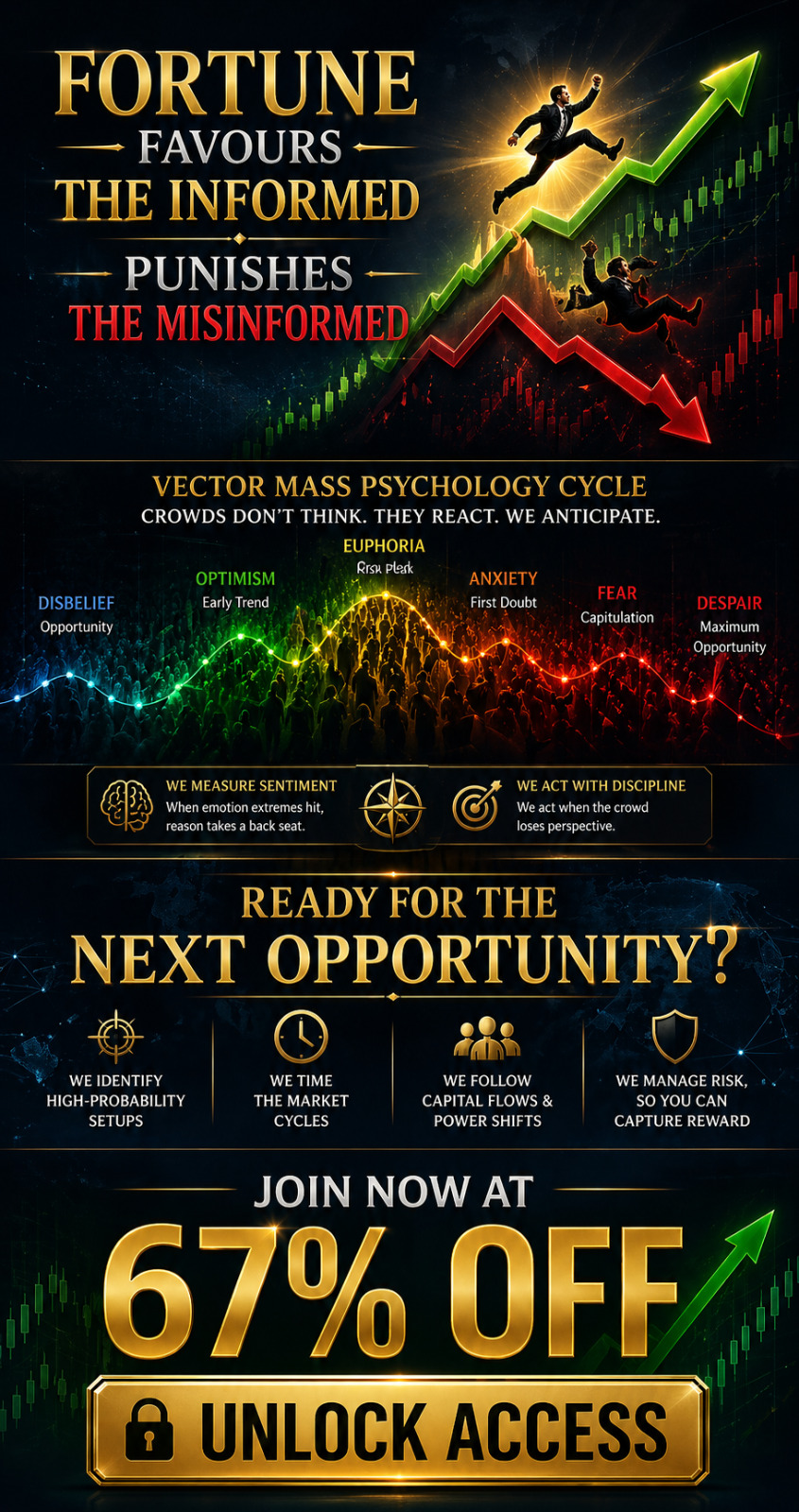
This is the foundation of Vector Mass Psychology. Markets respond less to emotional magnitude than to emotional geometry. Direction matters. Velocity matters. Coherence matters. Acceleration matters. Fear dispersed across countless unrelated concerns produces background noise. Fear concentrated around one dominant narrative produces market crashes. Optimism scattered across sectors creates healthy participation. Optimism concentrated into one unstoppable belief creates speculative bubbles.
The crowd becomes dangerous not when emotions become stronger but when emotions become synchronised.
Every Cycle Changes the Story. The Geometry Never Changes.
Every generation believes it has escaped history. Railroads transformed commerce. Radio transformed communication. Television transformed politics. The internet transformed information. Artificial intelligence is transforming almost everything. Each technological revolution genuinely changes civilisation, yet each also produces remarkably familiar speculative behaviour because innovation changes technology far faster than it changes human nature.
Markets therefore repeat structure while constantly changing narrative. Optimism expands into confidence. Confidence becomes certainty. Certainty encourages concentration. Concentration increases fragility. Eventually, some unexpected disturbance disrupts the prevailing narrative, synchronisation reverses, and collective behaviour begins flowing in the opposite direction. Fear replaces confidence with astonishing speed because the geometry that previously amplified optimism now amplifies panic.
This explains why bubbles separated by centuries frequently resemble one another despite involving completely different assets. Tulips, railroads, radio stocks, dot-com companies, cryptocurrencies, artificial intelligence, and whatever comes next all follow remarkably similar behavioural structures. Human beings continue responding to novelty through the same emotional architecture that has governed crowds for thousands of years.
AI Has Changed the Speed, Not the Structure
Artificial intelligence has transformed one variable above all others: velocity. Information once travelled through newspapers, television, and delayed conversations. Today, AI generates commentary continuously, algorithms amplify emotionally engaging content within seconds, and social platforms synchronise millions of participants almost instantly. The feedback loops that once required months can now develop within hours.
This acceleration makes traditional sentiment analysis increasingly incomplete. The important question is no longer whether investors are optimistic or fearful. The important question becomes how rapidly those emotions are converging into coherent narratives and whether markets possess sufficient resilience to absorb that convergence.
The geometry compresses while the psychology remains remarkably familiar. This is why Vector Mass Psychology places greater emphasis on trajectories than static readings. Markets rarely fail because fear exists or because optimism exists. They fail because collective expectations become so aligned that even minor surprises force millions of participants to reposition simultaneously.
The Real Definition of Mass Psychology
Mass psychology is not the study of crowds. It is the study of how independent minds gradually lose independence without recognising the transition.
It examines how repetition becomes familiarity, familiarity becomes certainty, certainty becomes consensus, and consensus eventually becomes fragility. It measures the invisible geometry through which millions of separate decisions slowly converge until the crowd behaves less like individuals and more like a single adaptive organism responding to itself.
Once viewed through that lens, markets become easier to understand. Prices are not simply moving because information changes. They are moving because expectations become increasingly aligned, increasingly reinforced, and increasingly fragile. The greatest opportunities therefore rarely appear when information changes. They appear when the geometry of collective belief begins changing before the narrative has caught up.
That is the essence of Vector Mass Psychology and it is not the meaning of the crowd that matters. It is the direction in which the crowd is moving, the speed at which it is synchronising, and the pressure building beneath that invisible geometry long before the headlines discover what has already begun.

Fresh Perspectives