Vector Thinking: Stop Reading the Market. Start Reading the Forces That Move It.
Aug 6, 2026
Introduction: Markets Don’t Move. They Accelerate.
Most investors still analyse markets as though they were looking at a photograph. They ask whether sentiment is bullish or bearish, whether valuations are high or low, or whether earnings beat expectations. Those questions aren’t wrong; they’re simply incomplete. Markets are not static objects waiting to be measured. They are adaptive systems in perpetual motion, constantly reshaped by millions of interacting decisions, competing narratives, and shifting expectations.
That distinction changes everything. Price isn’t the destination; it is the visible consequence of invisible forces colliding beneath the surface. Every earnings release, interest-rate decision, geopolitical shock, AI breakthrough, or social-media frenzy enters a network where investors aren’t merely processing information: they’re processing everyone else’s interpretation of that information. The result is a feedback system where today’s expectations become tomorrow’s reality, which then creates new expectations in an endless loop.
Traditional market psychology asked a simple question: How does the crowd feel? That worked when information travelled slowly and investors had time to reflect. Today’s world is radically different. AI generates content around the clock, algorithms amplify emotion within seconds, and social media compresses the distance between rumour and market reaction almost to zero. The crowd no longer moves in waves. It synchronises in real time. In that environment, measuring sentiment alone is like measuring the wind while ignoring the hurricane forming offshore.
This is why we moved beyond classical Mass Psychology toward Vector Mass Psychology (VMP) and the Vector Psychology System (VPS). Markets are no longer defined by emotion alone but by the direction, velocity, coherence, and acceleration of collective behaviour. The geometry has changed. Our methods must evolve with it.
Why Linear Thinking Keeps Investors One Step Behind
Linear thinking assumes that markets behave like dominoes: one cause produces one effect. Raise interest rates and stocks fall. Strong earnings arrive and stocks rise. Inflation declines and bonds rally. Reality rarely cooperates with such tidy logic because markets are adaptive systems populated by intelligent participants who constantly adjust to one another.
Behavioural finance has spent decades exposing the gap between rational theory and human behaviour. Daniel Kahneman demonstrated that people rely on cognitive shortcuts rather than objective analysis. George Soros showed that perceptions can reshape the very fundamentals investors believe they are analysing through reflexivity. Michael Mauboussin argued that markets are driven not by absolute outcomes but by the gap between expectations and reality. These ideas converge on one conclusion: markets evolve through feedback loops, not straight lines.
AI has accelerated that process dramatically. Information no longer spreads gradually; it cascades through networks at machine speed. One viral narrative becomes thousands of identical posts, those posts reinforce investor beliefs, those beliefs influence prices, and rising prices validate the original narrative. The crowd begins breathing as one organism rather than millions of independent thinkers. That synchronisation, not emotion by itself is what creates bubbles, panics, and explosive trend reversals.
This is where vector thinking departs from traditional analysis. Instead of asking whether sentiment is optimistic or pessimistic, it asks whether the crowd is becoming increasingly aligned, how rapidly expectations are changing, and whether the underlying system can absorb that change without breaking. Markets don’t collapse because fear appears. They collapse because fear becomes coherent.
Vector Thinking: Measuring Motion Instead of Position
Imagine two markets with identical bullish sentiment readings.
The first reached that level after climbing steadily over eighteen months. Investors remain optimistic, but the journey has been orderly and expectations have adjusted gradually. The second reached the same reading in less than two weeks after a wave of AI headlines, momentum buying, leveraged ETFs, and retail speculation pushed prices sharply higher. Traditional indicators see identical optimism. Vector thinking sees two completely different systems.
Direction alone tells you almost nothing. Velocity tells you far more. Acceleration tells you even more. A rapidly changing market contains stored energy, just as a stretched spring contains potential energy. When that energy meets resistance, the release is rarely proportional. This is why explosive rallies often end with equally violent corrections and why slow-moving trends frequently prove more durable than spectacular advances.
Markets therefore should not be viewed as destinations but as trajectories. Price, sentiment, leverage, liquidity, volatility, and positioning all possess vectors. They move somewhere, at some speed, under some force. The investor’s job isn’t simply to observe where they are today but to understand where they are likely to converge tomorrow.
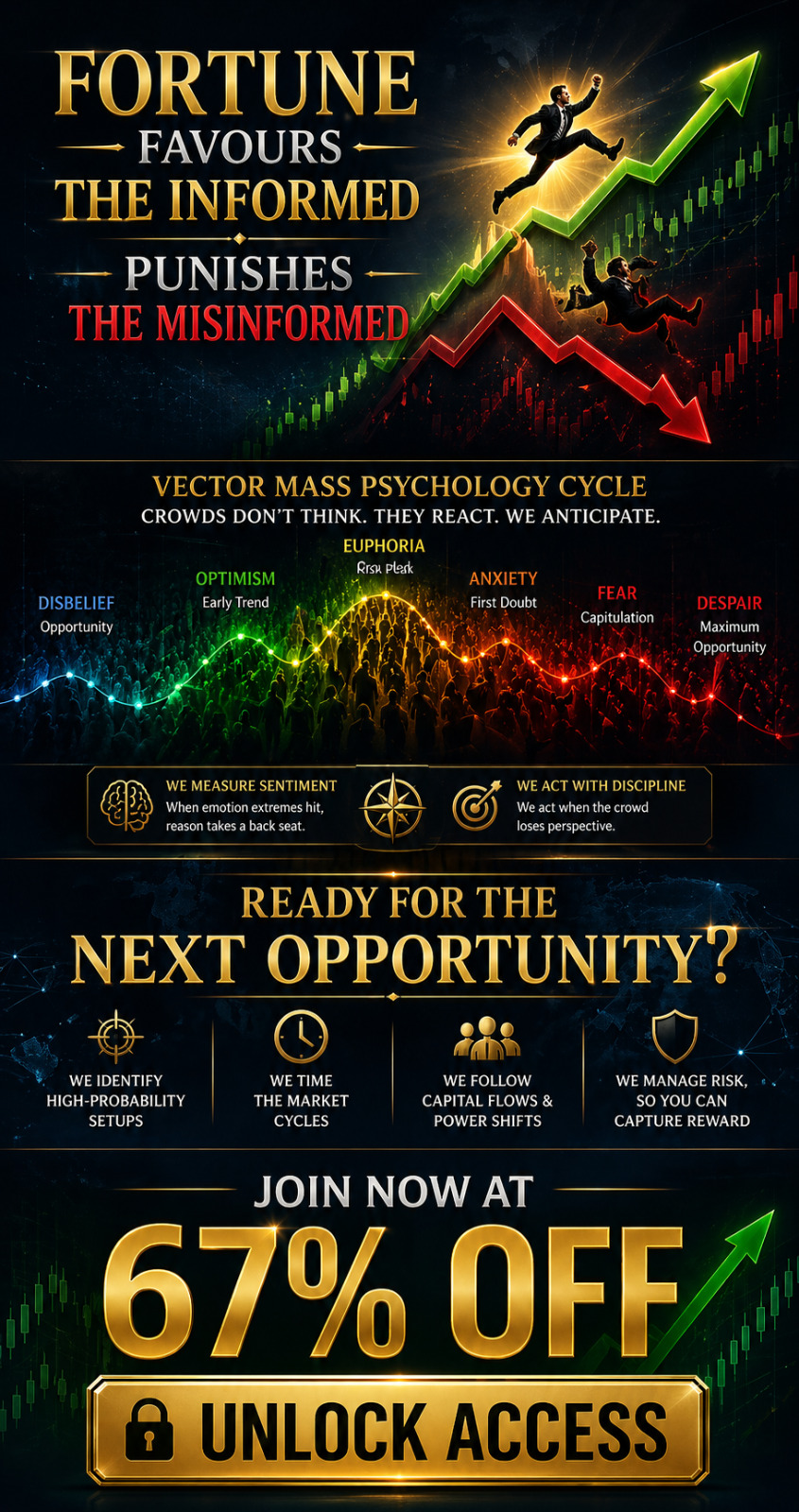
This principle sits at the heart of Vector Mass Psychology. The crowd doesn’t merely possess emotions; it develops directional momentum. Hope transforms into confidence, confidence evolves into certainty, certainty becomes euphoria, and eventually euphoria collapses under the weight of its own coherence. Psychology isn’t static. It accelerates.
When Small Changes Trigger Massive Consequences
One of the great mistakes investors make is assuming that big outcomes require big causes. Complex systems rarely work that way. Small disturbances can propagate through tightly connected networks until they produce consequences completely disproportionate to the original trigger.
Financial history is full of these moments. A seemingly insignificant mortgage market evolved into the Global Financial Crisis. A handful of COVID headlines triggered one of the fastest bear markets in history. A retail trading movement transformed GameStop into a multi-billion-dollar phenomenon. None of these events followed linear cause-and-effect relationships. Each became amplified through network effects, leverage, social proof, and emotional synchronisation.
Behavioural psychology explains why. Human beings naturally seek confirmation from one another, especially under uncertainty. Solomon Asch demonstrated our tendency to conform even when the group is objectively wrong. Philip Zimbardo illustrated how group identity reshapes individual behaviour. Modern digital platforms multiply those psychological tendencies by connecting millions of participants into one enormous feedback network where beliefs spread faster than evidence.
The result is a market where fragility often remains invisible until the system reaches a critical threshold. Everything appears stable until suddenly it isn’t. Adaptive systems absorb stress remarkably well right up until the moment they cannot. Then adjustment happens all at once.
From Mass Psychology to Vector Mass Psychology
Traditional Mass Psychology helped explain crowd behaviour. Vector Mass Psychology explains where that behaviour is heading.
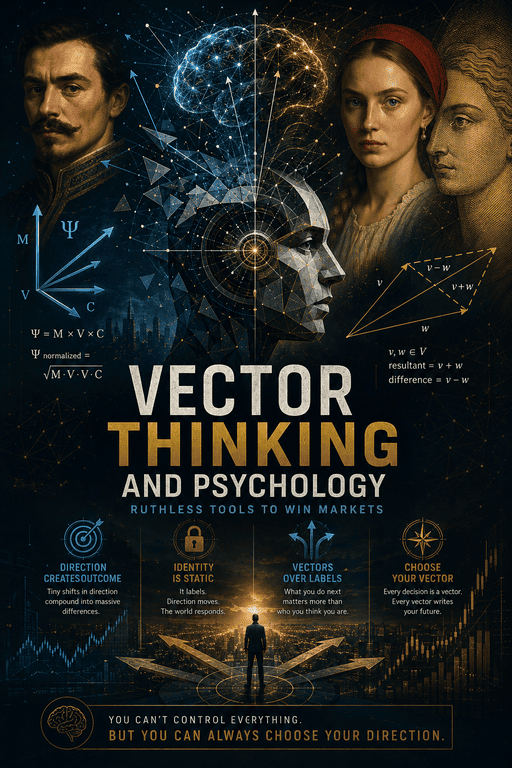
Rather than measuring isolated emotions, VMP measures three interacting components: the intensity of crowd emotion, the direction of that emotion, and the degree to which the crowd has synchronised around a common narrative. Fear scattered across thousands of unrelated concerns is merely background noise. Fear concentrated around one dominant narrative becomes a powerful directional force capable of reshaping entire markets.
This distinction matters because markets rarely respond to isolated opinions. They respond to coherent expectations. Investors acting independently create volatility. Investors acting together create bubbles and crashes.
The VPS framework translates that behavioural geometry into a measurable system by integrating indicators of leverage, liquidity, speculative participation, sentiment, volatility, financial stress, search behaviour, options positioning, and market breadth. None of these variables possesses magical predictive power individually. Their value emerges when they begin moving together. Coherence is the multiplier. Fragmented signals create uncertainty. Aligned signals create probability.
The objective isn’t to predict every market move. The objective is to recognise when the geometry of crowd behaviour changes from scattered motion into unified force. That transition is where the greatest opportunities, and the greatest dangers, usually emerge.
Conclusion: Stop Measuring Sentiment. Measure Direction.
Markets have always been driven by human behaviour, but the architecture of that behaviour has changed. AI, algorithmic trading, social media, instant communication, and global information networks have compressed the distance between information, interpretation, and action. Classical sentiment analysis still matters, but it no longer captures the speed or coherence with which modern narratives spread.
Vector thinking begins with a different premise. Markets are adaptive systems, not mechanical machines. Their greatest risks arise not from isolated events but from synchronised behaviour, accelerating expectations, and feedback loops that reinforce themselves until they finally break. The most important question therefore isn’t whether investors are optimistic or pessimistic. It is whether their beliefs are becoming increasingly aligned in a direction the underlying system can no longer sustain.
When you stop measuring where the crowd stands and start measuring where the crowd is moving, the market looks fundamentally different. You stop reacting to headlines and begin tracking pressure. You stop chasing trends and begin identifying phase transitions. Most importantly, you stop seeing sentiment as a mood and start seeing it for what it really is a vector.