
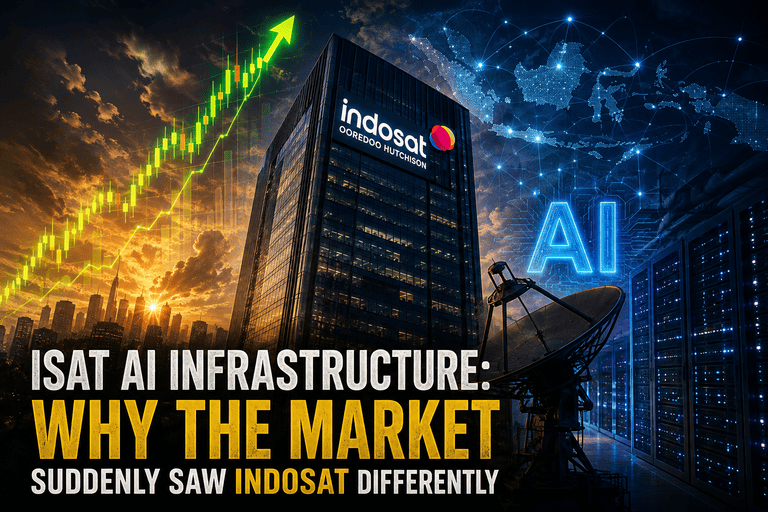
ISAT AI Infrastructure: Why the Market Suddenly Saw Indosat Differently
Aug 18, 2026
For months, ISAT looked like the awkward sibling of Indonesia’s telecom sector. Telkom had the obvious infrastructure story, the dividend, the scale and the reputation, while Indosat was still viewed mainly as a challenger trying to improve its economics in a crowded market. Then the market suddenly changed its mind, and the speed of that change tells us almost as much about investor psychology as it does about Indosat.
The catalyst was Zankore by Indosat, launched on 6 August 2026 with Ooredoo Group, Nokia and NVIDIA. The project starts with about 200 MW of AI Factory capacity targeted for the first half of 2027, using NVIDIA GB300 NVL72 systems, with a longer-term ambition of reaching 1 GW. Indonesia’s Ministry of Communication and Digital Affairs described it as a potential foundation for the country’s role as a regional AI hub. (Komdigi Portal)
The market reacted immediately. ISAT closed at Rp2,170 on 7 August, up 14.2% in one session after trading as high as Rp2,240. Its previous close had been Rp1,900. (Investing.com Philippines). That move was not simply investors getting excited about another AI announcement and the market had discovered a new vector.
ISAT Was No Longer Just a Telco
The important change is not that Indosat suddenly became an AI company. It is that investors began seeing how its existing infrastructure could become the foundation for a much larger business.
The old model was easy to understand.
Mobile subscribers → data usage → ARPU → telecom earnings.
The emerging model is broader.
Connectivity → cloud → data centres → GPU compute → AI services → enterprise infrastructure.
Indosat has been building towards this transition for several years. Its existing businesses already include cellular services, ICT, data centres, FTTH and other digital services, while its partnerships with NVIDIA and Google have been pushing it deeper into AI infrastructure and cloud services. (Google Cloud Press Corner). That means Zankore did not arrive in isolation. It gave the market a new way to connect pieces that were already sitting on the table and that is often how major reratings begin. The company does not necessarily change overnight. The market’s interpretation changes first.
The Earnings Were Already Moving
This is the part that makes the ISAT story more interesting than a simple AI speculation trade. Indosat entered the AI story with improving operating performance. In the first quarter of 2026, revenue reached Rp15.2 trillion, up 12% year on year, while EBITDA increased 13% to Rp7.2 trillion. EBITDA margin remained high at 47.6%, and net profit attributable to shareholders increased 26%. ARPU reached Rp45,000, up 15.3%, while data traffic increased about 25%. (The Jakarta Post)
The improvement continued into the first half. Revenue reached about Rp30.7 trillion, up 13.1%, while EBITDA rose 14% to Rp14.6 trillion. (https://www.idxchannel.com/)
This matters because the market was not being asked to value a company with no earnings and a fashionable story. It was looking at a profitable telecom operator that was already improving monetisation, while a potentially much larger AI infrastructure opportunity was developing alongside it. That combination changes the risk profile.
The Two AI Engines
There are actually two AI stories inside ISAT. The first is AI improving the existing business. Indosat has been using AI-driven personalisation to improve customer engagement and monetisation. DBS noted that the company’s AI-powered offers were helping support ARPU growth, while management was targeting further ARPU improvement.
The second is ISAT selling AI infrastructure to other businesses. That is potentially much more important. The Jakarta Post reported that Indosat’s AI Neocloud business generated about US$16 million of revenue in Q1 2026, with roughly US$170 million of contracted revenue over the following three years. It also reported that the business was designed to be EPS-accretive from the start and free-cash-flow positive.
So the company is not merely using AI to make its telecom business smarter. It is attempting to become part of the infrastructure that allows other companies to use AI and that is a much larger opportunity.
Then Came Zankore
Zankore takes the existing strategy and increases its scale. The initial AI Factory is planned at around 200 MW, with deployment targeted for the first half of 2027. The long-term target is 1 GW of NVIDIA DSX AI Factory capacity, creating one of Southeast Asia’s larger AI infrastructure platforms. (Komdigi Portal)
That does not mean ISAT will immediately earn enormous profits from 1 GW. The market still has to see customers, utilisation, pricing, margins and cash flow. But it creates optionality, and optionality is precisely what the market had been missing from the ISAT narrative.
Why ISAT Had Been Lagging
For years, the market could make a straightforward comparison.
TLKM: infrastructure, scale, dividends and predictable cash generation.
ISAT: telecom growth, competition, network investment and a less obvious long-term story.
That naturally gave TLKM the stronger quality narrative, but ISAT was quietly changing underneath the surface. Its ARPU was improving. Data usage was growing. AI was being used to improve customer economics. Its Neocloud business was securing customers. It was developing partnerships with global technology companies. And the company was building an AI infrastructure position rather than simply talking about artificial intelligence.
Research from DBS already described ISAT as an underappreciated player with AI-led advantages before the latest Zankore announcement. It also noted that ISAT was trading at about 3.7 times forward EV/EBITDA, close to one standard deviation below its five-year average. (DBS Singapore)
That is where the asymmetry appeared as the market was still valuing much of ISAT through the lens of a telecom company, but now the business was beginning to offer something different.
This Is a Multiple-Expansion Story
There is a powerful psychological mechanism behind what happened. Markets rarely rerate companies simply because they announce more revenue. They rerate companies when investors believe the type of business has changed. A telecom company is often valued through mature-industry metrics.
An AI infrastructure platform can attract a different set of expectations. That does not mean ISAT deserves an AI software multiple. It does mean investors may begin assigning greater value to its data centres, cloud services, GPU capacity and enterprise AI contracts.
The transition could therefore look like this:
Telco valuation → digital infrastructure valuation → AI infrastructure optionality.
That is the rerating vector. And it explains why the stock could move so quickly once investors accepted the new narrative.
The Mass Psychology Is Almost More Interesting
There is another lesson here. The AI infrastructure opportunity did not suddenly appear on 6 August. ISAT had already been building its AI strategy before Zankore. It had worked with NVIDIA, Google and other partners, while its AI Neocloud business was already generating revenue. (The Jakarta Post)
Yet the stock did not fully price the story. Then one large announcement compressed several existing developments into a single narrative.
AI Factory. NVIDIA. Nokia. Ooredoo. 200 MW. 1 GW. Indonesia as an AI hub.
Suddenly the story became easy for the market to understand and that is mass psychology at work. Information can exist for months without moving capital. Then a narrative arrives that allows thousands of investors to interpret the information in the same direction, and capital begins moving rapidly. The fundamentals may have been developing slowly.
The perception changed quickly.
ISAT Versus TLKM
This is where the Titanium framework becomes useful. TLKM remains the stronger traditional infrastructure business. Its scale, cash generation and dividend profile provide a level of visibility that ISAT cannot simply replicate.
ISAT, however, now has the more interesting growth vector.
| Factor | TLKM | ISAT |
|---|---|---|
| Core telecom quality | 9/10 | 8/10 |
| Earnings visibility | 9/10 | 8/10 |
| Dividend | 9/10 | 6/10 |
| Growth potential | 6/10 | 8.5/10 |
| AI optionality | 8/10 | 9.5/10 |
| Rerating potential | 6.5/10 | 9/10 |
| Risk | Lower | Higher |
| Titanium asymmetry | 7/10 | 8.5/10 |
TLKM is easier to understand. ISAT is becoming harder to value.
That is not necessarily a weakness. Sometimes the largest reratings happen when a company moves from one category into another and the old valuation framework starts becoming inadequate.
But Do Not Chase the Story Blindly
This is where discipline matters.ISAT has already moved sharply. The market now knows about Zankore. The easy information advantage has disappeared.
The next phase requires evidence.
- Watch the AI Neocloud revenue.
- Watch contracted customers.
- Watch GPU utilisation.
- Watch margins.
- Watch capital expenditure.
- Watch free cash flow.
Most importantly, watch whether AI becomes a meaningful earnings contributor rather than remaining an impressive presentation slide. The company has already demonstrated that its AI business can attract customers and generate revenue. The next question is whether it can scale that revenue without destroying returns through excessive capital requirements. That is where the thesis becomes real.
The Bigger Story
The most interesting part of ISAT is not that a telecom company is using AI, because that is becoming standard across the industry, but that Indosat is attempting to move up the AI value chain, using its existing network and digital infrastructure as a foundation for data, cloud, compute, AI infrastructure and eventually higher-value applications, creating several potential revenue layers from assets the company already operates.
Indonesia also has structural advantages that could support this strategy, including available power, land and water for large-scale computing infrastructure, while Indosat is developing sovereign and localised AI services that could strengthen its position as domestic demand for AI infrastructure grows. (Fortune)
None of this guarantees success, but it gives ISAT a more interesting growth vector than the market historically assigned to it, and the real test now is whether earnings and cash flow eventually validate the new narrative, because if they do, the recent rerating may prove to be the point where investors began recognising that ISAT was becoming more than a traditional telecom operator.

Beyond the Headlines