Paradox of Tolerance in Investing: The Contrarian’s Edge When Consensus Breaks
Aug 17, 2026
The market’s greatest opportunities often arrive disguised as threats because fear changes the way investors perceive both risk and value. When panic spreads, people stop asking what an asset is worth and start asking how quickly they can escape it, while every falling price becomes evidence that something even worse is coming. The investor who can tolerate that environment without surrendering to it gains an advantage that cannot be downloaded, automated or copied from a screen: the ability to think independently when everyone else is thinking together.
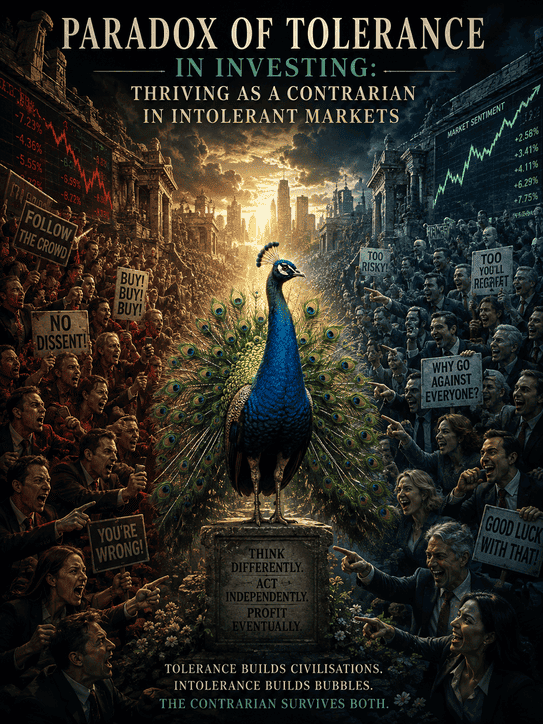
This is the real paradox of tolerance in investing. The market becomes intolerant of uncertainty, volatility and temporary losses precisely when those conditions can create the largest pricing distortions, while patient capital becomes more valuable because it can wait for the emotional pressure to exhaust itself. The objective is not to enjoy falling markets or blindly buy whatever has been crushed, but to recognise when panic has pushed price further than the underlying change in value justifies.
Panic Is a Feedback Loop
Market panic rarely begins with a complete collapse in fundamentals. A disappointing earnings report, policy comment, geopolitical shock or liquidity problem can provide the initial spark, but the damage accelerates when investors begin reacting to one another rather than to the original information. Falling prices trigger fear, fear produces selling, selling creates larger declines, and those declines become new evidence for the fearful narrative, creating a feedback loop in which price itself becomes the catalyst.
This explains why intelligent people can behave irrationally during major sell-offs without becoming unintelligent overnight. Confirmation bias encourages investors to collect evidence supporting their fears, availability bias makes the latest disaster appear more probable than history suggests, and herd behaviour makes other people’s actions look like confirmation that selling is correct. Once the feedback loop becomes powerful enough, valuation becomes secondary because investors are no longer asking what something is worth; they are trying to avoid discovering what it might be worth tomorrow.
History repeatedly demonstrates the mechanism, from 1929 and Black Monday in 1987 to the financial crisis of 2008 and the pandemic collapse of 2020. The details change, but the behavioural architecture remains remarkably stable: uncertainty becomes fear, fear becomes positioning, positioning becomes forced selling, and forced selling creates prices that can eventually become disconnected from the original source of the panic. That final stage is where the contrarian starts paying attention.

Contrarian Does Not Mean Reckless
The greatest misunderstanding about contrarian investing is that it means automatically doing the opposite of the crowd. It does not. Buying simply because everyone else is selling is no more intelligent than selling because everyone else is selling, because the crowd can sometimes be correctly identifying a genuine deterioration in earnings, liquidity or solvency.
A serious contrarian begins before the panic. They know which businesses, sectors or indexes they would want to own if prices were substantially lower, understand the balance sheets and cash flows involved, establish acceptable valuations, and decide in advance how much capital can be committed without creating financial stress. When the market finally becomes disorderly, the decision has already been partly made because the investor is comparing price with a prepared framework rather than improvising while headlines are screaming.
This changes the psychological equation. The crowd sees a collapsing price and asks how much worse things could become; the prepared contrarian sees the same price and asks whether the expected damage has already been discounted. Neither knows the future, but one is reacting to uncertainty while the other is measuring it against previously established conditions.
That is the difference between courage and stupidity.
The Opportunity Is in the Dislocation
The best contrarian opportunities appear when several vectors align: sentiment becomes extreme, liquidity-driven selling overwhelms normal valuation, positioning becomes one-sided, and price begins moving faster than the underlying fundamentals justify. No single indicator proves that a bottom is forming, but when independent measures begin pointing towards the same psychological extreme, the probability of a meaningful dislocation increases.
March 2020 illustrates the point. The VIX reached a record closing level of 82.69 while CNN’s Fear & Greed Index fell to 2, reflecting an extraordinary collapse in risk appetite. The opportunity was not created simply because those numbers were frightening; it was created because the market had moved from ordinary uncertainty into a state where fear itself was influencing prices, liquidity and decision-making.
The same principle applies during euphoric markets, although investors find it harder to recognise because rising prices feel reassuring. When speculation becomes widespread, options activity becomes aggressive, valuations are justified by increasingly optimistic assumptions and investors begin buying primarily because they fear missing the next move, the vector changes from fundamental accumulation towards behavioural momentum. That can continue much longer than expected, but it also means that the market becomes increasingly dependent on new participants arriving to sustain the trade. Contrarian analysis is therefore less about predicting reversals than identifying distortions.
Fear Can Be Monetised, But Only With Boundaries
Options can provide another way to exploit sentiment extremes because volatility itself becomes more expensive when fear surges. Selling puts on a company you genuinely want to own can, in the right circumstances, allow an investor to collect premium while establishing a lower effective purchase price, but the strategy only makes sense when the investor has both the capital and willingness to own the shares if the market continues falling.
That condition is essential because selling puts does not remove downside risk; it converts part of the risk into an obligation. If a $100 stock falls to $60, the premium received provides only partial protection, so the strategy should be used only when the underlying business remains attractive at substantially lower prices and the position is small enough to survive a severe decline.
Long-dated calls, including LEAPS, provide the opposite form of exposure by allowing investors to express a longer-term bullish thesis with defined maximum loss but substantial sensitivity to the underlying price. They can become attractive when fear has depressed both the stock and the market’s expectations, but time decay, implied volatility and the possibility of a prolonged recovery mean that leverage should never be confused with certainty.
The principle is simple: use volatility to improve entry conditions, not to manufacture risk you cannot afford.
The Discipline Most Contrarians Ignore
Contrarian investing fails when investors confuse conviction with permanence. A thesis can be wrong, a business can deteriorate, a liquidity crisis can become systemic, and a market that appears irrational can remain irrational far longer than the investor expects, which is why position sizing is more important than the elegance of the argument.
Capital should therefore be deployed in stages rather than in one dramatic gesture. The first allocation establishes exposure, subsequent allocations depend on additional evidence, and the thesis must remain subject to revision if the underlying facts change, because averaging down into a permanently impaired asset is not contrarian investing; it is simply refusing to admit that the original analysis was wrong.
The investor also needs predefined conditions for abandoning the thesis. If earnings collapse beyond the original assumptions, debt becomes unmanageable, liquidity disappears or the competitive structure of the business changes, the fact that the stock is cheaper is irrelevant because the investment case itself has deteriorated.
This is where humility becomes part of the strategy. The crowd can be wrong, but so can the person standing against it.
Tolerance Is the Edge
Most investors think their greatest advantage is information, but information is increasingly abundant and increasingly cheap. Patience is rarer because modern markets continuously force investors to react, with every headline, price movement and social-media narrative demanding an opinion before the underlying situation has had time to develop.
Tolerance creates distance from that noise. It allows an investor to distinguish between volatility and permanent impairment, between a falling price and a deteriorating business, and between genuine fundamental change and a temporary psychological stampede.
That distinction is enormously valuable because markets repeatedly transfer ownership from investors with short time horizons to investors with longer ones. The impatient investor sells because uncertainty has become unbearable; the patient investor can buy because uncertainty has created a price that compensates for bearing it.
The opportunity therefore comes from a simple asymmetry: the crowd is often forced to act precisely when patience becomes most valuable.
The Final Vector
The Paradox of Tolerance is not about becoming fearless. Fear contains information, and sometimes the crowd is correct to be afraid, so the goal is not to suppress the emotional signal but to prevent it from becoming the decision. The disciplined investor observes the panic, measures the change in fundamentals, examines positioning and liquidity, compares price with value, and then decides whether the market is revealing genuine deterioration or merely amplifying uncertainty.
That process turns mass psychology into an analytical advantage. Panic becomes a variable rather than a command, volatility becomes a condition rather than a threat, and falling prices become something to investigate rather than automatically escape.
The market will continue moving between euphoria and despair because human psychology has not evolved to accommodate the speed of modern finance. The investor does not need to eliminate that cycle, predict every turn or become permanently contrarian; they need enough tolerance to remain rational while the crowd loses its tolerance for uncertainty.
That is the real advantage.
When everyone else is demanding certainty, patient capital can buy uncertainty at a price. When everyone else is desperate to escape volatility, the disciplined investor can decide whether that volatility has created a genuine mispricing. And when the crowd eventually regains its composure, the investor who tolerated the chaos may discover that the greatest risk was never the panic itself, but surrendering to it.