Trading Discipline and Patience: The Last Edge No Algorithm Can Replicate
July 23, 2026
When Stillness Becomes Strategy
The market is never as dangerous as when it appears to be doing nothing. Price compresses, volatility fades, headlines lose their urgency, and silence settles over the tape like a heavy fog. For most investors, that stillness becomes intolerable because inactivity feels like lost opportunity, prompting them to manufacture trades simply to escape the discomfort of waiting. The market has not changed, yet their psychological state has, and that shift alone is often enough to transform patience into costly overtrading.
This is why trading discipline and patience are not passive virtues but active disciplines. They require participation without unnecessary interference, the willingness to remain fully engaged while refusing to confuse movement with progress. The greatest edge in modern markets is rarely faster execution or more sophisticated algorithms. It is the ability to think more slowly than the crowd while the crowd becomes increasingly desperate to act.
History Rewards Those Who Can Wait
The greatest investors built extraordinary fortunes not through relentless activity but through disciplined inactivity. Warren Buffett often remarked that most of his success came from patiently holding a handful of exceptional businesses rather than constantly searching for the next trade. Jesse Livermore reached the same conclusion decades earlier when he observed that the real money was made not in trading but in waiting. George Soros spent months preparing for the collapse of the British pound before making a single asymmetric bet, while Stanley Druckenmiller distilled decades of market experience into one deceptively simple principle: when there is nothing to do, do nothing.
Market history repeatedly validates this philosophy. During the panic of March 2020, investors who preserved liquidity and accumulated positions as breadth improved and volatility began stabilising captured one of the strongest recoveries in modern history, while those reacting to every headline, every Federal Reserve rumour, and every news cycle repeatedly bought and sold at precisely the wrong moments. Markets reward patience because opportunity rarely appears gradually; it arrives suddenly after long periods of waiting that most participants find psychologically unbearable.
The Psychology of Needless Action
The greatest enemy of disciplined investing is rarely the market itself but the constant internal pressure to do something. Human beings evolved to respond to immediate threats, making inactivity feel unnatural even when it represents the rational choice. Modern financial markets amplify this instinct through endless notifications, streaming headlines, social media commentary, and platforms deliberately designed to convert attention into transactions.
Investors begin mistaking activity for control, even though excessive activity usually signals the opposite. Every unnecessary trade becomes an emotional response disguised as a strategic decision, reinforcing the illusion that constant engagement improves performance when it more often transfers wealth through commissions, taxes, slippage, and poor judgement.
Nature follows a different rhythm. Forests spend years growing invisible root systems before expanding above ground. Mountains accumulate pressure for centuries before shifting in moments. Capital compounds in much the same way. The periods that appear uneventful often create the foundations for the most significant advances.
Patience Is Aggressive Selectivity
One of the great paradoxes of investing is that action frequently represents surrender while stillness represents control. Investors click because waiting feels uncomfortable, yet every impulsive decision hands control to external events rather than internal discipline. Patience, by contrast, is not inactivity but aggressive selectivity, a deliberate refusal to deploy capital until probability and psychology align.
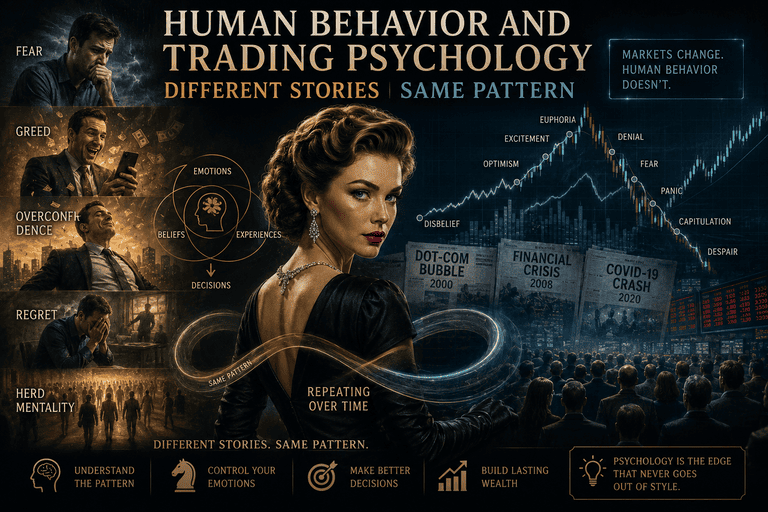
Fear encourages premature selling because investors seek emotional relief. Greed encourages premature buying because investors fear being left behind. Both emotions distort timing by shifting attention away from process and towards immediate gratification. Patience restores perspective by allowing opportunities to mature before capital is committed.
The market therefore rewards boredom far more often than excitement. Boredom fuels overtrading, revenge trades, and fear of missing out, while patience allows emotional extremes to exhaust themselves before decisions are made. Discipline is not the absence of action but the refusal to act before conditions justify it.
Making Patience Measurable
Discipline improves only when it becomes measurable. Investors should monitor not only returns but the quality of the decisions producing those returns.
Declining trade frequency accompanied by improving expectancy often signals increasing discipline. Rising activity accompanied by shrinking returns usually indicates emotional interference rather than improving skill. Average holding periods provide another valuable measure because exceptional investments often require weeks, months, or years before their full potential becomes apparent.
Keeping a decision journal frequently reveals patterns invisible in real time. Recording every urge to trade, the emotion driving it, and the eventual outcome quickly exposes how often impulse would have produced inferior results. Equally valuable is measuring adherence to a predefined investment process. The objective is not to eliminate mistakes but to ensure that decisions arise from preparation rather than emotional reaction.
Constraints reinforce discipline. Restricting execution to predetermined review periods, maintaining hard risk limits, and stepping away after reaching predefined losses all reduce the probability of allowing temporary emotions to become permanent financial damage.
The Crowd Monetises Urgency
Modern financial media profits from urgency because calm investors generate neither clicks nor commissions. Every alert, breaking headline, and dramatic prediction encourages immediate reaction by exploiting the brain’s instinctive response to uncertainty. The result is a marketplace where attention becomes the most valuable commodity and patience the rarest.
Disciplined investors recognise that every notification represents someone else’s attempt to direct their attention. Instead of reacting continuously, they focus on a limited number of variables that genuinely matter: market breadth, credit conditions, liquidity, leadership, and sentiment. By filtering information rather than consuming all of it, they preserve both clarity and emotional capital.
When the crowd becomes obsessed with every fluctuation, disciplined investors observe quietly until genuine changes in market structure begin emerging beneath the surface. Only then do they act.
The Cost of Waiting
Patience carries a psychological cost that many investors underestimate. Remaining inactive while others appear to profit creates anxiety, self-doubt, and the persistent fear of missing the next great opportunity. Watching prices fluctuate while resisting the urge to intervene often feels more difficult than executing the trade itself.
Yet that discomfort frequently represents the price of superior returns. The best investments rarely provide immediate reassurance. They spend long periods appearing unremarkable before the underlying thesis gradually becomes recognised by the broader market. Investors who abandon sound positions simply because nothing appears to be happening often discover that they paid the emotional cost of waiting without ever collecting its financial reward.
The opposite mistake proves equally painful. Selling too early may temporarily relieve anxiety, but watching the market subsequently validate the original thesis teaches an expensive lesson: conviction rarely feels comfortable while it is being tested. Successful investing requires remaining faithful to disciplined analysis long enough for reality to catch up with price.
The Final Asymmetry
Markets remain unpredictable, but process does not have to be. Outcomes fluctuate beyond anyone’s control, yet discipline, preparation, and emotional consistency remain entirely within it. Every cycle eventually rewards those capable of separating temporary noise from lasting opportunity because markets repeatedly transfer wealth from impatient participants to patient ones.
Trading discipline and patience are therefore not simply techniques for improving performance. They represent a philosophy of capital allocation built upon the understanding that probability improves with preparation, clarity improves with restraint, and compounding accelerates when unnecessary interference is removed.
Conclusion: The Edge Hidden in Silence
In an age where technology competes to shorten attention spans and financial media monetises urgency, patience has become one of the rarest and most valuable investment advantages. Buffett, Livermore, Soros, and Druckenmiller reached remarkably similar conclusions despite operating in different eras because they understood that exceptional returns emerge not from constant activity but from disciplined waiting followed by decisive action.
The market continually tempts investors to mistake movement for progress and noise for information. Those who resist that temptation discover an enduring truth: the greatest opportunities usually appear after long periods when nothing seems to be happening at all.
Patience is therefore not the absence of action but the refusal to interfere before probability, psychology, and opportunity converge. The investor who masters that discipline stops reacting to the market’s rhythm and instead allows the market, eventually and inevitably, to move on theirs.
Your Mind Is the Real Market