
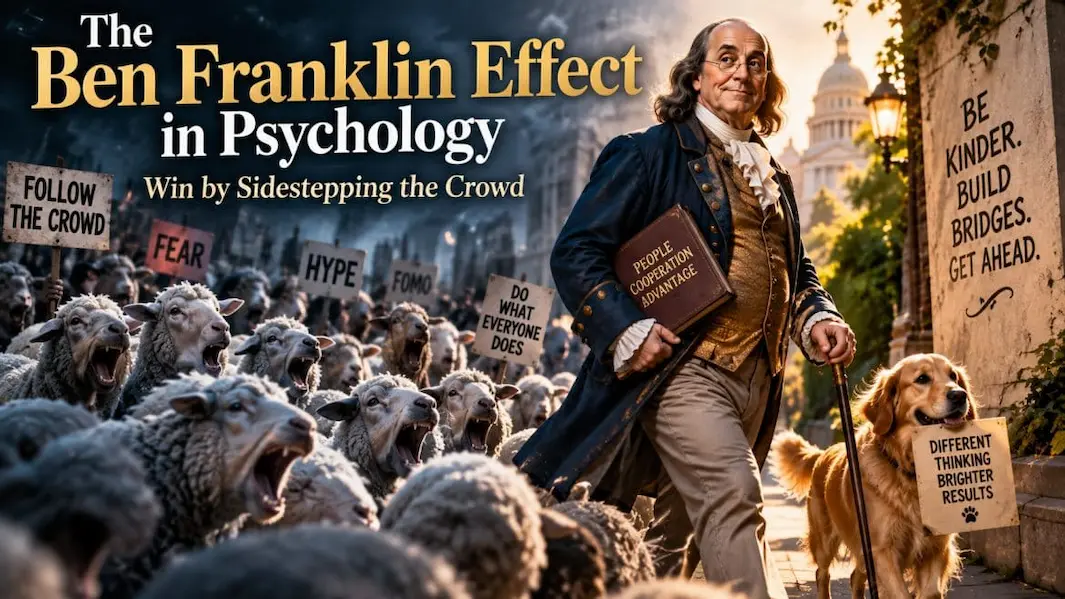
The Ben Franklin Effect in Psychology: Win by Sidestepping the Crowd
Sept 22, 2026
Why the Market’s Most Uncomfortable Moments Can Become Your Greatest Opportunities
The crowd has a peculiar way of turning uncertainty into certainty, especially when the market is moving violently. During a bull market, investors convince themselves that rising prices are proof of their intelligence. During a crash, the same investors can become equally convinced that falling prices signal the end of the world. The direction changes, but the psychological mechanism remains remarkably consistent: people look around, absorb the prevailing emotional current, and gradually mistake collective conviction for independent thought.
The Ben Franklin Effect offers an intriguing psychological lens through which to examine this behaviour. The principle is that when we do someone a favour, we may subsequently develop a more favourable attitude towards that person, partly because our minds seek consistency between our actions and beliefs. Rather than helping only those we already like, we can sometimes come to like those we have helped.
At first glance, this seems far removed from investing. But the deeper connection lies in the way our actions shape our beliefs, how social environments reinforce those beliefs, and how easily people become trapped inside psychological feedback loops.
Markets are built upon such loops. Investors buy because prices rise, then interpret their own buying as evidence that the investment must be sound. They sell because prices fall, then use their decision to sell as further confirmation that the situation is dangerous. The crowd does not merely respond to the market. Through its collective actions, it helps create the conditions that reinforce its own convictions. The opportunity emerges when you recognise the loop before it becomes your reality.
The Ben Franklin Effect: When Behaviour Rewrites Belief
The Ben Franklin Effect is commonly associated with a story in which Franklin, seeking to improve relations with a political rival, asked him to lend him a rare book. The rival agreed, and Franklin later returned it with a note of thanks. Franklin described how the man, who had previously been unfriendly, subsequently showed him greater civility.
The psychological interpretation is that people often seek consistency between their actions and their self-image. If we do something helpful for another person, we may adjust our attitude towards them to make our behaviour feel coherent. Our actions can influence our beliefs, rather than our beliefs always determining our actions.
This is not a universal law. The effect depends on circumstances, and people do not invariably become more favourable towards someone simply because they have helped them. But it illustrates a broader principle: human psychology is not a passive observer of reality. It participates in constructing the meaning we assign to our behaviour.
That principle becomes particularly important in financial markets, where investors are continually interpreting their own decisions.
Someone buys a stock because the price is rising. The position then becomes part of their identity. They begin defending the investment, searching for information that supports it, and dismissing evidence that challenges it. The original decision influences the beliefs that follow.
The same process operates during a crash. An investor sells in fear, then becomes increasingly committed to the idea that selling was correct. Every additional decline reinforces that belief, while every rebound may be dismissed as temporary. The investor is no longer simply evaluating the market. They are defending a psychological position.
Mass Psychology: The Crowd Is a Signal, Not a Master
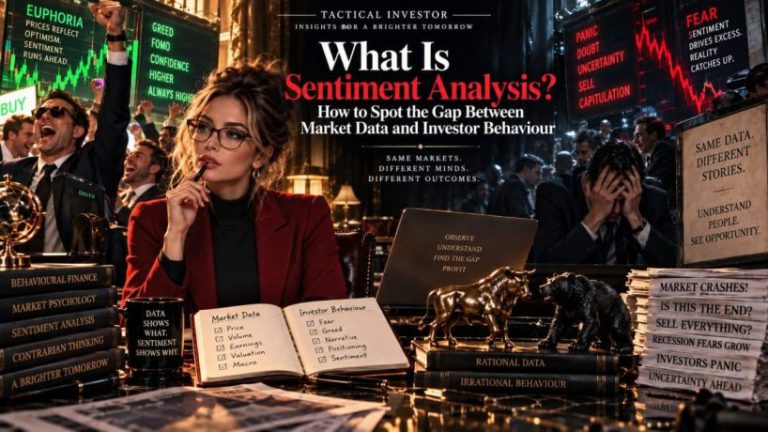
Mass psychology provides a way to examine these collective feedback loops. It is not about following experts, obeying the crowd or automatically taking the opposite side. It is about detecting the prevailing trend in sentiment and behaviour, identifying the forces driving it, and verifying those observations against evidence. The crowd reveals information. Its enthusiasm, fear, positioning and behaviour can expose the direction of collective expectations. But that information must be interpreted rather than accepted blindly.
When investors become euphoric, the market can begin to price in an increasingly optimistic future. When fear takes hold, expectations can move in the opposite direction, with investors assuming that recent damage will continue indefinitely.
Neither extreme is automatically wrong. The crowd can be optimistic for valid reasons, and a crash can reflect genuine economic deterioration. The analytical challenge is to determine when collective emotion has begun to distort the assessment of value.
This is where contrarian thinking becomes useful. It does not mean opposing consensus as a matter of principle. It means being willing to question consensus when the evidence suggests that expectations have become excessive.
A contrarian who buys simply because everyone else is selling is no more independent than an investor who sells because everyone else is selling. Both are allowing the crowd to determine their actions. True independence means using the crowd’s behaviour as data while retaining responsibility for your own conclusions.
Vector Psychology: Follow the Forces Beneath the Surface
Markets are not driven by a single emotion. They are shaped by interacting forces that change in strength, direction and influence. Vector psychology examines these forces as vectors: pressures that can reinforce one another, compete, weaken or reverse. Investor sentiment, liquidity, price momentum, economic conditions, positioning and expectations all contribute to the market’s direction.
During a bull market, rising prices can reinforce optimism. Optimism attracts new capital, new capital supports prices, and stronger prices appear to validate the original bullish narrative. The resulting feedback loop can push valuations beyond what the underlying businesses can reasonably justify.
During a crash, the same mechanism can operate in reverse. Falling prices increase fear, fear encourages selling, and selling pushes prices lower. The decline becomes its own psychological reinforcement system. But the forces do not always move together. Prices may collapse while the long-term earnings power of selected businesses remains relatively intact. Sentiment may become deeply pessimistic even as liquidity conditions begin to improve. Conversely, prices may continue rising while deteriorating fundamentals quietly undermine the investment case.
These divergences matter because they reveal where the market’s emotional narrative may be separating from other forces. The objective is not to identify one magical signal. It is to examine the interaction between vectors, determine which are strengthening or weakening, and assess whether the prevailing market response is proportionate to the underlying conditions.
Why Fear Can Become a Buying Signal
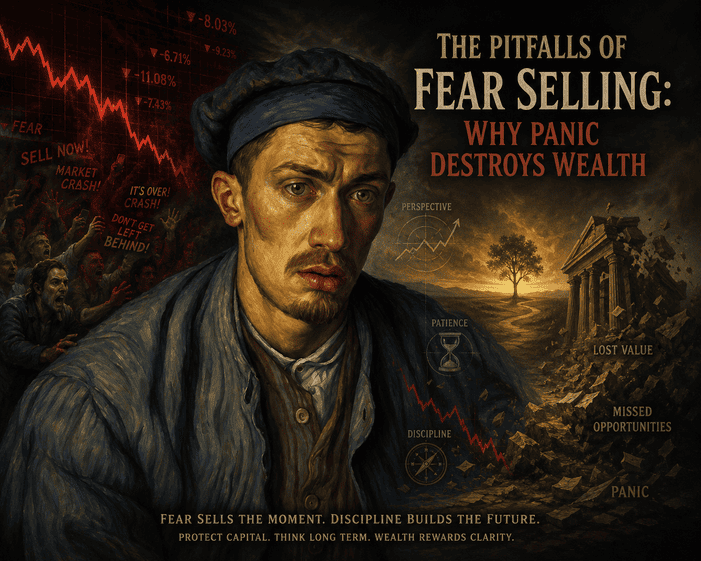
Fear is often treated as a reason to sell. Yet fear can also create the conditions for attractive long-term purchases. The distinction depends on what the fear is responding to. When investors panic, they often prioritise immediate relief over long-term value. They may sell because losses have become psychologically intolerable, because they fear further declines, or because the behaviour of others makes holding feel increasingly dangerous.
This can create indiscriminate selling. Strong businesses and weak businesses may decline together, even though their long-term prospects differ substantially. For the prepared investor, that separation between price and value deserves attention.
A quality company whose shares have fallen sharply may become more attractive if its competitive position, balance sheet and long-term earnings potential remain intact. The lower price can improve the prospective return, provided the original investment thesis still holds.
But a falling price is not proof of undervaluation. Sometimes the market is correctly recognising permanent damage. A company burdened by excessive debt, collapsing demand or a broken business model does not become a bargain simply because its shares have fallen 70%.
The useful question is not, “How much has it fallen?” It is, “What has changed in the business, what is the market pricing in, and how does that compare with a realistic assessment of long-term value?” Fear becomes a potential buying signal when the price reflects excessive pessimism relative to the evidence, not merely because fear is widespread.
Why Fear Can Also Be a Selling Signal
The same psychological framework must work in both directions. Otherwise, it becomes a belief system rather than an analytical tool. Fear can signal opportunity when it creates mispricing, but it can also signal genuine danger when the underlying forces are deteriorating.
A market decline accompanied by worsening credit conditions, weakening earnings, financial stress and impaired liquidity presents a different situation from a temporary panic affecting otherwise resilient businesses.
The investor must distinguish between emotional excess and fundamental deterioration. Fear can also expose risks that were ignored during a period of euphoria. When sentiment reverses, leverage becomes more dangerous, liquidity can disappear, and assets that appeared stable may prove vulnerable to forced selling.
In these circumstances, selling or reducing exposure may be a rational response. The objective is not to remain bullish at all costs. It is to preserve capital and agency when the balance of evidence changes.
The Tactical Investor approach therefore treats fear as a diagnostic signal, not an automatic instruction. Extreme fear invites investigation, but it does not guarantee a bottom. Extreme optimism invites scrutiny. It does not guarantee an imminent crash. The value lies in identifying what the emotion reveals about expectations, positioning and potential vulnerability, then testing that interpretation against the underlying market structure.
Selling Puts During a Crash: Getting Paid to Wait
One strategy that can become relevant during severe market declines is selling cash-secured put options on quality companies that an investor would genuinely be willing to own. The basic idea is straightforward: an investor sells a put option, receives a premium, and accepts the obligation to buy the underlying shares at the strike price if assigned. In return for taking on that obligation, the investor receives income upfront.
During periods of heightened fear, option premiums can increase because investors are paying more for protection against further declines. That can make put-selling more attractive, but it also reflects a market pricing in greater risk. A richer premium is not free money. It is compensation for accepting an obligation that may become costly.
Consider a hypothetical example. A quality company is trading at $100 per share. After examining its business, balance sheet and long-term prospects, an investor decides that $80 would represent an acceptable purchase price. They sell a cash-secured put with an $80 strike and receive a hypothetical premium of $3 per share.
If the option expires without assignment, the investor keeps the $3 premium. If the shares fall below the strike and the investor is assigned, they must buy the shares for $80 each. After accounting for the premium, the effective purchase cost is $77 per share, excluding transaction costs and taxes.
That may be attractive if the company’s long-term value supports the purchase. But if the business deteriorates and its shares fall to $50, the investor still faces a substantial loss relative to the effective cost.
The strategy does not eliminate downside risk. It converts the investor’s willingness to buy at a specified price into an option-selling position with defined obligations. The key is to sell puts on businesses you have independently assessed, at strike prices you can afford and genuinely accept.
Cash-secured put-selling is not appropriate for every investor. It requires sufficient cash or equivalent collateral, an understanding of assignment and expiration, and the capacity to withstand further declines. Selling uncovered puts can create substantially greater risk and should not be confused with a cash-secured approach. Nor should an investor sell puts simply because volatility has increased. A high premium may reflect a serious risk of further losses. The company’s quality, valuation and financial resilience still matter.
The Predator’s Advantage: Patience Without Paralysis
The most useful image during a crash is not the investor running from a tiger. It is the predator observing its environment, conserving energy and waiting for a favourable opportunity. A predator does not attack every movement. It evaluates conditions and acts when the opportunity justifies the risk.
The long-term investor needs a comparable discipline. When markets fall sharply, the instinct is often to react immediately. Sell everything. Buy the dip. Predict the bottom. Do something to regain a sense of control.
But action driven by discomfort is not necessarily useful action. The investor can instead step back and examine the vectors shaping the decline. Is fear accelerating? Are valuations becoming more reasonable? Is liquidity deteriorating? Are earnings estimates collapsing? Are quality businesses being sold alongside weaker companies? Is the market’s emotional narrative becoming more extreme than the evidence warrants?
These questions help separate the opportunity from the trap. Patience does not mean refusing to act. It means preserving the capacity to act when the conditions are favourable. Sometimes that means buying shares. Sometimes it means selling cash-secured puts. Sometimes it means holding cash, reducing exposure or doing nothing until the evidence becomes clearer. The objective is not to predict every turn. It is to avoid being psychologically forced into decisions at the worst possible moment.
Conclusion: Win by Sidestepping the Crowd
The Ben Franklin Effect illustrates how our actions can influence our beliefs, creating feedback loops that shape how we interpret ourselves and the world around us. In markets, those loops can become powerful: buying reinforces bullish conviction, selling reinforces bearish conviction, and collective behaviour can push sentiment towards extremes.
Mass psychology helps identify the emotional trend. Vector psychology examines the forces interacting beneath the surface. Contrarian thinking challenges prevailing assumptions, while independent verification determines whether the crowd’s reaction is justified or excessive.
This is how disasters can become opportunities without turning optimism into dogma. A crash may create attractive prices, but it may also reveal permanent damage. Fear can signal a potential buying opportunity when pessimism has outrun the fundamentals, and it can signal a need to sell when the underlying risks are worsening.
For investors with the capital, knowledge and risk tolerance to do so, selling cash-secured puts on quality companies can provide another way to approach a decline: get paid to accept a purchase obligation at a price that has already been judged acceptable, while remaining fully aware that further losses are possible.
The central principle is simple: do not let the crowd dictate your psychology, and do not let your psychology dictate your analysis. When the market is euphoric, question what everyone assumes. When it is collapsing, examine what everyone fears. Then verify the signals, assess the risks and act only when the evidence supports the decision.
The crowd sees a disaster and feels compelled to respond. The disciplined investor sees a changing set of conditions, studies the vectors and waits for an opportunity that makes sense. That is how you sidestep the crowd: not by standing against it blindly, but by refusing to surrender your independent judgement to its emotional momentum.

Fresh Viewpoints