
The Crowd Sees the Story. Winners See the Pattern.
June 21, 2026
One of the biggest mistakes people make is confusing the vehicle with the lesson.
They see a falcon and think the story is about birds. They watch a race truck and assume the lesson is about engines and horsepower. They observe a mother raising a child and conclude the subject is parenting. They watch an athlete train and think the discussion revolves around sports.
Most of the time, none of those things are the real story.
The falcon is not teaching flight. The racer is not teaching driving. The mother is not teaching parenting. The athlete is not teaching competition.
Each is demonstrating the same collection of principles through a different lens.
Patience.
Discipline.
Timing.
Persistence.
Observation.
Emotional control under pressure.
The setting changes. The lesson rarely does.
This is one reason so many people struggle to recognize patterns when they appear. They become fixated on the surface details while ignoring the forces operating underneath. They see different actors performing different tasks and assume they are witnessing different stories. In reality, they are often watching the same story repeated with different costumes.
Markets provide one of the clearest examples.
Many investors believe success comes from predicting the future, discovering secret information, or identifying the perfect indicator. Yet when one studies successful market operators across multiple generations, the same themes appear repeatedly. They wait when others rush. They observe when others react. They maintain discipline when others become emotional. They remain patient while the crowd becomes impatient.
The market is simply another arena where timeless human behaviors are tested.
The same principles appear in business, sports, warfare, science, and even everyday life. The individual who can delay gratification usually gains an advantage over the one demanding immediate results. The person capable of controlling emotion often makes better decisions than the person controlled by emotion. The observer frequently outperforms the reactor.
None of this is new.
Ancient military commanders understood it. Successful merchants understood it. Great athletes understand it today. The tools evolve, but the psychological requirements remain remarkably stable.
What changes is the packaging.
Modern society has become extraordinarily effective at distracting people with stories.
Every day new narratives compete for attention. Political battles. Financial forecasts. Social controversies. Celebrity dramas. Endless opinions presented as urgent and important.
The crowd becomes consumed by the noise because stories trigger emotion, and emotion captures attention.
Patterns require a different mindset.
Patterns require observation.
Observation requires distance.
Distance requires emotional control.
That is why relatively few people become skilled at recognizing them.
The crowd wants answers. Patterns demand patience.
The crowd wants certainty. Patterns offer probability.
The crowd wants excitement. Patterns reward discipline.
These differences seem minor until money becomes involved. Then they become enormously expensive.
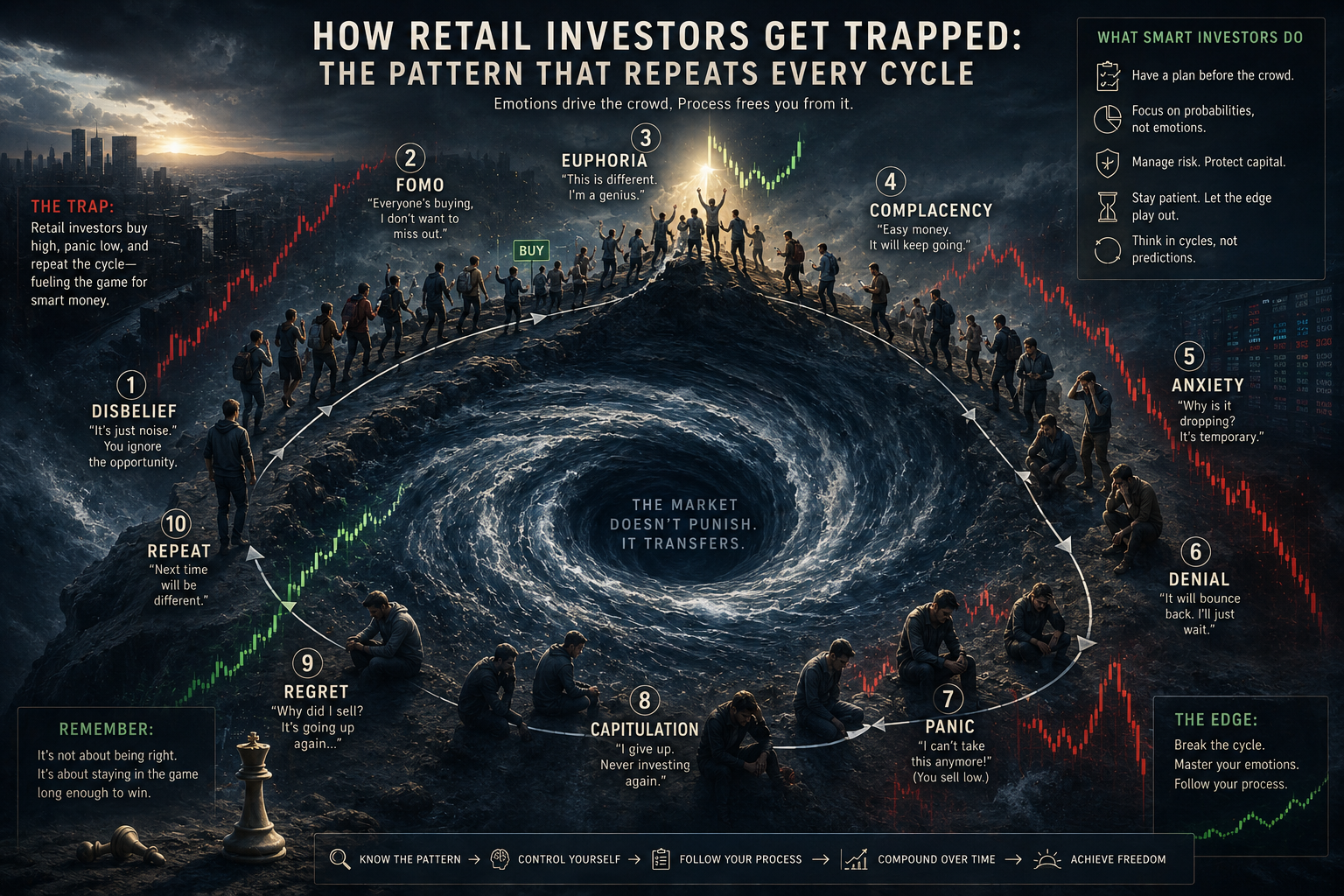
A person who understands patterns can watch fear spread through markets and recognize opportunity developing beneath the panic.
Another person watches the same event and sees only disaster. Both are looking at identical information. One sees the emotional reaction. The other sees the emerging pattern.
The same principle applies outside markets.
Most people focus on outcomes because outcomes are visible. They see success and become fascinated by the result. They rarely study the behaviors that produced it. They want the reward while ignoring the process responsible for creating the reward.
This explains why so many lessons are missed.
A champion athlete is admired for winning rather than for the years of discipline that made winning possible. A successful business is admired for its growth rather than for the persistence that sustained it through difficult periods. A great investor is admired for returns rather than for the emotional control required to remain rational when others were losing theirs.
The visible result captures attention.
The invisible pattern creates the result.
History follows the same script.
Different civilizations rise and fall. Different technologies emerge and disappear. Different leaders gain power and eventually fade. Yet beneath the changing headlines, familiar behavioral patterns continue repeating. Human beings respond to fear, greed, uncertainty, hope, status, and social pressure much as they always have.
The tools become more sophisticated.
Human nature remains remarkably consistent.
This is why pattern recognition becomes so valuable. It allows individuals to see beyond the immediate story and focus on the forces driving the story. Once that shift occurs, events that appear unrelated begin revealing common threads.
The lesson hidden inside a falcon’s patience, a racer’s timing, an entrepreneur’s persistence, an athlete’s discipline, or an investor’s restraint is often the same lesson expressed through different forms.
The crowd tends to focus on the actor.
The observer studies the behavior.
The crowd sees separate stories.
The observer sees recurring patterns.
And over time, it is usually the pattern that matters far more than the story.

The Sculpted Mind: Forging Intelligence with Purpose