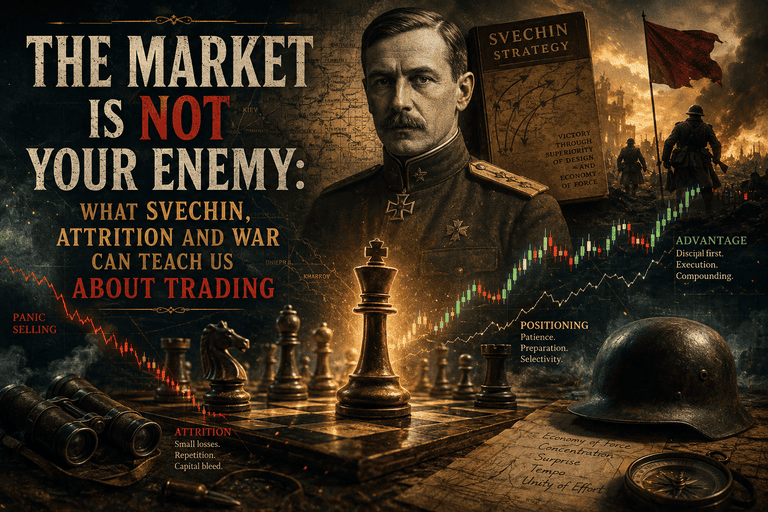
The Market Is Not Your Enemy: What Svechin, Attrition and War Can Teach Us About Trading
August 18, 2026
The Visible Battle Is Not the Real War
Alexander Svechin’s contribution to military thought is often reduced to a simple contrast between manoeuvre and attrition, but the deeper lesson is far more useful than the labels themselves. Svechin understood that strategy cannot be separated from the character of the conflict, because the method that works in one war can become disastrous when imposed mechanically on another. Territory, battlefield victories and spectacular manoeuvres are visible outcomes, but the deeper strategic question is whether the opposing system is becoming more or less capable of continuing the fight.
This matters far beyond military history. A war is not won simply because one army captures a particular piece of land, just as a market position is not successful simply because a stock moves in your expected direction for a few days. The visible movement is only the surface expression of a much larger system involving resources, logistics, psychology, endurance, incentives, positioning and the ability of each side to continue operating when conditions become unfavourable.
This is where Svechin becomes particularly relevant to the way we should think about markets. His framework was built around adaptation rather than ideology, which means the strategist must understand the environment before deciding how to fight within it. Sometimes decisive manoeuvre is appropriate; sometimes sustained pressure is superior; sometimes the correct response is to preserve strength rather than force a premature victory.
The mistake is not choosing attrition or manoeuvre. The mistake is believing one method must always be superior.
Strategy Begins With the Other Side
The common tendency in both war and markets is to begin with ourselves. We decide what should happen, construct an argument supporting that conclusion and then search for evidence that validates the position. The strategist does something different because the first question is not, “What do I believe?” but, “What does the other side believe, what are they trying to accomplish, and what constraints are shaping their behaviour?”
This is why saying that Russia simply follows Svechin would be too simplistic. Modern Russian military strategy has evolved through different experiences, technologies and political objectives, while Western military doctrine is itself far more complicated than the caricature that the West only wants territory and Russia only wants attrition. Both traditions have used manoeuvre, destruction of enemy forces, operational depth, logistics, deception and attempts to break an opponent’s ability to continue fighting.
The more useful distinction is therefore not Russia versus the West. It is visible objective versus underlying mechanism. Capturing territory is visible, but the strategic mechanism might be the destruction of logistics, depletion of ammunition, exhaustion of manpower, degradation of command structures, erosion of industrial capacity or collapse of political will. Likewise, an army can gain territory while becoming strategically weaker, or lose territory while imposing disproportionate damage on the opposing system.
That is a powerful way to think because it forces us away from appearances. The map tells you where the front is; it does not necessarily tell you which side is winning the underlying contest.
The Same Error Destroys Investors
Markets produce exactly the same cognitive trap. Investors constantly confuse the visible outcome with the underlying force, looking at price as though it were the complete explanation for what is happening rather than the final expression of thousands of competing vectors.
A stock rises and people say the company is strong. A stock falls and they say the company is weak. A market breaks higher and the crowd declares a new bull market; a market collapses and the same crowd suddenly discovers a hundred reasons why the financial system is doomed. In each case, the observer is describing the battlefield rather than understanding the war.
The market itself is neutral. It does not care whether your analysis is brilliant, whether the company deserves to rise, whether the economy is healthy or whether some famous strategist has declared the next crash inevitable. Price simply reflects the collision between competing expectations, capital flows, positioning, liquidity and psychology at a particular moment.
That neutrality is one of the most important concepts an investor can understand. The market is not wrong because it disagrees with you. It is simply showing you the current balance of forces.
If your view differs from the market, your job is not to scream louder. Your job is to determine why the market holds its current view, what would cause that view to change and whether the emerging evidence is beginning to shift the underlying vector.
Perspective Is a Weapon
This is where military strategy becomes directly applicable to market psychology. A commander who refuses to understand the enemy’s perspective is fighting an imaginary opponent, because he is responding to the enemy he wishes existed rather than the enemy actually standing in front of him.
Investors do exactly the same thing. They read one bullish analyst, one bearish strategist and one enthusiastic social-media commentator, then spend hours deciding which argument sounds most intelligent. None of that necessarily matters because the important question is not which narrative you personally prefer, but which narrative has captured the crowd and therefore has the ability to move capital.
Suppose an analyst believes a stock is dramatically undervalued, but the crowd believes the company is finished. The analyst can be fundamentally correct and still lose money for a considerable period because markets move through expectations before they move through eventual reality. Conversely, a company can trade at a valuation that looks absurd while the crowd remains convinced that growth will continue indefinitely, allowing the price to travel much further than a rational valuation model would suggest.
This is why understanding perspective is more valuable than broadcasting opinion. Once you understand what the opposing force believes, you can construct a plan around its behaviour rather than becoming emotionally attached to your own thesis. In markets, the crowd is the opposing force you need to understand.
Mass Psychology Turns Perspective Into Force
This is where mass psychology enters the equation. An individual investor can be wrong without moving the market, but millions of investors acting from the same emotional framework create a directional force capable of overwhelming fundamentals in the short term.
A crowd convinced that every dip must be bought behaves differently from a crowd convinced that every rally must be sold. The underlying economic data may be identical, yet the market response can be completely different because the psychological vector has changed. The information is not the force; the interpretation of the information by a synchronised crowd becomes the force.
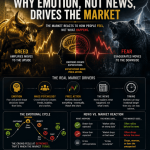
This is why our Vector Psychology framework focuses on direction, magnitude and coherence rather than merely asking whether sentiment is bullish or bearish. A crowd can be extremely emotional without being coordinated, in which case the market may remain relatively stable because opposing interpretations cancel one another. When emotion becomes concentrated around one narrative, however, the psychological energy becomes directional and can produce disproportionate price movement.
The crucial question therefore becomes: Where is the crowd’s energy going? And that question is far more useful than asking whether someone on television is bullish or bearish.
A Trade Is a Battle, Not the War
Svechin’s thinking also offers another lesson that investors routinely forget: a war consists of multiple engagements, and victory does not require winning every individual battle. The strategist who becomes emotionally attached to one battle can sacrifice the larger campaign simply because he cannot tolerate a temporary setback.
Trading should be viewed in exactly the same way. You are not trying to win every position, predict every turning point or prove that every analysis you make is correct, because that objective is both impossible and unnecessary. The objective is to construct a series of asymmetric opportunities where the gains from being right materially outweigh the losses from being wrong.
You can lose several battles and still win the war. In fact, accepting small losses is often what allows you to preserve capital for the opportunity where the vector becomes overwhelmingly favourable. The amateur wants to be right every time; the strategist wants to remain in the game long enough for the high-payoff situations to appear.
That changes the entire psychology of investing. A losing trade stops being an attack on your intelligence and becomes information about the battlefield. A position that fails teaches you something about the crowd, the trend, the timing or the thesis, provided you are willing to examine the evidence rather than defend your ego. The objective is not perfection. The objective is asymmetric survival.
Adaptation Beats Ideology
This is perhaps the deepest lesson contained in Svechin’s strategic framework. A strategist should not decide in advance that brute force is always superior, just as he should not decide that manoeuvre is always superior; the method must fit the conditions.
Markets demand the same flexibility. Sometimes the trend is so strong that fighting it is simply intellectual vanity, and sometimes the crowd becomes so euphoric that continuing to chase it becomes dangerous. Sometimes fear creates genuine systemic deterioration, while at other times fear creates an extraordinary mispricing that deserves to be bought.
The Tactical Investor approach therefore does not begin with a permanent bullish or bearish position. It begins with observation. We watch the crowd, identify the dominant narrative, measure the psychological pressure, examine the price structure and then determine whether the conditions favour participation, patience or retreat.
That is why an oversold market can become more interesting rather than less interesting. When fear becomes extreme and the crowd begins dumping assets indiscriminately, the strategist does not automatically assume the market is broken. He asks whether the selling pressure is creating an asymmetry between perception and reality.
The same principle applies during euphoria. When everyone becomes convinced that the future is guaranteed, the strategist does not automatically short everything simply because valuations appear excessive. He watches for the point where conviction becomes crowded, leverage becomes dangerous and the vector begins to fracture.
The Crowd Does Not Have to Be Wrong
This distinction is critical because contrarian investing is often misunderstood as betting against everyone. That is not strategy; it is another form of emotional reaction. The crowd can be correct. A trend can continue for much longer than expected, an expensive company can become even more expensive and a seemingly irrational narrative can eventually become reality. The mistake is assuming that because the crowd is sometimes wrong, the crowd must therefore always be wrong.
The strategist does not fight consensus. He studies consensus. When the crowd is aligned with the underlying fundamentals and the vector remains strong, there is little reason to stand in front of it. When the crowd becomes excessively confident while the underlying structure begins deteriorating, the opportunity changes. When fear becomes extreme while the underlying system remains intact, the opportunity changes again.
This is why neutrality is so powerful. You do not need the market to validate your beliefs because you are not entering the market to prove that your beliefs are correct. You are entering because the relationship between price, psychology and underlying conditions creates an asymmetry worth exploiting.
The Market Has No Perspective
Ultimately, the market itself has no ideology. It does not favour bulls, bears, governments, corporations, analysts or individual investors, and it certainly does not care which narrative sounds most intelligent. It simply processes competing vectors through price.
Your job is therefore not to tell the market what it should do. Your job is to understand what the participants within it are trying to do, identify where their behaviour is becoming excessive and position yourself accordingly. This is where the connection to Svechin becomes useful: strategy begins when you stop imposing your preferred method on reality and start adapting your method to the environment actually in front of you.
A commander who understands the enemy’s intent can build a campaign. An investor who understands the crowd’s intent can build a trade. A strategist who understands that individual battles exist inside a much larger war can absorb losses without losing direction, and that is ultimately the difference between trading and strategy.
You do not need to win every battle. You need to understand the battlefield, recognise the changing vector, preserve your resources and make sure that when the asymmetric opportunity appears, you are still standing. The market is neutral. Your perspective is not. Learn the difference.

Interesting Insights