
Why Investors Panic: Confidence Fails Long Before Markets Do.
July 29, 2026
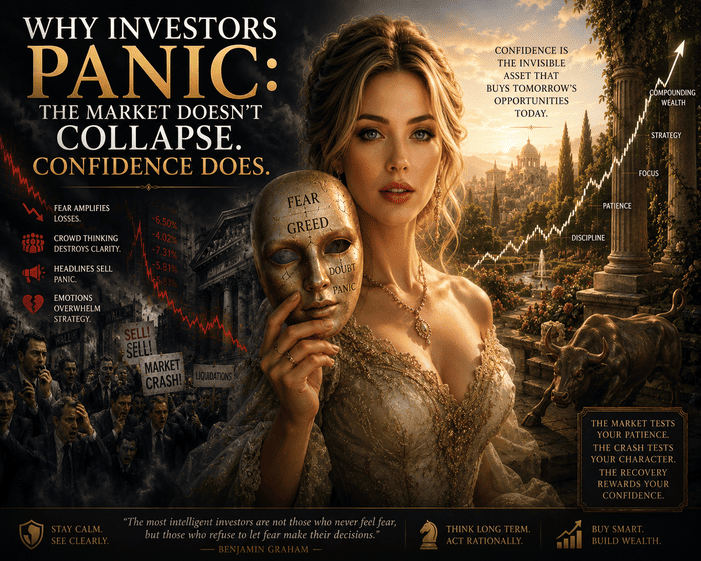
Every market crash feels unprecedented while it is unfolding. Headlines predict financial ruin, commentators explain why this time is different, and investors who spent years insisting they would buy during the next correction suddenly discover that conviction evaporates precisely when prices become attractive. Markets rarely destroy wealth because businesses lose all their value overnight. They destroy wealth because confidence breaks first, altering perception long before it alters reality and convincing otherwise rational investors that selling is safer than thinking.
The market itself is simply the mechanism through which this psychological shift becomes visible. Prices do not collapse in isolation. They reflect millions of individual decisions made under increasing uncertainty, where fear gradually replaces analysis as the dominant force shaping behaviour. Once confidence begins deteriorating, investors stop asking what a business is worth and begin asking how much further it might fall. That subtle change transforms investing from a process of valuation into a process of emotional preservation.
The Primitive Isn’t the Crash. It’s Confidence.
Every major market cycle is organised around a primitive that quietly governs everything else. Bull markets are sustained not by optimism alone but by confidence that tomorrow will resemble today. Investors borrow because they believe financing will remain available. Institutions allocate capital because they believe markets will remain liquid. Consumers spend because they believe employment will remain secure. Confidence quietly supports the countless decisions that keep the financial system functioning, even though few participants consciously recognise its influence.
A market crash therefore represents far more than falling prices. It represents the rapid deterioration of the confidence holding those assumptions together. Liquidity begins tightening, uncertainty expands and investors gradually abandon the belief that risk will continue being rewarded. The decline becomes self-reinforcing because every wave of selling weakens confidence further, encouraging still more selling. Markets rarely collapse because everyone suddenly discovers new information. They collapse because confidence, once fractured, spreads fear through the system faster than facts can restore it.
Panic Doesn’t Differentiate. It Liquidates.
One of the defining characteristics of every major correction is that quality temporarily stops mattering. Businesses with exceptional balance sheets, durable competitive advantages and decades of consistent execution often decline alongside heavily indebted companies with fundamentally weaker economics. The distinction disappears because panic does not allocate capital rationally. It removes it indiscriminately.
This is why broad market declines often create extraordinary opportunities. Investors facing margin calls, redemption requests or emotional exhaustion are rarely selling because they have concluded a particular company has permanently deteriorated. They are selling because they need liquidity, because they want certainty or because preserving capital suddenly feels more important than preserving long-term returns. Fear compresses distinctions that optimism had previously exaggerated, allowing exceptional businesses to trade at valuations that bear little relationship to their long-term earning power.
The Crowd Confuses Permanence With Emotion.
Perhaps the greatest psychological mistake investors make during market declines is assuming that current conditions will persist indefinitely. During bull markets, rising prices create the illusion that prosperity has become permanent. During bear markets, falling prices create the equally dangerous illusion that deterioration will continue without end. In both cases, investors project the emotional intensity of the present into the future, mistaking temporary conditions for lasting reality.
History repeatedly demonstrates the opposite. Every major decline has eventually given way to recovery because businesses continue adapting, economies continue evolving and confidence gradually rebuilds as uncertainty fades. The headlines that dominate near market bottoms often appear obvious in hindsight precisely because they reflected prevailing emotions rather than emerging realities. By the time optimism returns, much of the opportunity has already disappeared.
Opportunity Appears When Confidence Disappears.
Disciplined investors understand that market corrections compress opportunity rather than eliminate it. As confidence deteriorates, the gap between price and intrinsic value often widens because emotional selling overwhelms careful analysis. The market temporarily becomes a poor weighing machine, assigning similar discounts to businesses whose long-term prospects remain fundamentally different.
This is why preparation matters far more than prediction. Investors do not need to identify the exact bottom to benefit from major corrections. They need the emotional discipline to recognise when falling prices reflect collapsing confidence rather than collapsing business quality. The greatest opportunities rarely announce themselves through comforting headlines or improving sentiment. They emerge when uncertainty remains high enough that most investors are still unwilling to act.
Final Thought
Every market crash tells the same psychological story, even though the economic details change from one cycle to the next. Confidence expands gradually during bull markets until risk feels ordinary, then contracts rapidly once liquidity tightens and uncertainty spreads. Prices simply reflect that emotional transition. By the time the crowd believes the financial system has fundamentally changed, fear has often become a larger influence on valuation than business fundamentals themselves.
Understanding that distinction changes how investors experience market declines. Instead of seeing collapsing prices as evidence that opportunity has disappeared, they begin recognising that confidence itself has become temporarily mispriced. Markets do not destroy long-term wealth simply because prices fall. They destroy wealth when fear convinces investors to abandon exceptional businesses precisely when those businesses become available at extraordinary prices.

Fresh Viewpoints