
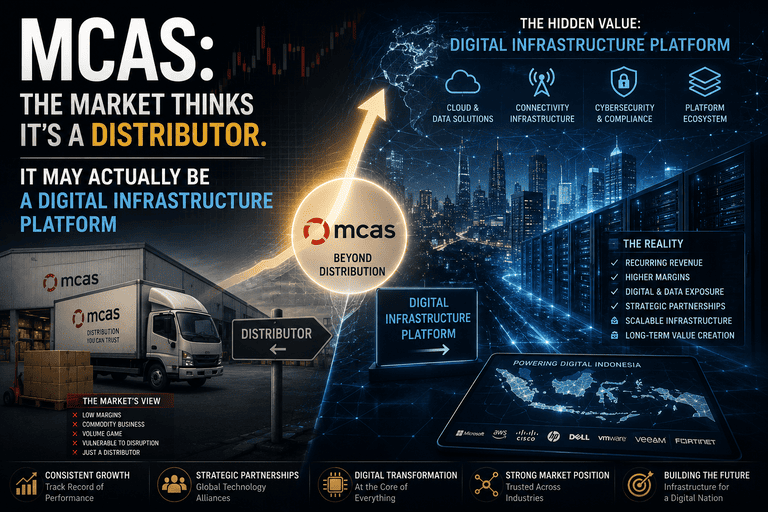
MCAS: The Market Thinks It’s a Distributor. It May Actually Be a Digital Infrastructure Platform
July 29, 2029
The market rarely misprices a business because it has the wrong financial statements. It misprices businesses because it asks the wrong question. In the case of PT M Cash Integrasi Tbk (IDX: MCAS), investors continue to analyse the company as though it were primarily a distributor of digital products, with every quarterly report filtered through the familiar metrics of revenue growth, operating margins and earnings per share. Those figures undoubtedly matter, but they no longer appear sufficient to explain what the business is becoming.
The more closely one examines MCAS’s evolution over the past several years, the clearer it becomes that the company has been systematically repositioning itself away from being a transactional distributor and towards becoming a digital infrastructure platform. Whether that transition ultimately succeeds remains uncertain, but the distinction is critical because infrastructure businesses are valued very differently from distributors. The opportunity, if one exists, lies not in discovering hidden financial statements but in recognising that the market may still be using yesterday’s framework to value tomorrow’s business.
Observable Reality: The Financials Appear to Tell a Story of Decline
Viewed superficially, the market’s pessimism is understandable. Reported revenue has fallen dramatically over recent years, declining from approximately IDR 11.7 trillion in 2023 to around IDR 7.1 trillion in 2024 before falling further to roughly IDR 4.7 trillion in 2025. Earnings have also remained inconsistent, with profitability proving elusive after several years of thin margins.
On conventional screening models, these characteristics immediately trigger warning signals. Declining revenue, unstable earnings and a relatively small market capitalisation are precisely the attributes that quantitative investors and algorithmic models tend to avoid. In isolation, the conclusion seems obvious: a shrinking business deserves a lower valuation. Yet financial statements often reveal more through the relationships between numbers than through the numbers themselves, and it is here that the conventional narrative begins to weaken.
One of the most striking features of MCAS’s recent financial history is that gross profit has remained comparatively resilient despite the sharp decline in reported revenue. At the same time, gross margins have expanded materially, increasing from levels closer to commodity distribution economics towards significantly healthier levels.
That combination deserves far more attention than it has received. If revenue collapses while gross profit remains relatively stable, the most plausible explanation is not necessarily that demand has evaporated but that management has deliberately exited lower-margin activities in favour of businesses capable of generating greater economic value from each unit of sales. In other words, the company may not be shrinking as much as it is changing.
The Narrative Confuses Scale with Quality
Markets have a natural tendency to equate larger revenue with stronger businesses because revenue is one of the simplest figures to compare across companies. Unfortunately, simplicity often comes at the expense of accuracy. Commodity businesses can generate enormous sales while producing very little economic value, whereas software platforms, payment networks and infrastructure providers frequently generate lower revenue with substantially higher returns on capital. Investors who focus primarily on top-line growth therefore risk confusing volume with quality.
This distinction becomes increasingly important when analysing MCAS because the company’s strategic direction appears to have shifted steadily towards activities where relationships matter more than transactions. Digital payments, merchant software, cloud advertising, API integration, logistics technology and business software all derive much of their long-term value from the networks they create rather than from the individual products they sell. A distributor earns income by moving products through a network. An infrastructure company increasingly earns income because it owns the network itself. Those are fundamentally different economic models despite often appearing similar in consolidated financial statements.
The Structural Reality: MCAS Is Building an Ecosystem Rather Than a Product Portfolio
The strongest evidence supporting this interpretation is not found in any single acquisition but in the consistency of management’s capital allocation over time. Rather than diversifying randomly into fashionable industries, successive investments have generally reinforced existing capabilities. Merchant relationships create opportunities for payment services.
Payment services naturally extend into point-of-sale software. Software generates valuable operating data. Data creates opportunities for advertising, customer engagement and API services. Logistics strengthens merchant integration, while cloud infrastructure enhances the scalability of the entire ecosystem. Each addition increases the usefulness of the others because the underlying network becomes denser with every complementary business that joins it.
That distinction is frequently overlooked because traditional accounting treats these businesses as separate operating segments. Strategically, however, they function less like independent divisions and more like interconnected components of a single commercial platform. Every additional merchant connected to the ecosystem reduces the acquisition cost of introducing future products.
Every software deployment creates another distribution point for adjacent services. Every payment endpoint becomes another gateway through which higher-value products can eventually flow. This is the defining characteristic of infrastructure businesses: the network itself becomes an appreciating asset whose value compounds as utilisation increases.
Why the Market Remains Sceptical
If this structural transformation is occurring, why has the market remained so cautious? The answer is probably less mysterious than many investors assume. Public markets reward measurable improvements long before they reward strategic intent. Revenue declines remain visible. Weak earnings remain visible. Thin margins remain visible.
The gradual strengthening of a commercial ecosystem is considerably harder to quantify, particularly when many of its benefits may not emerge for several years. Smaller companies also face an additional handicap because limited liquidity tends to amplify investor sentiment. Once negative narratives become established, relatively little buying or selling pressure is required to produce disproportionately large movements in share prices.
Recent insider purchases by senior management deserve attention within this context, not because they prove the investment case, but because they align management’s incentives more closely with outside shareholders. Insider buying should never be interpreted as evidence that a stock is undervalued.
It does, however, provide greater confidence that those directing the company’s long-term strategy are willing to commit their own capital alongside other investors. That alignment becomes particularly meaningful when management is asking shareholders to look beyond short-term financial weakness towards a longer-term structural transformation.
The TICAF Perspective: What the Market May Be Missing
Viewed through the Tactical Investor Capital Allocation Framework, MCAS becomes considerably more interesting than conventional valuation metrics suggest. The central issue is no longer whether revenue declined this year or whether margins improved modestly over the last quarter. The more important question is whether management has been quietly assembling a digital infrastructure platform capable of generating significantly higher returns over the next decade than its historical financial statements imply.
Infrastructure businesses possess characteristics that traditional valuation methods often underestimate because much of their value resides in relationships rather than tangible assets. Distribution networks, merchant ecosystems, software integrations and payment infrastructure become progressively more valuable as new services are layered onto existing customers. That optionality rarely appears on a balance sheet, yet it frequently becomes the primary driver of long-term shareholder returns once the ecosystem reaches sufficient scale.
None of this guarantees that MCAS will succeed. Execution risk remains substantial, profitability must still improve and the company must demonstrate that its expanding ecosystem can eventually translate into consistently stronger cash generation. Those uncertainties cannot be dismissed simply because the strategic narrative is compelling. At the same time, neither should investors dismiss the possibility that the market is still analysing the company through an increasingly outdated framework.
Tactical Investor Forensic Verdict
The debate surrounding MCAS should not begin with whether revenue has fallen. That is already visible to everyone. The more important question is whether the company is gradually ceasing to be what the market believes it is. If MCAS remains fundamentally a distributor, then today’s cautious valuation may prove entirely justified. If, however, management is successfully transforming the business into an integrated digital infrastructure platform, investors may eventually conclude that they have been valuing a network as though it were merely a reseller.
That distinction changes everything, because distributors are valued according to the products they sell today, while infrastructure platforms are increasingly valued according to the opportunities their networks create tomorrow.

Interesting Reads