
Market Sentiment Analysis: The Market Has Moods. Learn Not to Catch Them.
Aug 26, 2026
Introduction: Decoding the Market’s Emotional Pulse
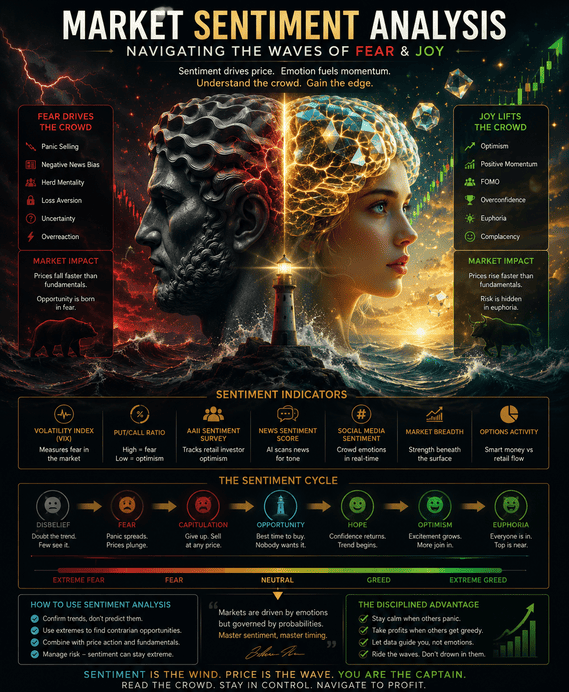
Markets appear numerical, but numbers do not buy or sell themselves. People do. Fear, greed, hope and uncertainty flow through prices, often pushing markets beyond what fundamentals alone can explain. Market sentiment analysis studies these collective emotional currents, helping investors distinguish between a genuine change in conditions and a crowd reacting to its own reflection.
Understanding sentiment does not provide certainty. It provides context. It shows where emotion is concentrated, where conviction may be excessive and where the gap between perception and reality may be widening. Combined with mass psychology, technical analysis and disciplined risk management, sentiment becomes less about predicting the future and more about recognising when the crowd is creating an opportunity.
Robert Shiller’s work in behavioural finance demonstrated how psychology can help produce bubbles, crashes and market anomalies that traditional models struggle to explain. Markets are not machines operating in isolation. They are feedback systems in which beliefs influence behaviour, behaviour moves prices, and rising or falling prices reinforce the beliefs that caused the movement. That feedback loop is where sentiment becomes powerful.
Mass Psychology: The Emotional Engine Behind Price
Gustave Le Bon understood that individuals can behave differently inside a crowd. Daniel Kahneman later demonstrated how cognitive biases such as loss aversion, overconfidence and recency bias distort judgement.
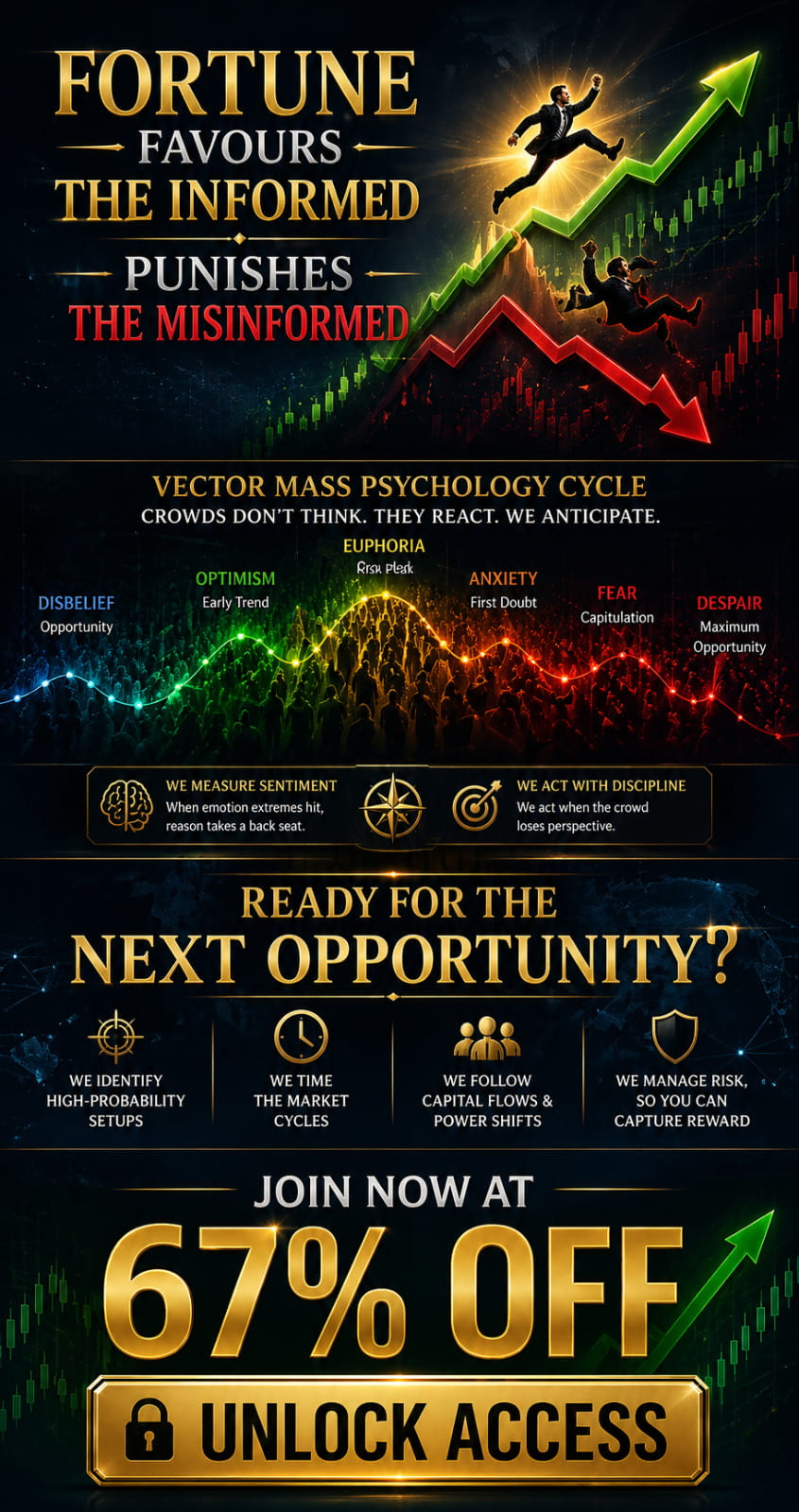
In markets, the mechanism is brutally simple. Prices rise. Confidence grows. Confidence attracts new buyers. More buying pushes prices higher, apparently validating the original belief. Eventually, the crowd stops asking whether the price is justified and begins asking how much higher it can go.
The same process works in reverse. Prices fall, fear spreads and selling accelerates. Each decline becomes evidence that further decline is inevitable. Investors who were comfortable owning an asset at higher prices suddenly refuse to touch it at lower ones.
This is why sentiment matters. Markets do not merely reflect emotion. Collective emotion can amplify the underlying trend until price and perception become temporarily detached from value.
Fear can create bargains. Euphoria can create traps. The difficulty is that extremes can persist. A market can remain overbought longer than a sceptic expects, and fear can continue long after prices appear cheap. Recognising extreme sentiment is therefore not the same as knowing when to act. That requires structure. The advantage comes from studying the vector: emotion → behaviour → price movement → opportunity or risk.

Beyond Emotion: Sentiment Meets Structure
Mass psychology tells you what the crowd feels. Technical analysis shows you what the crowd is actually doing with its money.
Neither should operate alone. Sentiment without price analysis can leave an investor early. A market may be euphoric and continue rising. Technical analysis without psychological context can produce signals stripped of meaning. A breakout during widespread optimism does not carry the same implications as a breakout emerging from deep pessimism.
The strongest analysis comes from combining the two. Suppose sentiment reaches an extreme of fear. On its own, that does not automatically mean buy. But if pessimism is extreme, selling pressure begins to weaken and technical indicators show stabilisation or positive divergence, the probability of a reversal may improve.
The same logic applies at the other end. Extreme optimism is not an automatic sell signal. But if sentiment is euphoric, valuations are stretched and momentum begins to deteriorate, the market may be entering a more dangerous phase. The goal is not to find a magical indicator. It is to look for alignment between psychology, price and momentum. When several vectors point in the same direction, the signal becomes more meaningful.
Technical Analysis: Timing Without Pretending to Predict
Technical analysis provides a framework for studying price structure, momentum and potential turning points. Long-term charts reveal major support and resistance zones. Oscillators such as MACD, RSI and StochRSI can help identify stretched conditions, fading momentum and divergences between price and underlying momentum.
But indicators are not prophecies. An overbought market can become more overbought. An oversold market can continue falling. The mistake is treating a technical reading as a command rather than evidence.
The more useful approach is probabilistic. Extreme fear plus a deeply oversold market may justify closer attention. Extreme optimism combined with weakening momentum may justify reducing risk or protecting gains. Neither guarantees a reversal. Both identify conditions where the balance between risk and reward may be changing.
This is where patience matters. The investor’s job is not to catch every move. It is to wait until the available evidence creates a favourable asymmetry. Fear may tell you the crowd is capitulating. Technical structure can help determine whether capitulation is becoming exhaustion. Joy may tell you the crowd is euphoric. Momentum analysis can reveal whether the trend still has strength or is beginning to lose it. That distinction separates analysis from prediction.
Buying Fear, Selling Euphoria
The 2008–2009 financial crisis offers a clear example of sentiment overwhelming judgement. As markets collapsed, fear compressed every possibility into a single narrative: disaster. Prices fell because investors were selling, and investors sold because prices were falling. The feedback loop fed itself.
Yet periods of maximum fear often produce the widest gap between price and long-term value. Investors capable of separating temporary panic from permanent impairment could acquire assets at levels that later proved extraordinarily attractive.
The lesson was not that every falling market should be bought. Many assets deserved to collapse. The lesson was that panic destroys discrimination. When fear becomes indiscriminate, it can create opportunities for those willing to analyse rather than react.
The dot-com bubble demonstrated the opposite vector. Rising technology stocks created optimism. Optimism became enthusiasm, enthusiasm became certainty and certainty removed the need for valuation. Investors were no longer asking whether a business justified its price. They were buying because prices kept rising.
The eventual collapse did not create the underlying excess. It exposed it. This is the recurring pattern: fear exaggerates danger; euphoria exaggerates opportunity. The crowd moves from one emotional extreme to another, often abandoning discipline precisely when discipline matters most.
The contrarian lesson is not to oppose the crowd automatically. The crowd can be right for extended periods. The real question is whether collective conviction has pushed price, expectation or risk to an unsustainable extreme.
The Limits of Sentiment: Respect Uncertainty
Sentiment analysis is powerful precisely because markets are emotional. It is dangerous when it creates the illusion that emotion can be measured with perfect precision. No index, oscillator or psychological model can eliminate uncertainty. Nassim Nicholas Taleb has repeatedly warned against excessive confidence in prediction. Markets contain unknown variables, unexpected shocks and feedback loops that cannot always be modelled in advance. A sound strategy therefore does not depend on being right about every outcome.
It depends on surviving the outcomes you did not anticipate. That means sentiment analysis should improve positioning, not encourage reckless conviction. Extreme fear may justify selective exposure, not blind buying. Extreme optimism may justify caution, not automatic short positions.
The objective is to improve the quality of decisions under uncertainty. A disciplined investor asks: What is the crowd believing? How is that belief affecting price? What does the technical structure confirm or contradict? And most importantly, what happens if the analysis is wrong? that final question is where risk management begins.
Conclusion: Read the Crowd, Then Think for Yourself
Market sentiment analysis is not a crystal ball. It is a way of reading collective behaviour before becoming trapped inside it. Fear and greed will always move markets because they are expressions of human nature, not temporary market conditions. Technology may accelerate the cycle, social media may amplify it and algorithms may measure it, but the underlying pattern remains remarkably familiar: people chase strength, flee weakness and confuse the crowd’s conviction with truth.
The investor’s task is to step outside that loop. Use market sentiment to identify emotional extremes. Use technical analysis to study structure and momentum. Use mass psychology to understand why the crowd is behaving as it is. Then apply discipline to the only part you control: your response.
Do not try to predict every turn. Look for distorted probabilities, improving asymmetry and moments when emotion has pushed the market further than reason can justify. The crowd will continue to swing between fear and joy. Your edge begins when you stop moving with the emotion and start measuring it.