
Artificial Intelligence Investing: Why the Real Revolution Isn’t AI: It’s Information
July 30, 2026
Artificial intelligence is rapidly becoming the most misunderstood force in modern investing. Much of the public conversation revolves around chatbots, autonomous agents and increasingly powerful reasoning models, yet these technologies are merely the latest stage in a much older story. Every great financial revolution has been driven by one simple principle: those who process information faster, more accurately and with fewer biases consistently outperform those who do not. Steam multiplied physical labour, electricity multiplied industrial productivity, the internet multiplied communication and global connectivity, while artificial intelligence is multiplying cognition itself. The technology may be unprecedented, but the competitive advantage it creates follows one of the oldest rules in financial history.
Markets Have Always Rewarded Information Advantages
Long before artificial intelligence existed, investing was fundamentally an information competition. The telegraph allowed traders to exploit price differences before competitors received the same news, Bloomberg terminals compressed research into seconds rather than hours, and algorithmic trading transformed speed into a measurable financial advantage. Artificial intelligence simply accelerates this evolutionary process by allowing investors to analyse enormous quantities of structured and unstructured information simultaneously, identifying relationships that would take human researchers weeks or months to uncover. The edge has never belonged to those with the most data; it has always belonged to those who convert information into superior judgement more effectively than everyone else.
Today’s AI systems are fundamentally different from the machine-learning models that dominated discussions only a few years ago. Modern reasoning models can synthesise research across thousands of documents, analyse earnings calls alongside regulatory filings, compare geopolitical developments with historical precedents and generate coherent hypotheses within minutes rather than days. Multimodal systems combine text, images, spreadsheets, audio and video into a single analytical framework, while autonomous agents increasingly perform repetitive research tasks that previously consumed countless hours of analyst time. Artificial intelligence is therefore becoming less of a software application and more of an intellectual infrastructure layer that continuously supports human decision-making.
AI Doesn’t Eliminate Uncertainty
One of the greatest misconceptions surrounding artificial intelligence is the belief that more computing power will somehow eliminate uncertainty from investing. Markets, however, are not engineering problems waiting for sufficient processing capacity; they are adaptive systems shaped by human psychology, political decisions, regulatory change and unexpected events that continually redefine the landscape. Artificial intelligence can dramatically improve information processing, but it cannot perfectly predict elections, wars, technological breakthroughs or sudden shifts in collective behaviour because these events emerge from complex interactions rather than deterministic equations. Investors searching for certainty will therefore remain disappointed, regardless of how sophisticated the underlying technology becomes.
This distinction explains why exceptional investors are unlikely to be replaced by AI despite increasingly sensational predictions. Successful investing extends far beyond recognising statistical patterns because capital allocation requires judgement, patience, emotional discipline and an understanding of incentives that frequently resist quantitative modelling. The greatest investors succeed not because they predict every market movement correctly but because they understand optionality, asymmetric risk and the psychological forces driving collective behaviour. Artificial intelligence can improve those decisions, but it cannot assume responsibility for them because responsibility itself remains fundamentally human.
The Real Casualties Will Be Average Thinking
Artificial intelligence is unlikely to replace exceptional investors, but it will place enormous pressure on mediocrity across the financial industry. Average research analysts, generic market commentators, routine financial advisers and professionals whose primary value lies in gathering or summarising publicly available information will increasingly compete against systems capable of producing similar work in seconds at negligible cost. This transition mirrors previous technological revolutions where calculators transformed arithmetic, spreadsheets transformed accounting and Bloomberg transformed financial research. The technology did not eliminate expertise; it dramatically increased the performance gap between exceptional practitioners and everyone else.
The same principle applies to investing. Once every institution has access to powerful reasoning models, proprietary data pipelines and autonomous research agents, artificial intelligence itself becomes commoditised rather than differentiated. Competitive advantage will migrate away from access to technology and toward the quality of the questions being asked, the mental models guiding interpretation and the judgement used when allocating capital under uncertainty. Technology raises the baseline for everyone, but it does not eliminate the premium attached to superior thinking.
The New Edge Is Human Judgment
This shift fundamentally changes what investors should optimise. During previous decades, possessing better information often created an immediate advantage because information itself was scarce. Today, information is abundant and increasingly inexpensive, meaning the scarce resource has become interpretation rather than acquisition. Investors capable of filtering noise, recognising second-order consequences, understanding market psychology and identifying structural change will continue outperforming those who merely possess access to advanced software.
Artificial intelligence therefore amplifies rather than replaces human capability. An undisciplined investor equipped with powerful AI simply reaches poor conclusions more efficiently, while a disciplined investor gains the ability to evaluate more scenarios, test more assumptions and identify opportunities that previously remained hidden beneath overwhelming quantities of data. The technology magnifies existing strengths and weaknesses instead of erasing them, making judgement more valuable rather than less.
The Future Belongs to Human-AI Partnerships
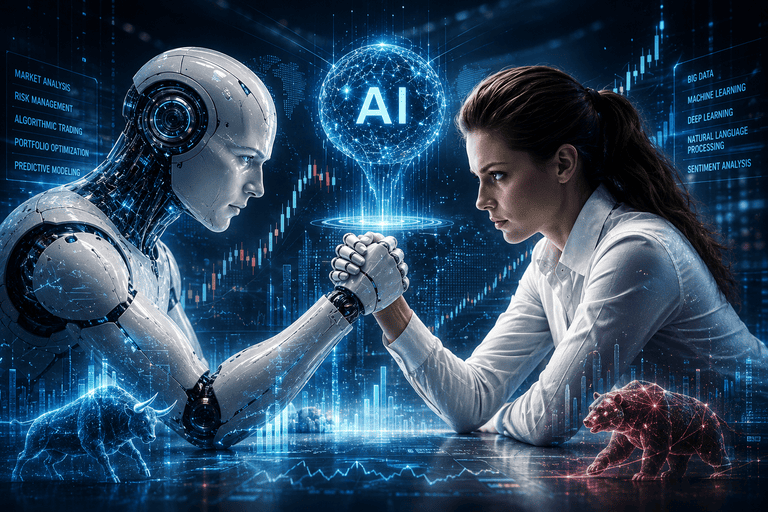
The most successful investment firms over the coming decade will not be those attempting to replace humans entirely with autonomous systems, nor those resisting technological change in favour of traditional methods. Instead, leadership will belong to organisations that integrate artificial intelligence into every stage of research while preserving human oversight for capital allocation, strategic thinking and risk management. Machines excel at processing information without fatigue, while humans remain uniquely capable of understanding incentives, exercising ethical judgement and recognising when unprecedented events render historical patterns unreliable. The future of investing therefore belongs neither to humans nor machines alone but to the partnership that extracts the greatest strengths from both.
History suggests that every technological revolution eventually becomes ordinary as widespread adoption eliminates the initial advantage enjoyed by early adopters. Artificial intelligence will almost certainly follow the same trajectory, becoming an essential utility rather than an extraordinary differentiator. When that happens, investors will once again discover that technology alone never created lasting wealth because sustainable success has always depended upon superior judgement, disciplined execution and the willingness to think independently when consensus becomes comfortable. Artificial intelligence is transforming investing, but the real revolution is not artificial intelligence itself; it is the unprecedented ability to transform overwhelming amounts of information into better decisions before everyone else does.

Compelling Piece Worth Delving Into